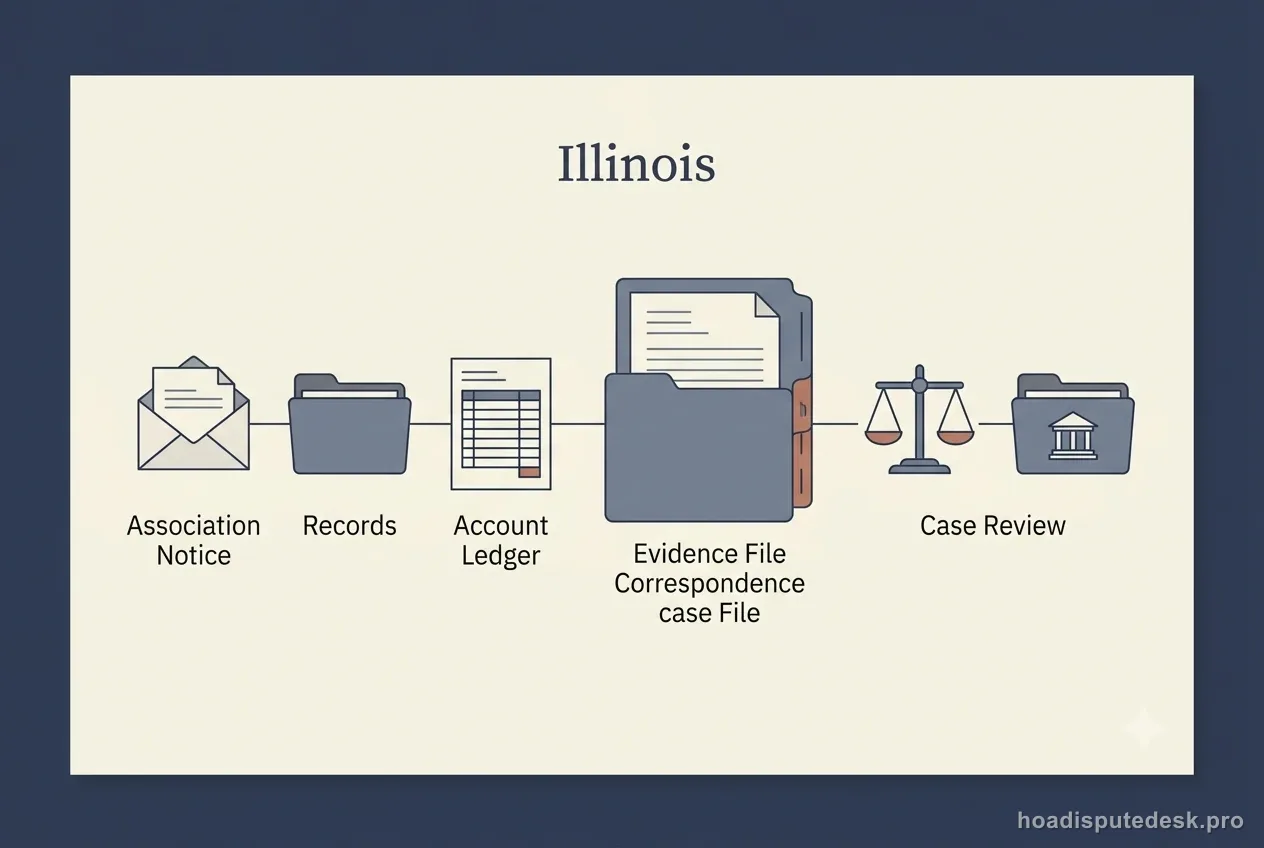
Illinois separates the Condominium Property Act from the Common Interest Community Association Act. Both require notice and an opportunity to be heard before a reasonable fine, but their records clocks differ: specified condominium records can trigger a 10-business-day response rule, while common-interest communities generally use a 30-day framework. Condominium unpaid common expenses and fines can become a statutory lien under 765 ILCS 605/9, subject to earlier recorded encumbrances.
Which Illinois statute controls your dispute
Before anything else in an Illinois dispute, pin down the property's legal form and when the declaration was recorded. For planned communities, start with Common Interest Community Association Act, 765 ILCS 160. For condominiums, start with Condominium Property Act, 765 ILCS 605. Do not take the board's or manager's label at face value — an older community may sit under a legacy statute or a transition provision, so confirm what actually applies before you count on a deadline, remedy, or voting rule.
Do not treat the statute as a substitute for the declaration in Illinois. Pull the declaration and amendments, bylaws, rules, and any resolution tied to the disputed charge or enforcement action. The useful question is whether the association had authority under both mandatory law and its own governing documents, using the versions that were actually in effect when the dispute arose.
How Illinois owners challenge an assessment vote
Read an assessment dispute as two questions: did the association have authority to levy the charge, and is the calculation correct. Ask which budget line or board vote created it, which declaration clause allocates common expenses among units, when owners were notified, and — where Illinois law or the governing documents required an owner vote — whether that vote actually took place. Ordinary annual dues and a special assessment often follow different approval paths, so confirm which one governs the charge in front of you.
For a disputed Illinois assessment, build the paper trail before choosing a payment strategy. Ask for the complete ledger, the budget or resolution supporting the charge, and any notice or vote the association relies on. State clearly which part you challenge. That makes it easier to test the association's authority without turning an accounting disagreement into an avoidable delinquency dispute.
Sources: [1]
Contesting an Illinois HOA fine and demanding a hearing
Illinois does not let a board skip process merely because the declaration authorizes enforcement. Condominium boards use 765 ILCS 605/18.4(l), while common-interest communities use 765 ILCS 160/1-30(g); both require notice and an opportunity to be heard before levying a reasonable fine for a violation.
For a fine challenge, preserve the cited rule, notice, hearing date, evidence, owner response, board decision, and account entry. Also confirm which Act applies before relying on a deadline or remedy, because the condominium and common-interest statutes are similar in places but not interchangeable.
Records requests and inspection rights in Illinois
Records deadlines are a place where Illinois community type matters. Under 765 ILCS 605/19, a condominium owner who makes a sufficiently particular written request has a 10-business-day rule for specified association records. Under the Common Interest Community Association Act, the records framework generally treats failure to provide or respond to a proper request within 30 days as a denial.
Identify the statute in the request and ask for the smallest set of records that proves the issue: ledger, budget, minutes, contracts, invoices, rule, violation file, and governing documents. Keep the request, delivery proof, response date, fees demanded, and any written reason for withholding.
The Illinois assessment-lien timeline and priority
For condominiums, 765 ILCS 605/9(g) creates a lien for unpaid common expenses and unpaid fines, together with authorized collection amounts. The lien is not a blanket first-priority interest: taxes and certain encumbrances recorded before the owner’s default remain ahead of it. Illinois therefore should not be described as having a universal HOA superpriority over a first mortgage.
Common-interest communities use a different statute and their governing documents, so trace the exact lien authority before applying the condominium rule. In either case, reconcile the ledger and identify which amounts are assessments, fines, interest, fees, or attorney charges before evaluating lien validity or enforcement.
Judicial vs. nonjudicial foreclosure for Illinois HOAs
Illinois condominium associations have more than one collection remedy. Section 9 creates the statutory lien, and Illinois case law recognizes foreclosure of that lien; § 9.2 also provides a separate possession/eviction-style remedy for qualifying defaults. Those remedies are procedural alternatives, not proof that every balance can be taken directly to a sale without court process.
For a common-interest community, use the CICAA and declaration rather than assuming the condominium foreclosure mechanics apply. If a complaint, possession action, or lien-foreclosure filing arrives, identify the remedy actually pleaded, the balance supporting it, and the response deadline on the court papers.
Pre-suit steps Illinois requires before a lawsuit
No single mandatory mediation gate covers every Illinois community-association lawsuit. Some declarations include arbitration or mediation provisions that must be checked before filing.
Sources: [1]
The forums that hear Illinois association disputes
The Illinois Department of Financial and Professional Regulation regulates community association managers but is not a general HOA merits tribunal. A licensing complaint can matter when manager conduct is at issue, while records, lien, declaration, or injunction claims may require a different statutory remedy or court.
Sources: [1]
Sources
- Illinois Common Interest Community Association Act, 765 ILCS 160Official Illinois General Assembly text for non-condominium common-interest communities within the Act's scope.
- Illinois Condominium Property Act, 765 ILCS 605Official Illinois General Assembly chapter page for condominium associations.
- 765 ILCS 605/18 — Condominium bylaws and governanceOfficial section covering meetings, budgets, reserves, owner voting, and association governance.
- 765 ILCS 605/19 — Condominium recordsOfficial condominium records and inspection requirements.
- IDFPR — Condominium and Common Interest Community OmbudspersonIllinois Department of Financial and Professional Regulation program information and educational resources.
- 765 ILCS 605/12 — Condominium insuranceOfficial condominium insurance section; current codified text controls for coverage details.
- 765 ILCS 605/9 — condominium assessment and fine lienCurrent Condominium Property Act lien text and priority exceptions.
- 765 ILCS 605/19 — condominium recordsCurrent condominium records-access rules, including the 10-business-day response rule for specified records.
- 765 ILCS 160/1-30 and 1-30(i) — common-interest fines and recordsCommon Interest Community Association Act governance rules, including notice/hearing before fines and records procedures.