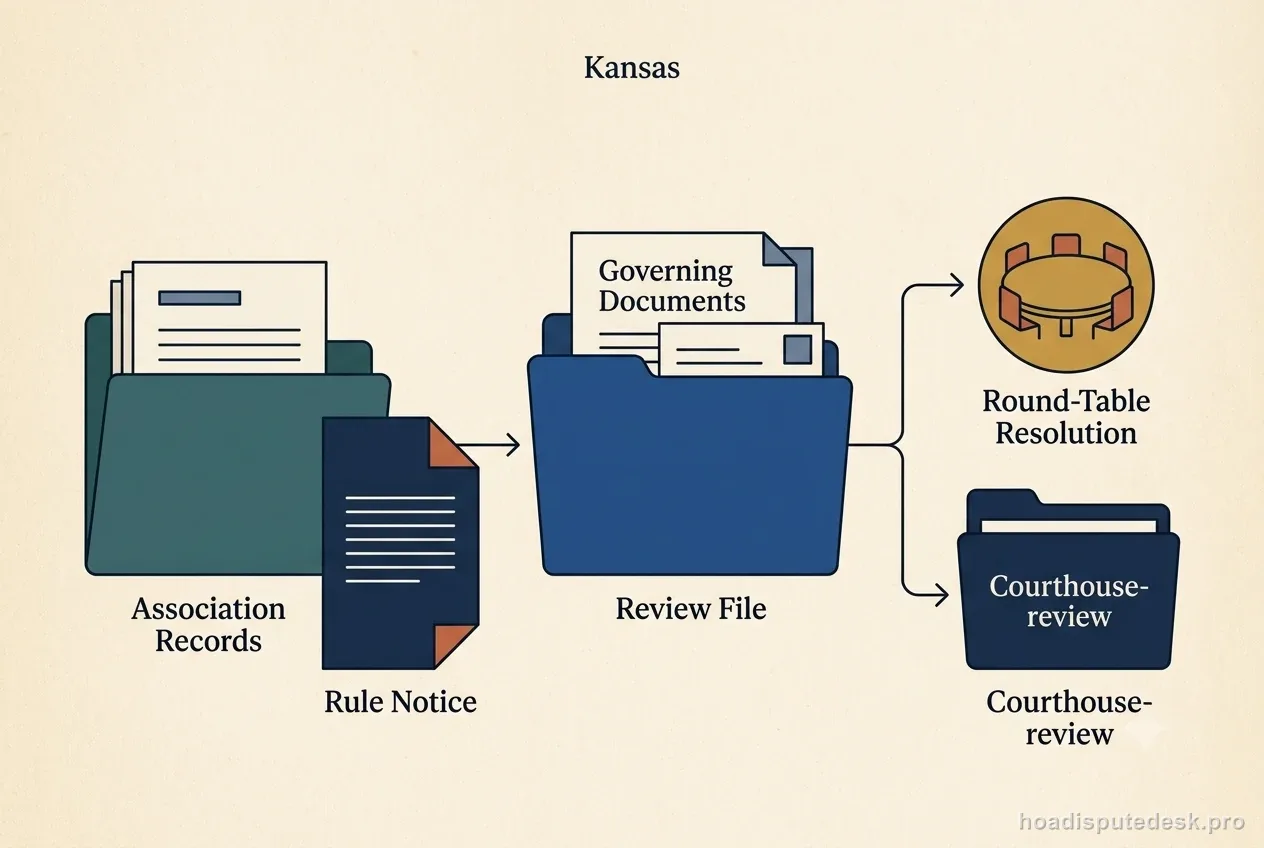
Kansas uses the Uniform Common Interest Owners Bill of Rights Act across common-interest communities, but it is not a complete lien code. Owners have governance rights: records access on 10 days’ written notice, advance notice and owner comment for new or amended rules, and possible nonbinding ADR before suit. Lien and foreclosure authority still must be traced to the declaration, applicable statutes, and the recorded lien; do not assume super-priority or automatic power of sale.
Kansas: planned-community law vs. condominium law
Start a Kansas association dispute by identifying the property's legal form and the declaration's recording date. For planned communities, start with Kansas Uniform Common Interest Owners Bill of Rights Act, K.S.A. 58-4601 et seq. For condominiums, start with Kansas Apartment Ownership Act, K.S.A. 58-3101 et seq., plus K.S.A. 58-4601 et seq. where applicable. The label a board or manager uses is not decisive on its own; older communities can be affected by legacy statutes or transition provisions, so check applicability before relying on a deadline, remedy, or voting rule.
In Kansas, read the recorded declaration, amendments, bylaws, rules, and properly adopted resolutions alongside the statute. Governing documents can fill procedural gaps, but they do not override mandatory law. Before challenging a fine, assessment, records decision, or lien, confirm the declaration date and keep the exact version of every document the association says it relied on.
Disputing a regular or special assessment in Kansas
Break an assessment challenge into authority and math. The association should be able to point to the budget or board action behind the charge, the declaration provision that spreads common expenses, the date notice went out, and any owner vote that Kansas law or the governing documents made a precondition. Do not assume a special assessment cleared the same threshold as the regular budget; the two frequently carry separate voting requirements.
Challenging a Kansas assessment starts with a written objection and a request for the current owner ledger, not a unilateral stop-payment. Pay or set aside the undisputed portion, document the disputed portion, and retain copies of everything. Because the balance can keep drawing collection steps during the dispute, make the association justify both the authority for the charge and the math behind each contested item.
Sources: [1]
What Kansas requires before an association fine sticks
Kansas law is more useful here as a rule-governance framework than as a universal fine-hearing code. Under K.S.A. 58-4617, the board must give owners notice before adopting, amending, or repealing a rule, provide the proposed text, allow owner comments before action, and keep every rule reasonable. For a particular fine, then trace the sanction authority to the declaration, bylaws, rule, and any procedure the association adopted.
For a Kansas enforcement dispute, keep a dated sequence: cited covenant or rule, photos or complaint, first notice, opportunity to cure, your reply, the hearing request and notice, what evidence the board weighed, and the outcome. If the concern is selective enforcement, line up truly similar properties across the same timeframe — documentation of dates and board action matters more than an impression about the neighbors.
Kansas record-inspection rules and refusal remedies
K.S.A. 58-4616 gives Kansas owners a specific records route: association records generally must be available for examination and copying on 10 days’ written notice that reasonably identifies the requested records, subject to listed exclusions. The statute also identifies records the association must retain, including financial records, minutes, current governing documents, contracts, and voting records.
A a Kansas records request works best when it is itemized — account ledger, budget, special-assessment resolution, minutes, the applicable rule, violation history for the unit, the supporting contract or invoice, and the recorded declaration and amendments. Put anything implicating another owner's privacy in its own category, and demand a specific legal basis for every withheld document.
Sources: [4]
When an assessment lien attaches under Kansas law
Do not assume a super-lien. The association must show the lien source, amount, perfection, and priority under the applicable statute and recorded instruments.
A Kansas lien analysis has four parts that should not be collapsed: the moment the lien arises, the recording or notice conditions, its priority against competing liens, and the enforcement steps. Read the recorded claim itself for owner name, legal description, period covered, amount, signature, filing date, and notice compliance — and remember that priority is not the same as a right to foreclose.
How association foreclosure works in Kansas
Kansas is largely document-driven for many HOAs; court foreclosure is the conservative default for an assessment lien unless the governing documents and other applicable law support a different valid mechanism. The owner should identify the exact lien language, confirm how it was perfected, and check the court or notice procedure before treating a collection letter as a foreclosure event.
When a Kansas foreclosure notice arrives, calendar all of its dates the same day and request a fresh ledger. Scrutinize the charge categories cited, the notices and mailing addresses used, the board's authorization, and any remaining cure, payment-plan, reinstatement, or redemption option. The governing statute, court rule, or declaration — not an internet summary — controls the order of events.
What to complete before filing in Kansas court
Kansas is unusual in expressly allowing an association, under K.S.A. 58-4608(a)(3), to require disputes involving the common-interest community to go through nonbinding alternative dispute resolution as a prerequisite to a judicial proceeding. That power does not make ADR mandatory in every Kansas dispute; first confirm that the association has actually required it and that the dispute falls within the statute.
Where Kansas HOA and condo disputes are decided
Kansas routes association disputes through the regular court system rather than a dedicated HOA tribunal. The right forum turns on the claim — general trial court, small-claims or limited-jurisdiction court for a money claim under the threshold, or a statute- or document-created arbitration or mediation process.
Sources: [1]
Sources
- Kansas Uniform Common Interest Owners Bill of Rights Act, K.S.A. 58-4601 et seq.Official Kansas Legislature article index; current-session portal for the common-interest owners bill of rights.
- Kansas Apartment Ownership Act, K.S.A. 58-3101 et seq.Official Kansas condominium/apartment-ownership statute index.
- K.S.A. 58-4611 — association meetings and owner noticeOfficial meeting-notice section; adjacent sections govern open meetings, quorum, and voting.
- K.S.A. 58-4616 — association recordsOfficial records-retention and owner-inspection rules.
- K.S.A. 58-4620 — annual budget and special assessmentsOfficial budget and special-assessment procedure.
- K.S.A. 58-4612 — board meetings and executive sessionsOfficial board-open-meeting and executive-session rule.
- K.S.A. 58-4617 — rules and owner noticeCurrent rule-adoption notice requirements and reasonableness standard.
- K.S.A. 58-4608 — association powers and ADRCurrent association powers, including ability to require nonbinding ADR as a prerequisite to judicial proceedings.