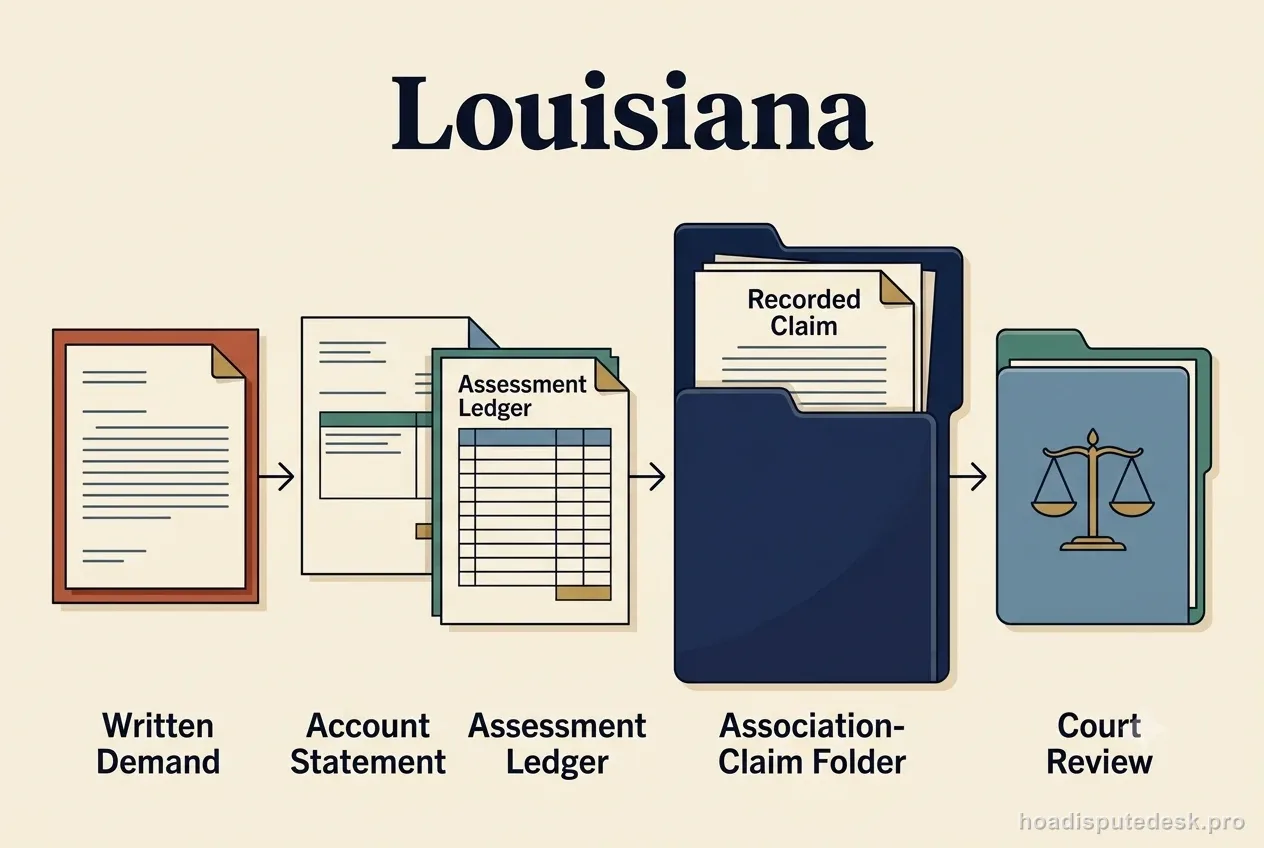
Louisiana’s association collection law changed materially effective January 1, 2025. Part III of Title 9 now gives covered HOAs and condominium associations a common privilege framework. An owner can demand a binding unpaid-assessment statement within 10 business days. Before recording the privilege, the association generally sends written demand and allows 30 days to pay; enforcement then requires the recorded claim, board approval, and the applicable court process to be analyzed separately.
Louisiana: planned-community law vs. condominium law
Before anything else in a Louisiana dispute, pin down the property's legal form and when the declaration was recorded. For planned communities, start with Louisiana Planned Community Act, La. R.S. 9:1141.1 et seq. For condominiums, start with Louisiana Condominium Act, La. R.S. 9:1121.101 et seq. Do not take the board's or manager's label at face value — an older community may sit under a legacy statute or a transition provision, so confirm what actually applies before you count on a deadline, remedy, or voting rule.
Do not treat the statute as a substitute for the declaration in Louisiana. Pull the declaration and amendments, bylaws, rules, and any resolution tied to the disputed charge or enforcement action. The useful question is whether the association had authority under both mandatory law and its own governing documents, using the versions that were actually in effect when the dispute arose.
Disputing a regular or special assessment in Louisiana
Break an assessment challenge into authority and math. The association should be able to point to the budget or board action behind the charge, the declaration provision that spreads common expenses, the date notice went out, and any owner vote that Louisiana law or the governing documents made a precondition. Do not assume a special assessment cleared the same threshold as the regular budget; the two frequently carry separate voting requirements.
For a disputed Louisiana assessment, build the paper trail before choosing a payment strategy. Ask for the complete ledger, the budget or resolution supporting the charge, and any notice or vote the association relies on. State clearly which part you challenge. That makes it easier to test the association's authority without turning an accounting disagreement into an avoidable delinquency dispute.
Sources: [1]
What Louisiana requires before an association fine sticks
Louisiana uses civil-law “privilege” concepts in collection. Homeowners should separate covenant enforcement, fines, assessments, and the recorded privilege rather than assuming one automatically validates the others.
In Louisiana, a useful fine-defense file is a timeline rather than a stack of screenshots. Match the cited covenant to the notice, the notice to any cure period, and the hearing record to the final decision. If unequal treatment is part of the dispute, collect comparable examples that involve the same rule and similar facts; unsupported neighbor comparisons are usually weak evidence.
Louisiana record-inspection rules and refusal remedies
Louisiana owners have a concrete collection-record tool that the earlier draft missed. Under R.S. 9:1145(D), the association must furnish a statement of unpaid assessments within 10 business days after receiving a request made in a record, and that statement is binding on the association. Use it before trying to reconcile a portal balance or a privilege amount.
For records in Louisiana, narrow the request to documents that answer the dispute: owner ledger, budget or assessment approval, minutes, governing rule, property-specific enforcement history, supporting invoices, and recorded declaration or amendments. A focused request creates a cleaner record if access is denied. Ask for the basis of any refusal or redaction rather than debating it informally.
Sources: [7]
When an assessment lien attaches under Louisiana law
Under the Part III framework effective January 1, 2025, the association first makes a written demand under R.S. 9:1146. The owner has 30 days after that demand to pay; only after the period expires may the association file the sworn detailed statement of privilege. R.S. 9:1147 specifies the property description, owner, delinquency date, periodic dues, fines/late fees, and demand date that belong in the filing, and the association must deliver a copy of the recorded privilege to the owner.
Priority is recording-based, not a generic superlien. R.S. 9:1148 governs duration and rank, so compare the privilege recordation date with mortgages and other rights rather than assuming the association jumps ahead of a previously effective mortgage.
How association foreclosure works in Louisiana
Louisiana’s current association-privilege statute uses a court enforcement action. R.S. 9:1145(E) provides that, with board approval, an association may commence an action to enforce the privilege. The owner should distinguish the 30-day written demand, recordation of the sworn privilege, preservation of that privilege, and the later enforcement action rather than treating the recorded claim as an automatic sale power.
If enforcement is threatened, obtain the board authorization, demand, recorded statement, proof of delivery, and current ledger. Check any lis pendens or petition and the applicable preservation period under R.S. 9:1148. The 2025 framework applies broadly to qualifying associations, so older internet explanations of separate HOA/condo lien mechanics may be stale.
What to complete before filing in Louisiana court
Louisiana does not impose one blanket mediation-or-ADR requirement across association disputes. A pre-suit obligation, where it exists, comes from the statute for the particular claim, the declaration and bylaws, or a court's procedural rules, so read those rather than assuming.
Sources: [1]
Where Louisiana HOA and condo disputes are decided
Louisiana routes association disputes through the regular court system rather than a dedicated HOA tribunal. The right forum turns on the claim — general trial court, small-claims or limited-jurisdiction court for a money claim under the threshold, or a statute- or document-created arbitration or mediation process.
Sources: [1]
Sources
- Louisiana Planned Community Act, La. R.S. 9:1141.1 et seq.Official Louisiana Legislature table of contents for the Planned Community Act, substantially revised by Act 158 of 2024 effective January 1, 2025.
- La. R.S. 9:1141.26 — planned-community owner and board meetingsOfficial annual/special meeting notice rule; adjacent sections cover quorum and voting.
- La. R.S. 9:1141.34 — budgets and special assessmentsOfficial budget-ratification and special-assessment provisions for planned communities.
- La. R.S. 9:1141.36 — association recordsOfficial planned-community retention and inspection requirements.
- La. R.S. 9:1123.112 — condominium property and liability insuranceOfficial condominium master-insurance section; fidelity coverage is in the immediately following statute.
- La. R.S. 9:1123.113 — condominium fidelity bond or equivalent insuranceOfficial condominium fidelity rule; includes the lesser-of $1 million/reserves-plus-one-fourth-assessments formula and $10,000 minimum.
- La. R.S. 9:1145 — association privileges and 10-day statementCurrent Part III privilege framework; owner assessment statement due within 10 business days; board approval required to commence enforcement action.
- La. R.S. 9:1146 — written demand before privilege filingCurrent written-demand procedure, 30-day payment period, payment application order, and privilege filing after expiration.
- La. R.S. 9:1147 — sworn statement of privilegeRequired contents, mortgage-record filing, and delivery of recorded privilege to owner.
- La. R.S. 9:1148 — privilege duration and rankCurrent preservation periods and recording-based rank for association privileges.