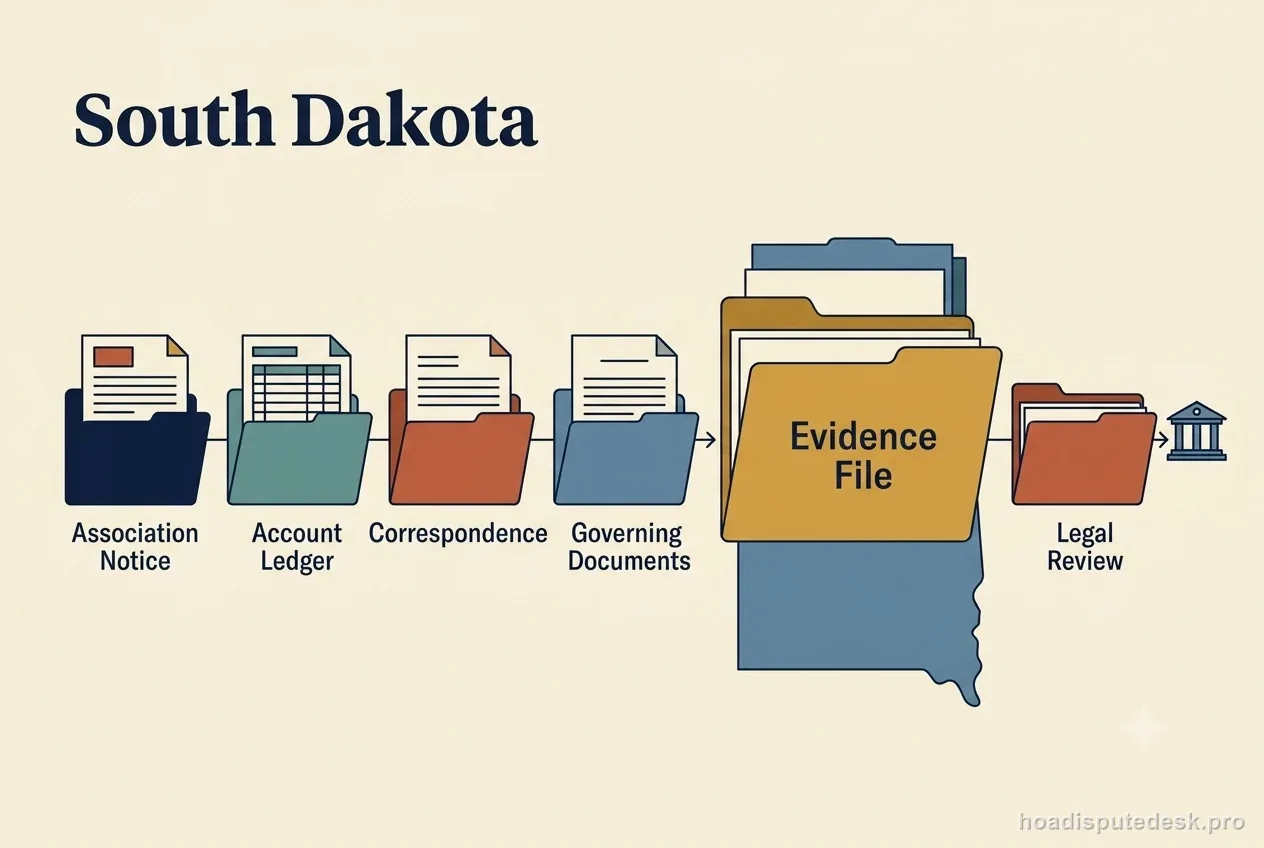
In South Dakota, first identify whether the property is an HOA or condominium, then apply the correct statute and governing documents. The enforcement route is document-driven, so the association must identify its lien and foreclosure authority. Do not presume super-priority over a first mortgage. Do not assume mediation is mandatory for every claim; check the dispute-specific statute and governing documents. Get the ledger, lien, and notices before choosing payment, ADR, or court relief.
Which South Dakota statute controls your dispute
Start a South Dakota association dispute by identifying the property's legal form and the declaration's recording date. For planned communities, no comprehensive South Dakota HOA act; recorded covenants and entity law control many subdivisions. For condominiums, start with South Dakota Condominium Act, S.D. Codified Laws ch. 43-15A. The label a board or manager uses is not decisive on its own; older communities can be affected by legacy statutes or transition provisions, so check applicability before relying on a deadline, remedy, or voting rule.
In South Dakota, read the recorded declaration, amendments, bylaws, rules, and properly adopted resolutions alongside the statute. Governing documents can fill procedural gaps, but they do not override mandatory law. Before challenging a fine, assessment, records decision, or lien, confirm the declaration date and keep the exact version of every document the association says it relied on.
How South Dakota owners challenge an assessment vote
Break a South Dakota assessment challenge into authority and calculation. Chapter 43-15A is not a modern governance code, so for most communities the authority to levy comes from the recorded covenants and the entity's bylaws rather than a statute. Ask which budget or board action created the charge, which recorded provision allocates it, when notice was sent, and whether any owner vote the documents required actually happened. The annual budget and a special assessment can have different approval paths.
Challenging a South Dakota charge begins with a written objection and a request for the current owner ledger, not a unilateral stop-payment. Cover the undisputed portion, record the disputed portion, and keep copies of everything. Because collection activity can continue on the balance during the dispute, make the association justify the authority for the charge and the math behind each contested item.
Sources: [1]
Contesting an South Dakota HOA fine and demanding a hearing
For both subdivisions and condominiums, the recorded declaration and bylaws are especially important because Chapter 43-15A is not a modern association-governance code. Demand the specific covenant and board authority for any fine.
For a South Dakota enforcement dispute, keep a dated sequence: the covenant or rule cited, photos or complaint, first notice, opportunity to cure, your reply, the hearing request and notice, the evidence the board considered, and the final decision. Because Chapter 43-15A supplies little governance procedure, the recorded declaration and bylaws carry the enforcement rules, so quote the specific covenant and the board authority behind any fine. Selective-enforcement claims need truly comparable properties across the same timeframe.
Records requests and inspection rights in South Dakota
Corporate/entity records and the governing documents may provide the principal access route. The condominium chapter focuses substantially on creation and sales regulation.
Make a South Dakota records request specific enough to enforce. Identify the account ledger, budget, special-assessment resolution, relevant minutes, applicable rule, violation history for the property, supporting contract or invoice, and recorded declaration or amendments. Keep private-owner information in a separate category and, if records are withheld, ask the association to identify the legal basis for each withheld item.
The South Dakota assessment-lien timeline and priority
Do not assume a statutory assessment lien or super-priority from Chapter 43-15A. If the association claims a foreclosure right, identify the recorded declaration provision and the general lien or mortgage law supporting it.
A South Dakota lien analysis has four parts that should stay separate: when the lien arises, the recording or notice conditions, its rank against other liens, and the steps that make it enforceable. Do not assume Chapter 43-15A supplies a statutory assessment lien or any super-priority; if the association claims one, make it point to the recorded declaration provision and the general lien or mortgage law behind it. Check the recorded claim for owner name, legal description, period, amount, signature, filing date, and notices.
Judicial vs. nonjudicial foreclosure for South Dakota HOAs
South Dakota is largely document-driven because its Condominium Act does not supply a comprehensive assessment-lien foreclosure system comparable to some Uniform Act states. The owner should identify the lien authority in the declaration and other applicable law, then confirm the court or notice procedure actually being used before assuming a statutory power of sale exists.
When a South Dakota foreclosure notice arrives, calendar all of its dates the same day and request a current ledger. Since the Condominium Act does not provide a comprehensive assessment-lien foreclosure system, first identify the lien authority in the declaration and the general law the association is relying on. Then scrutinize the charge categories, the notices and mailing addresses, the board's authorization, and any remaining cure, payment-plan, reinstatement, or redemption right. The declaration, statute, or court rule controls the order of events.
Pre-suit steps South Dakota requires before a lawsuit
Do not assume one statewide mediation or ADR prerequisite applies to every South Dakota HOA or condominium dispute. Check the claim-specific statute, governing documents, and court rules for any required pre-suit step.
Sources: [1]
The forums that hear South Dakota association disputes
The South Dakota Real Estate Commission administers parts of the condominium statute but is not a general HOA dispute tribunal. Use the commission for matters within its statutory role, and use the appropriate court or governing-document procedure for private lien, covenant, or foreclosure disputes.
Sources: [1]
Sources
- S.D. Codified Laws ch. 43-15A — Condominiums, official LegislatureCurrent condominium chapter; notably not a comprehensive modern assessment-lien code.
- South Dakota Legislature — Codified LawsOfficial statutes portal.
- South Dakota Real Estate CommissionAgency administering portions of condominium/developer regulation.