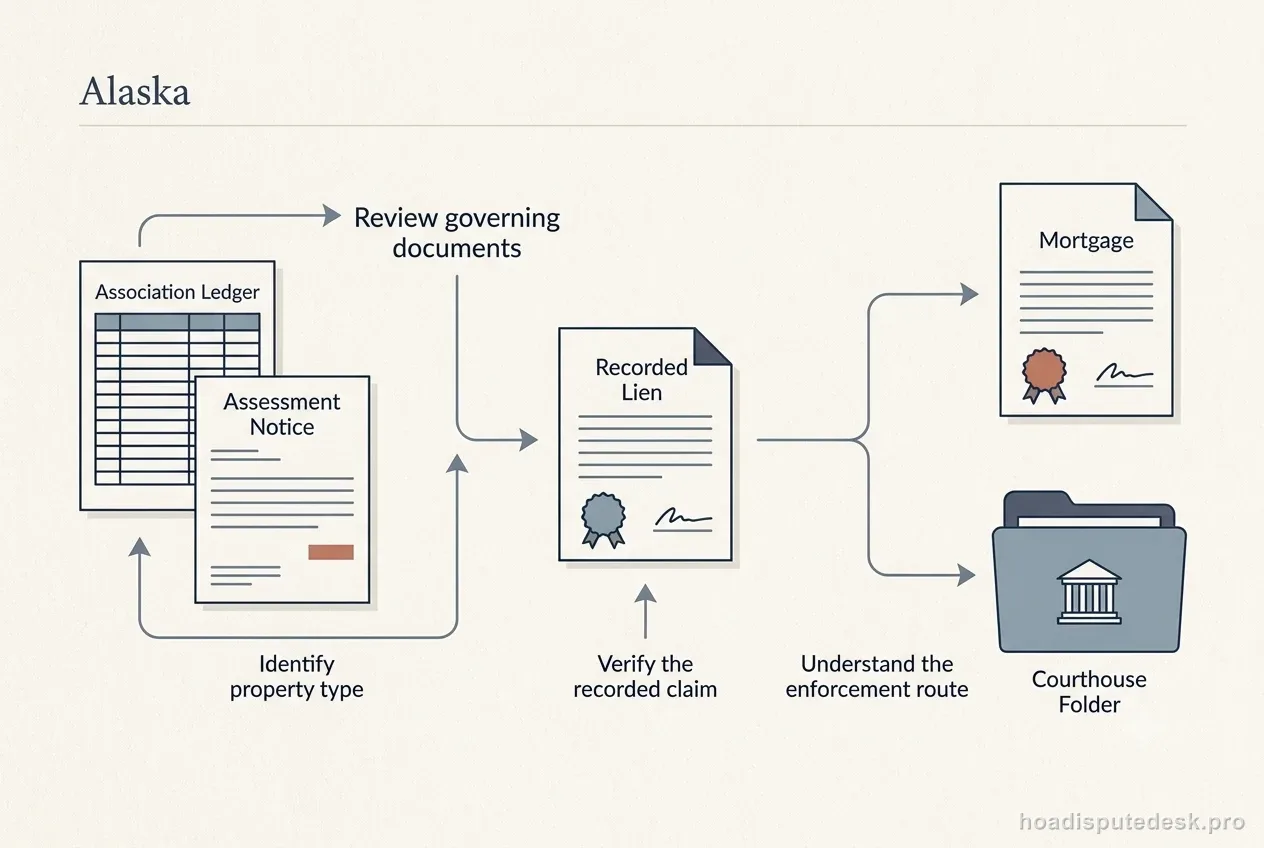
In Alaska, AS 34.08 is the core statute for covered common-interest communities, but older projects can raise applicability questions. For condominiums and planned communities, the association lien is foreclosed through the judicial lien process referenced in AS 34.08.470(j) and AS 34.35.005. The statute also gives qualifying periodic common-expense assessments a limited six-month priority over an earlier first security interest.
Which Alaska statute controls your dispute
Start an Alaska association dispute by identifying the property's legal form and the declaration's recording date. For planned communities, start with Alaska Uniform Common Interest Ownership Act, AS 34.08. For condominiums, the same act governs post-1985 condominiums, cooperatives, and planned communities: AS 34.08. The label used by a board or manager is not enough by itself; older communities may be affected by legacy statutes or transition provisions, so applicability should be checked before relying on a deadline, remedy, or voting rule.
In an Alaska matter, read the recorded declaration next to the current statute rather than trusting a portal summary or a management-company label. Request the amendments, bylaws, rules, and board resolutions. Transition and applicability provisions can decide the outcome in an older community, so keep whatever shows when the community was formed and which regime it now claims.
How Alaska owners challenge an assessment vote
Read an assessment dispute as two questions: did the association have authority to levy the charge, and is the calculation correct. Ask which budget line or board vote created it, which declaration clause allocates common expenses among units, when owners were notified, and — where Alaska law or the governing documents required an owner vote — whether that vote actually took place. Ordinary annual dues and a special assessment often follow different approval paths, so confirm which one governs the charge in front of you.
Preserve an assessment challenge in writing in Alaska and ask for a ledger that shows charges, credits, interest, late fees, and collection costs separately. Withholding every payment can create a second dispute over delinquency, so document what you are contesting and why. If you make a payment while the dispute is open, keep proof and avoid assuming that a particular 'under protest' label has the same legal effect in every claim.
Sources: [1]
Contesting an Alaska HOA fine and demanding a hearing
For a community governed by AS 34.08, the association may levy a reasonable fine for a violation only after notice and an opportunity to be heard. Read the declaration and rules as well, because the statute supplies the power and basic process while the governing documents often define the underlying conduct and hearing mechanics.
For a fine or covenant dispute in Alaska, preserve the chronology. Keep the cited rule, the alleged violation evidence, notice, any cure deadline, hearing materials, your response, and the final decision. A selective-enforcement argument is fact intensive, so document materially similar examples with dates and records instead of relying on general neighborhood impressions.
Records requests and inspection rights in Alaska
AS 34.08 contains association-record duties. Ask in writing, identify the records and time period, and keep proof of delivery so a later records dispute is about a defined request rather than an informal conversation.
A useful Alaska records request names records and time periods instead of asking for 'everything.' Request the ledger, budget materials, minutes tied to the disputed action, applicable rules, invoices or contracts supporting pass-through charges, and the current declaration and amendments. If the association refuses or redacts material, ask it to state the reason by category and preserve that response.
The Alaska assessment-lien timeline and priority
AS 34.08.470 gives a covered association a statutory lien for assessments and certain other amounts. A limited priority applies to six months of qualifying periodic common-expense assessments over an earlier first security interest, but that priority does not automatically extend to every fine, fee, attorney charge, or other balance. Separate lien attachment, recording or notice requirements, priority, and foreclosure authority instead of treating them as one issue.
For an Alaska lien dispute, distinguish attachment, perfection, priority, and foreclosure authority. Those are different legal questions. Compare the ledger with the recorded lien and any pre-lien notice, and check the owner name, property description, covered charge period, stated amount, execution, and recording date before debating who has priority over whom.
Judicial vs. nonjudicial foreclosure for Alaska HOAs
For condominiums and planned communities covered by AS 34.08, the lien foreclosure route is judicial. AS 34.08.470(j) sends foreclosure to the lien procedure in AS 34.35.005, which calls for an action in district or superior court depending on the amount and the court’s monetary jurisdiction. A homeowner should therefore treat a filed complaint or summons as a court deadline, not as an informal collection notice.
An Alaska foreclosure notice should trigger a document audit, not a guess about the timeline. Get the current ledger and every pre-lien and foreclosure notice, then check service, addresses, board authority, charge categories, and any cure or reinstatement option. Court and sale deadlines can be unforgiving, so use the statute and filed papers rather than a national foreclosure checklist.
Pre-suit steps Alaska requires before a lawsuit
There is no single Alaska rule that pushes every HOA or condominium dispute through mediation or arbitration before filing. Whether a pre-suit step is mandatory depends on the specific claim, what the governing documents say, and the court's own rules — check all three.
Sources: [1]
The forums that hear Alaska association disputes
There is no single Alaska agency or tribunal that decides the merits of association disputes in place of the courts. Where a claim lands depends on what it is: a trial court for most disputes, small-claims or a limited-jurisdiction court for a qualifying money amount, or an arbitration or mediation track created by statute or the governing documents.
Sources: [1]
Sources
- Alaska Statutes Title 34 — official current PDFPrimary official source; review AS 34.08.320 (association powers and fines), AS 34.08.470 (assessment lien and priority), AS 34.08.490 (records), and AS 34.35.005 (judicial lien foreclosure).
- Laws of Alaska 1985, Chapter 95 — UCIOA enactmentOfficial session law useful for insurance, records, meeting, and assessment text.
- Alaska Legislature HB 477 text — later AS 34.08 amendmentsOfficial legislative text showing applicability and later amendments to AS 34.08.