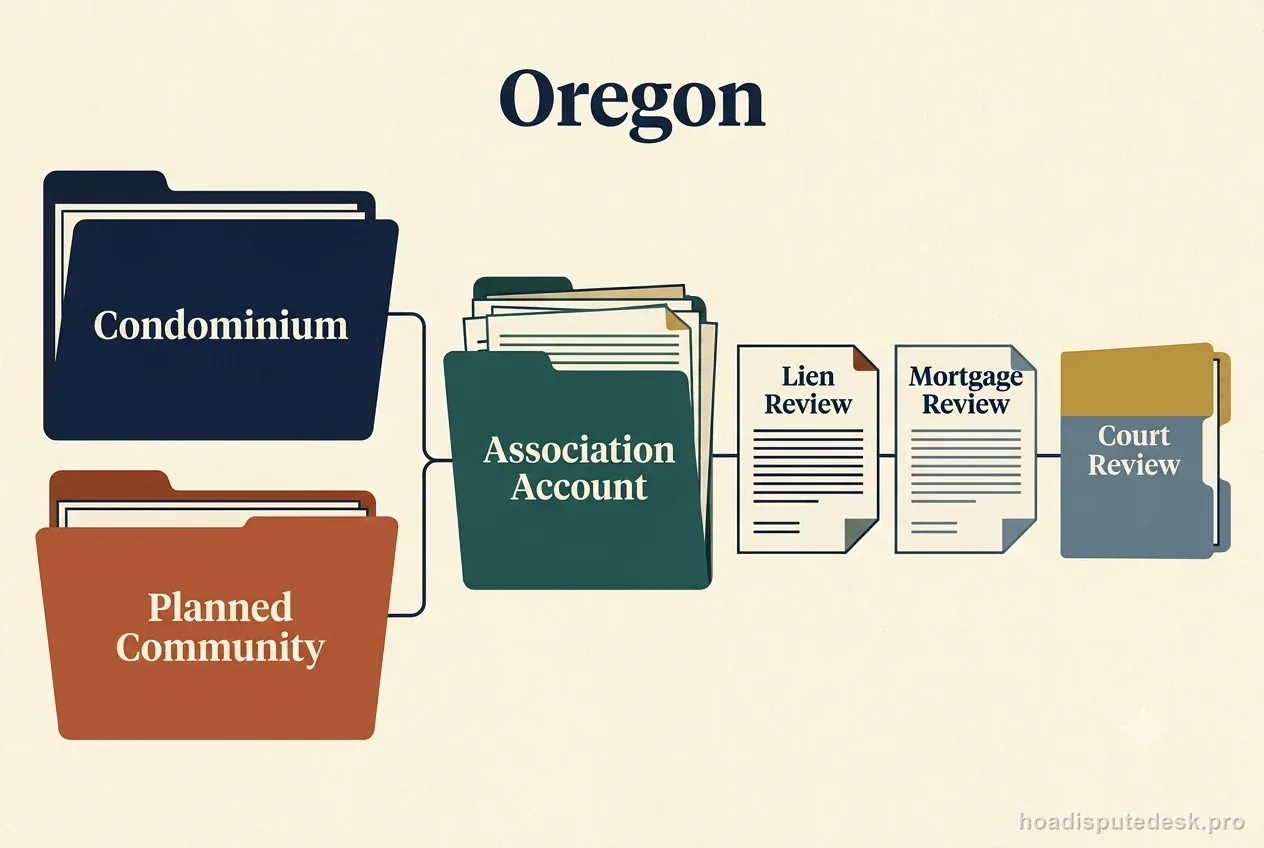
Oregon treats planned communities and condominiums differently on mortgage priority. ORS 94.709 leaves a planned-community assessment lien behind a first mortgage or trust deed. ORS 100.450 generally does the same for condominiums, but subsection (7) can elevate the condominium lien after a statutory 90-day lender notice if the lender does not take one of the specified foreclosure or deed-in-lieu steps. Both regimes require careful lien and notice review.
Oregon: planned-community law vs. condominium law
Start an Oregon association dispute by identifying the property's legal form and the declaration's recording date. For planned communities, start with Oregon Planned Community Act, ORS 94.550 to 94.783. For condominiums, start with Oregon Condominium Act, ORS ch. 100. The label a board or manager uses is not decisive on its own; older communities can be affected by legacy statutes or transition provisions, so check applicability before relying on a deadline, remedy, or voting rule.
When you work through an Oregon case, put the recorded declaration and the statute side by side. Ask for every amendment, the bylaws, the rules, and the board resolutions instead of a summary. Older communities in particular can turn on transition provisions, so preserve the records that establish the formation date and the regime the association says applies.
Disputing a regular or special assessment in Oregon
Break an assessment challenge into authority and math. The association should be able to point to the budget or board action behind the charge, the declaration provision that spreads common expenses, the date notice went out, and any owner vote that Oregon law or the governing documents made a precondition. Do not assume a special assessment cleared the same threshold as the regular budget; the two frequently carry separate voting requirements.
Preserve an assessment challenge in writing in Oregon and ask for a ledger that shows charges, credits, interest, late fees, and collection costs separately. Withholding every payment can create a second dispute over delinquency, so document what you are contesting and why. If you make a payment while the dispute is open, keep proof and avoid assuming that a particular 'under protest' label has the same legal effect in every claim.
Sources: [1]
What Oregon requires before an association fine sticks
Oregon has separate planned-community and condo statutes with owner-protection provisions. Request the notice, hearing/decision record, and rule text before a fine becomes a collection dispute.
For a fine or covenant dispute in Oregon, preserve the chronology. Keep the cited rule, the alleged violation evidence, notice, any cure deadline, hearing materials, your response, and the final decision. A selective-enforcement argument is fact intensive, so document materially similar examples with dates and records instead of relying on general neighborhood impressions.
Oregon record-inspection rules and refusal remedies
Oregon's planned-community and condominium statutes both impose recordkeeping and owner-inspection duties. A useful request should identify the owner ledger, budget, financial statements, minutes or resolutions authorizing the disputed assessment, collection policy, contracts relevant to the charge, and the version of the governing document in effect on the decision date. Ask the association to identify the statutory exception for anything withheld.
For assessment disputes, do not stop at a running balance. Reconcile each line item to the board action or governing-document authority that created it, and preserve the date the record request was made and the response received. If foreclosure is threatened, separately request the recorded notice of claim and, for a condominium priority claim under ORS 100.450(7), the notice sent to the first-mortgage lender and delivery evidence.
When an assessment lien attaches under Oregon law
ORS 94.709 gives a planned-community homeowners association a lien for unpaid assessments, including authorized interest, late charges, attorney fees, costs, and other amounts. Recording the declaration provides record notice and perfection, but the association must record a verified notice of claim of lien before a foreclosure suit may proceed. The statute puts taxes and a first mortgage or trust deed of record ahead of the planned-community lien; there is no parallel 90-day mortgage-priority mechanism in § 94.709.
Condominium ORS 100.450 follows a similar attachment and recording structure but adds an important exception. A first mortgage or trust deed is ordinarily senior, yet subsection (7) can make the condominium lien prior if the association gives the lender the prescribed 90-day written default notice and the lender does not, before the period expires, initiate judicial foreclosure, request issuance of a trustee's notice of sale, or accept the qualifying deed in lieu described by statute. That conditional rule is why a simple 'Oregon has no super-lien' statement is inaccurate for condominiums.
How association foreclosure works in Oregon
For both planned communities and condominiums, the association must record a notice of claim before a lien-foreclosure suit proceeds. ORS 94.709(4) and ORS 100.450(4) direct the foreclosure proceeding to conform as nearly as possible to the lien-foreclosure procedure referenced in ORS 87.010, and both statutes allow the lien to continue for up to six years from the assessment due date. A separate money-judgment action can be maintained without waiving the assessment lien.
A condominium file needs one additional lender-priority check. If the association claims its lien moved ahead of the first mortgage under ORS 100.450(7), obtain the lender notice, proof of delivery and the 90-day timeline, then determine whether the lender started one of the statutory foreclosure or deed-in-lieu steps before the period expired. That priority question can materially change the risk of a condominium lien sale or settlement.
What to complete before filing in Oregon court
Oregon does not impose one blanket mediation-or-ADR requirement across association disputes. A pre-suit obligation, where it exists, comes from the statute for the particular claim, the declaration and bylaws, or a court's procedural rules, so read those rather than assuming.
Sources: [1]
Where Oregon HOA and condo disputes are decided
Oregon routes association disputes through the regular court system rather than a dedicated HOA tribunal. The right forum turns on the claim — general trial court, small-claims or limited-jurisdiction court for a money claim under the threshold, or a statute- or document-created arbitration or mediation process.
Sources: [1]
Sources
- Oregon Legislature — ORS chapter 94Planned-community assessment lien, first-mortgage priority, recording and foreclosure procedure.
- Oregon Legislature — ORS chapter 100Condominium assessment lien, foreclosure procedure, and conditional first-mortgage priority under subsection (7).
- Oregon Legislature — ORS chapter 87 lien-foreclosure provisions