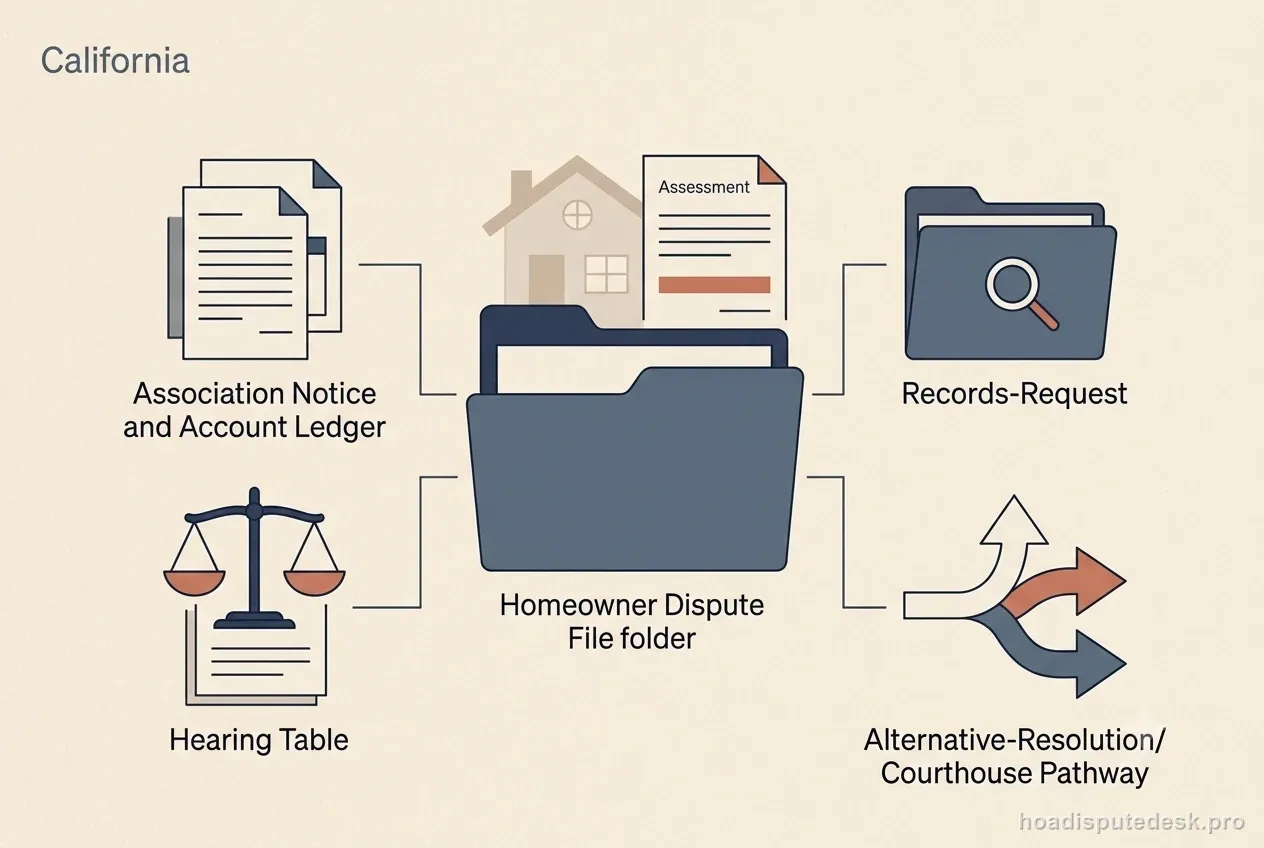
California’s Davis-Stirling Act governs common-interest developments, including qualifying condominiums and planned developments. For discipline, Civil Code § 5855 requires at least 10 days’ written notice before the board meeting, a chance to cure, and written notice of the decision within 14 days. Assessment foreclosure is generally unavailable until the delinquent assessments reach $1,800 or are more than 12 months delinquent, and certain superior-court enforcement actions require the ADR-request process first.
Identifying the governing law in California
California’s Davis-Stirling Common Interest Development Act, Civil Code §§ 4000 and following, is the central statute for qualifying common-interest developments, including condominium projects and planned developments. The project type still matters for the declaration and some property rules, but homeowners should not begin from the assumption that California has one unrelated “HOA act” and a separate condominium enforcement code. Start with Davis-Stirling, the recorded declaration, bylaws, operating rules, and the statute-specific procedure for the dispute.
In California, confirm the legal regime before arguing the merits. Obtain the recorded declaration, amendments, bylaws, rules, and any board resolution connected to the dispute, then compare them with the statute applicable to that community type. This prevents a common mistake: applying a condominium rule to a planned community, or a newer statute to a property governed by transition provisions.
Assessment and special-assessment challenges under California law
Read an assessment dispute as two questions: did the association have authority to levy the charge, and is the calculation correct. Ask which budget line or board vote created it, which declaration clause allocates common expenses among units, when owners were notified, and — where California law or the governing documents required an owner vote — whether that vote actually took place. Ordinary annual dues and a special assessment often follow different approval paths, so confirm which one governs the charge in front of you.
When challenging an assessment in California, ask the association to reconcile the account in writing and preserve your objection at the same time. Keep the ledger, notices, proof of payment, and the governing provision the board cites. If only part of the balance is disputed, distinguish that part clearly; a broad payment stoppage can obscure the original issue and create additional collection consequences.
Sources: [1]
Fine notices and hearing rights in California
Civil Code § 5855 gives a California owner concrete discipline rights. The association must generally give written notice of the board meeting at least 10 days before discipline is considered, state the alleged violation, and tell the owner about the right to attend and address the board. The owner must have an opportunity to cure where applicable, and the board must send written notice of its decision within 14 days. If the owner disputes the result, the statute also connects the discipline process to internal dispute resolution.
The most useful record in a California fine dispute is a dated enforcement file. Include the governing provision, initial notice, evidence, cure communications, hearing request, hearing notice, material considered, and final decision. If the issue is inconsistent enforcement, document comparable cases carefully; visual similarity alone does not establish that the properties were legally or factually alike.
Sources: [5]
How to get board records from an California association
Civil Code § 5210 uses different production periods depending on the records requested. Many association records from the current fiscal year must be made available within 10 business days after a proper written request, while records from the prior two fiscal years generally use a 30-calendar-day period; other categories have their own rules and exceptions. A records request should identify the fiscal period and category instead of demanding “all records” and assuming one universal deadline.
Treat a California records request as an evidence request, not a fishing expedition. Ask for the ledger, approval records, relevant minutes, rules, invoices, contracts, and recorded governing documents that bear on the issue. Separate categories that may contain other owners' private information. A written refusal should identify what was withheld and why so the dispute is defined.
Sources: [3]
How California associations perfect an assessment lien
California places a material threshold on assessment foreclosure. Under Civil Code § 5720, when delinquent regular or special assessments are less than $1,800, excluding specified add-ons, the association generally may not use judicial or nonjudicial foreclosure. A recorded lien generally does not become foreclosable until qualifying assessments reach at least $1,800 or are more than 12 months delinquent. That threshold makes it important to separate assessment principal from late charges, collection costs, attorney fees, and interest on the ledger.
When reviewing an association lien in California, separate the debt from the lien and the lien from foreclosure. Check the assessment ledger, any pre-lien notice, the recorded claim, legal description, amount, execution, and filing date. Then analyze priority and enforcement. This sequence avoids assuming that a recorded lien automatically outranks a mortgage or automatically permits a sale.
Sources: [6]
The California HOA foreclosure route, step by step
California permits either nonjudicial or judicial assessment-lien foreclosure, subject to Davis-Stirling safeguards and statutory foreclosure limits. The applicable route depends on the community type, the declaration, the charges secured by the lien, and the notices already completed. A recorded lien is therefore only one step in the process, not automatic authority to sell the property.
If a lien moves toward foreclosure in California, work from the actual documents. Calendar the dates, reconcile the ledger, identify any statutory minimum or excluded charges, and check notice, board approval, cure, payment-plan, and redemption rules that apply. National summaries can miss a state-specific court, trustee, or filing step.
Mandatory ADR and notice before suing in California
California’s ADR prerequisite is important but narrower than “mediation before every HOA lawsuit.” Civil Code § 5930 applies before certain superior-court enforcement actions seeking declaratory, injunctive, or writ relief, with only limited accompanying damages. It does not apply to small-claims actions and generally does not apply to an action that is solely about assessment collection. Identify the claims and requested remedy before deciding whether the statutory ADR-request process is mandatory.
Sources: [7]
California: courts, agencies, and ADR panels for these cases
There is no single California agency or tribunal that decides the merits of association disputes in place of the courts. Where a claim lands depends on what it is: a trial court for most disputes, small-claims or a limited-jurisdiction court for a qualifying money amount, or an arbitration or mediation track created by statute or the governing documents.
Sources: [1]
Sources
- Davis-Stirling Common Interest Development Act — Cal. Civ. Code § 4000Official California Legislature entry identifying Part 5 as the Davis-Stirling Common Interest Development Act.
- California finance and assessment rules — Cal. Civ. Code §§ 5300, 5550, 5605Official § 5550 reserve-study rule; the same official code also contains §§ 5300 (annual budget report) and 5605 (assessment thresholds).
- California governance, election, and records rules — Cal. Civ. Code §§ 4920, 5100, 5120, 5210Official § 4920 meeting rule; grouped with official §§ 5100/5120 election rules and § 5210 records timing for sourceRefs.
- California liability and fidelity/crime coverage — Cal. Civ. Code §§ 5805, 5806Official reserves-plus-three-months fidelity/crime formula; § 5805 contains general-liability thresholds.
- California discipline hearing — Cal. Civ. Code § 5855Official pre-hearing notice, cure opportunity, decision notice, and IDR provisions.
- Cal. Civ. Code § 5720 — foreclosure limitation (official)California Civil Code foreclosure-eligibility provision; current codified text controls the dollar and delinquency thresholds.
- Cal. Civ. Code § 5930 — ADR prerequisite for certain enforcement actionsOfficial California Legislature section defining when ADR must precede specified superior-court enforcement actions and its exceptions.