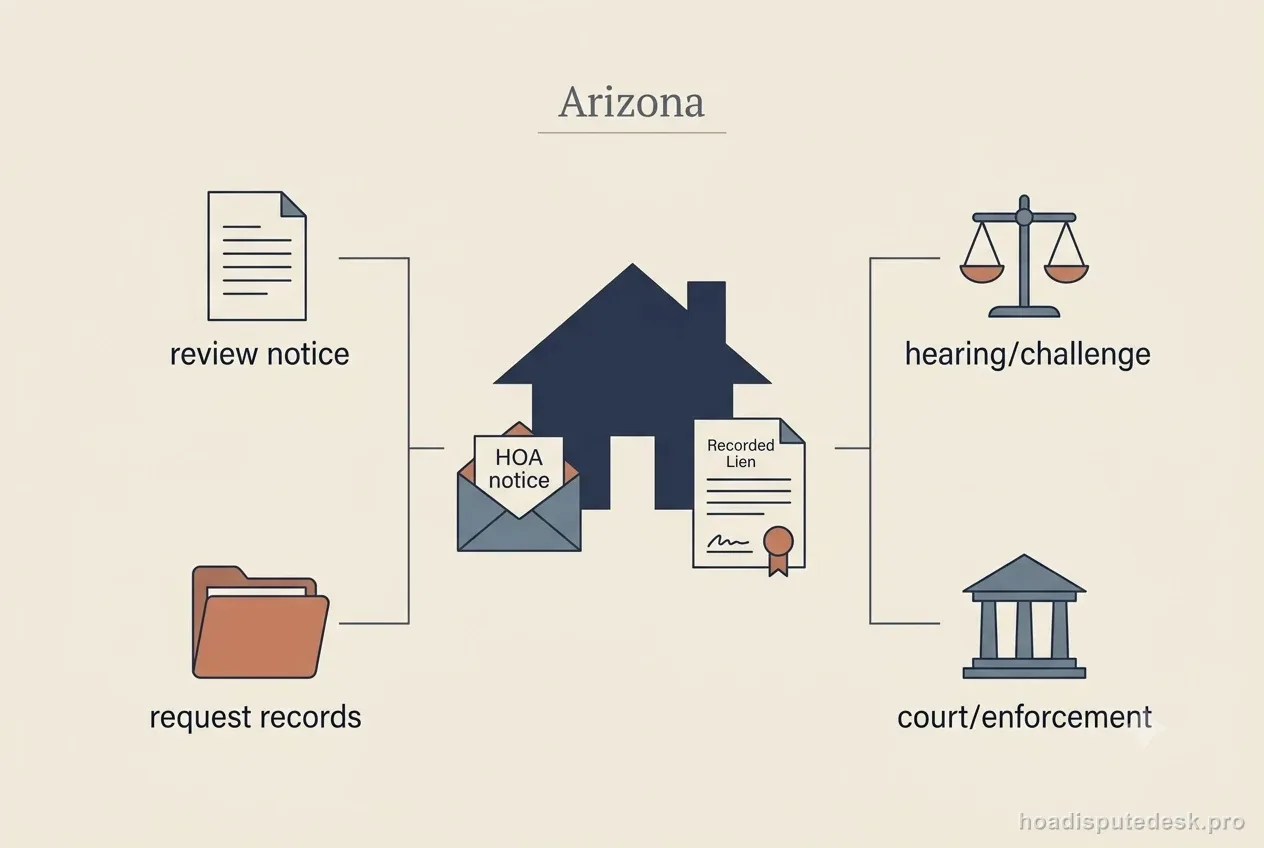
Arizona uses separate statutes for planned communities and condominiums. As of August 31, 2026, planned-community foreclosure generally requires an assessment delinquency of 18 months or $10,000, while the condominium threshold remains one year or $1,200 until September 12, 2026. On September 12, 2026, Chapter 162 raises the condominium threshold to 18 months or $10,000 and adds a special-assessment rule.
Which Arizona statute controls your dispute
Start an Arizona association dispute by identifying the property's legal form and the declaration's recording date. For planned communities, start with Arizona Planned Communities statutes, A.R.S. §§ 33-1801 et seq. For condominiums, start with Arizona Condominium Act, A.R.S. §§ 33-1201 et seq. The label a board or manager uses is not decisive on its own; older communities can be affected by legacy statutes or transition provisions, so check applicability before relying on a deadline, remedy, or voting rule.
Do not treat the statute as a substitute for the declaration in Arizona. Pull the declaration and amendments, bylaws, rules, and any resolution tied to the disputed charge or enforcement action. The useful question is whether the association had authority under both mandatory law and its own governing documents, using the versions that were actually in effect when the dispute arose.
How Arizona owners challenge an assessment vote
Treat an assessment dispute as an authority-and-calculation problem. Ask the association to identify the budget or board action that created the charge, the declaration provision that allocates common expenses, the date notice was sent, and the owner vote if the documents or Arizona law required one. A special assessment can have a different approval path from ordinary annual dues, so do not assume the same voting rule applies to both.
For a disputed Arizona assessment, build the paper trail before choosing a payment strategy. Ask for the complete ledger, the budget or resolution supporting the charge, and any notice or vote the association relies on. State clearly which part you challenge. That makes it easier to test the association's authority without turning an accounting disagreement into an avoidable delinquency dispute.
Sources: [1]
Contesting an Arizona HOA fine and demanding a hearing
Both regimes require notice and an opportunity to be heard before reasonable monetary penalties. Treat the violation notice, owner response, hearing, and final decision as separate steps.
In Arizona, a useful fine-defense file is a timeline rather than a stack of screenshots. Match the cited covenant to the notice, the notice to any cure period, and the hearing record to the final decision. If unequal treatment is part of the dispute, collect comparable examples that involve the same rule and similar facts; unsupported neighbor comparisons are usually weak evidence.
Records requests and inspection rights in Arizona
Arizona gives owners a concrete inspection/copy right. The cited statute provides a 10-business-day response framework for covered records requests and statutory limits on copy charges.
For records in Arizona, narrow the request to documents that answer the dispute: owner ledger, budget or assessment approval, minutes, governing rule, property-specific enforcement history, supporting invoices, and recorded declaration or amendments. A focused request creates a cleaner record if access is denied. Ask for the basis of any refusal or redaction rather than debating it informally.
The Arizona assessment-lien timeline and priority
Arizona’s lien rules are similar in structure but not identical for planned communities and condominiums. As of August 31, 2026, a planned-community association generally cannot foreclose until the owner has been delinquent in qualifying assessments for 18 months or owes $10,000, while the condominium statute still uses one year or $1,200. Chapter 162 changes the condominium rule on September 12, 2026, raising it to 18 months or $10,000 and addressing special assessments. Use the law in effect on the relevant enforcement date.
An Arizona assessment lien should be audited in layers. First ask whether the debt can become a lien; then whether required notice or recording occurred; then where the lien ranks; finally, whether foreclosure prerequisites are met. Check the recorded document against the ledger, legal description, dates, signatures, and notices. A priority rule does not excuse defects in the enforcement process.
Judicial vs. nonjudicial foreclosure for Arizona HOAs
Before treating an Arizona assessment lien as foreclosable, identify whether the property is a planned community or condominium and apply the threshold in force on the enforcement date. For condominium matters spanning September 12, 2026, that date matters because Chapter 162 changes the statutory threshold. Also separate assessment principal from attorney fees, collection charges, fines, and other amounts; not every ledger line has the same foreclosure significance.
Once association foreclosure is threatened in Arizona, preserve the notices and put every deadline on a calendar. Reconcile the debt, identify which charges count toward any foreclosure prerequisite, and check service, board action, payment-plan or cure rights, and the actual court or sale procedure. A generic HOA timeline is not a substitute for the state-specific process.
Pre-suit steps Arizona requires before a lawsuit
Arizona offers an Office of Administrative Hearings route for certain association disputes. That administrative option is not a substitute for checking whether a lien-foreclosure case belongs in superior court.
Sources: [1]
The forums that hear Arizona association disputes
Arizona has a specialized administrative hearing process for certain alleged violations of condominium and planned-community statutes through the framework in A.R.S. §§ 32-2199 to 32-2199.05. That process has defined jurisdiction and filing rules; it is not a universal HOA court. Other disputes may belong in justice court, superior court, arbitration, or another forum depending on the remedy and amount at issue.
Sources: [1]
Sources
- Arizona Revised Statutes, Title 33 — official Legislature portalPrimary official index for the Condominium Act and Planned Communities statutes; compilation timing warning is important in 2026.
- A.R.S. § 33-1248 — condominium open meetingsOfficial open-meeting, owner-speaking, recording, notice, and agenda provisions for condos.
- A.R.S. § 33-1804 — planned-community open meetingsOfficial parallel open-meeting rule for planned communities.
- A.R.S. § 33-1258 / § 33-1805 — association recordsOfficial condo records page; planned-community parallel is § 33-1805.
- A.R.S. § 33-1803 — planned-community assessment limitationCurrent compiled 20% regular-assessment rule; recheck after 2026 general effective date.
- 2026 Session summary — HOA legislation and effective datesOfficial House summary; includes chaptered 2026 HOA measures and effective-date information.
- Laws 2026, Chapter 162 (SB 1246) — condominium lien and foreclosure changesOfficial enrolled Arizona session law. Effective September 12, 2026; changes condominium foreclosure thresholds and special-assessment treatment.