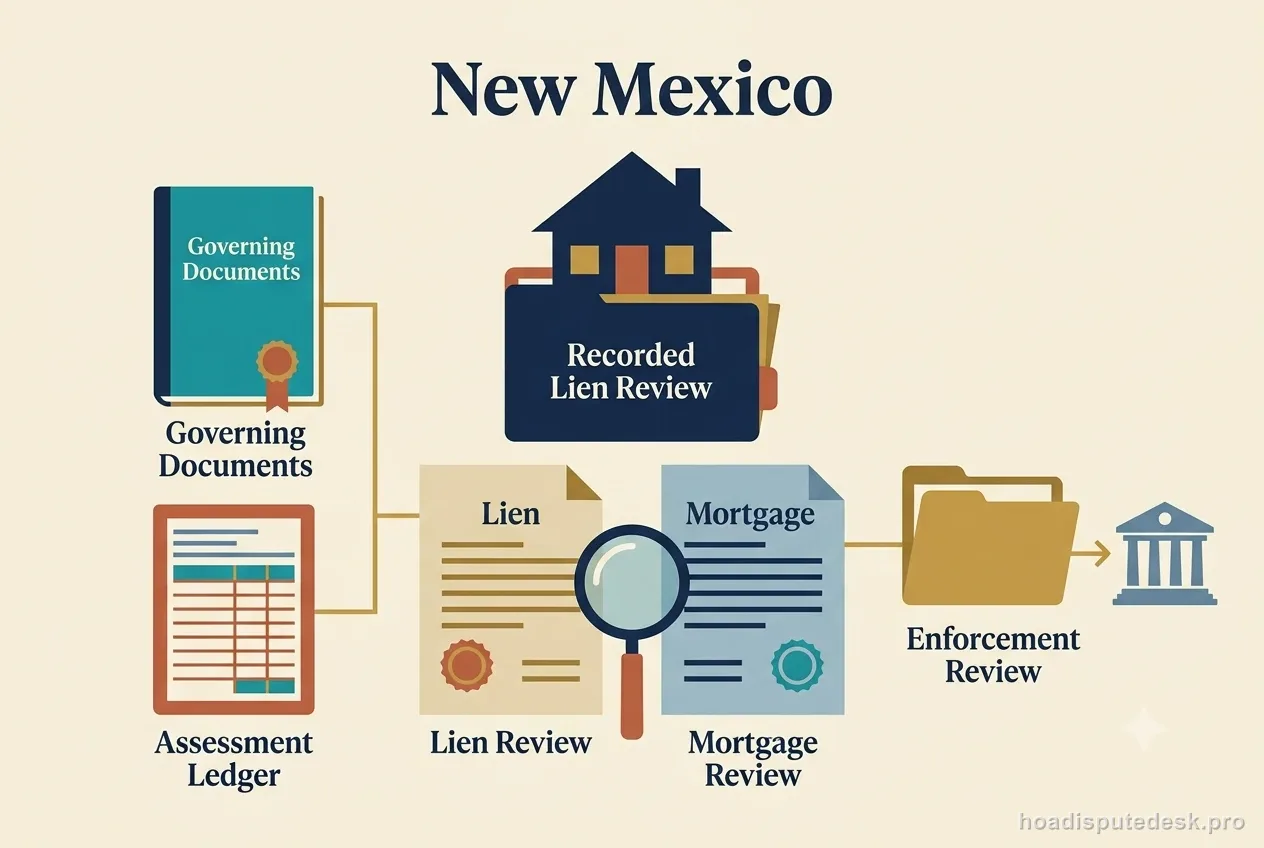
New Mexico treats subdivision HOAs and condominiums under different statutes, but both can create assessment liens that are foreclosed like real-estate mortgages. The modern Condominium Act does not give a six-month super-lien over a prior mortgage. For HOA fines, current § 47-16-18 requires notice and a dispute opportunity, including 14-day hearing notice when a hearing is used. ADR is optional unless the community documents require it.
Which New Mexico statute controls your dispute
Before anything else in a New Mexico dispute, pin down the property's legal form and when the declaration was recorded. For planned communities, start with New Mexico Homeowner Association Act, NMSA 1978 §§ 47-16-1 to 47-16-18. For condominiums, start with New Mexico Condominium Act, NMSA 1978 §§ 47-7-1 et seq. Do not take the board's or manager's label at face value — an older community may sit under a legacy statute or a transition provision, so confirm what actually applies before you count on a deadline, remedy, or voting rule.
In New Mexico, read the recorded declaration, amendments, bylaws, rules, and properly adopted resolutions alongside the statute. Governing documents can fill procedural gaps, but they do not override mandatory law. Before challenging a fine, assessment, records decision, or lien, confirm the declaration date and keep the exact version of every document the association says it relied on.
How New Mexico owners challenge an assessment vote
Read an assessment dispute as two questions: did the association have authority to levy the charge, and is the calculation correct. Ask which budget line or board vote created it, which declaration clause allocates common expenses among units, when owners were notified, and — where New Mexico law or the governing documents required an owner vote — whether that vote actually took place. Ordinary annual dues and a special assessment often follow different approval paths, so confirm which one governs the charge in front of you.
To contest a New Mexico assessment, put the objection in writing and ask for a current owner ledger instead of just withholding payment. Split what you concede from what you dispute, and keep every payment record and objection. Collection activity can continue on the unpaid balance while the dispute runs, so require the association to show the authority and the calculation for each line you challenge.
Sources: [2]
Contesting an New Mexico HOA fine and demanding a hearing
For a Homeowner Association Act community, current § 47-16-18 allows reasonable fines for non-assessment violations only after written notice and an opportunity to dispute the charge, unless the community documents provide another lawful procedure. If the owner chooses a hearing rather than only a written statement, the board must give written notice 14 days before the hearing. The statute also preserves an emergency exception for violations posing an imminent threat to public health or safety.
Build the New Mexico enforcement file in date order: the covenant or rule cited, photos or complaint, first notice, cure opportunity, your written response, hearing request, 14-day hearing notice, evidence considered, and final decision. Condominium procedures come from the Condominium Act and governing documents rather than § 47-16-18, so do not automatically apply the HOA hearing language to a condominium.
Records requests and inspection rights in New Mexico
For an HOA covered by the Homeowner Association Act, § 47-16-5 is unusually specific: financial and other association records must be made available during regular business hours within 10 business days of a written request. Inspection is free and copies are capped at $0.10 per page. A willful failure can expose the association to the greater of actual damages or $50 per calendar day beginning on the eleventh business day. Condominium records are governed separately by § 47-7C-18.
Make a New Mexico records request precise enough to enforce. Identify the account ledger, current budget and assessments, relevant minutes, bank or reserve records tied to the issue, current contracts, insurance information, and the recorded declaration or amendments. Keep proof of receipt because the HOA Act's 10-business-day clock runs from the written request.
The New Mexico assessment-lien timeline and priority
For a subdivision HOA, § 47-16-6 creates a lien from the time the assessment or fine becomes due; recording the declaration gives record notice and perfection, and the lien may be foreclosed in like manner as a mortgage. For a condominium under § 47-7C-16, the lien likewise arises when the assessment or fine becomes due and the declaration perfects it. Crucially, New Mexico omitted the Uniform Condominium Act subsection that would have given a six-month priority over a prior first mortgage, so the modern Condominium Act should not be described as a super-lien statute.
Keep four New Mexico lien questions separate: when the lien arises, how it is perfected, where it ranks, and how it is enforced. For condominiums, § 47-7C-16 also extinguishes an unpaid-assessment lien unless enforcement proceedings begin within three years after the full assessment becomes due. Review the declaration because it may subordinate the condominium lien further.
Judicial vs. nonjudicial foreclosure for New Mexico HOAs
Both § 47-16-6 for covered HOAs and § 47-7C-16 for modern condominiums say the association lien may be foreclosed in like manner as a mortgage on real estate. That makes a mortgage-style court foreclosure the safe statutory description. Do not import a six-month super-priority or a proposed foreclosure threshold from a bill that did not become current law.
If a New Mexico lien moves toward foreclosure, reconcile the ledger and identify which charges are actually secured, then compare the association's notices and filed papers with the applicable mortgage-foreclosure procedure. A 2025 proposal would have barred certain HOA foreclosures below time and dollar thresholds, but that proposal is not the current rule and should not appear as enacted law.
Pre-suit steps New Mexico requires before a lawsuit
Current § 47-16-18 says an HOA or lot owner may use alternatives to litigation—including mediation, facilitation, settlement conferences, arbitration and other processes—or must use them if the community documents require them. The statute therefore does not impose one blanket statewide mediation prerequisite for every HOA dispute. The 2026 amendment, effective July 1, 2026, changed § 47-16-18 in connection with child-care-home restrictions but retained the optional-ADR structure.
The forums that hear New Mexico association disputes
There is no single New Mexico agency or tribunal that decides the merits of association disputes in place of the courts. Where a claim lands depends on what it is: a trial court for most disputes, small-claims or a limited-jurisdiction court for a qualifying money amount, or an arbitration or mediation track created by statute or the governing documents.
Sources: [2]
Sources
- New Mexico Homeowner Association Act § 47-16-5 — current compiled textRecords access: 10 business days, copy-cost cap, and statutory damages for willful noncompliance.
- New Mexico Homeowner Association Act § 47-16-6 — current compiled textHOA lien creation, perfection, 10-business-day payoff statement, and mortgage-style foreclosure.
- New Mexico Condominium Act § 47-7C-16 — current compiled textCondo lien and foreclosure; compiler notes confirm New Mexico omitted the Uniform Act priority subsection.
- 2026 SB 96 — official New Mexico Legislature bill historyChapter 62, signed March 10, 2026; effective July 1, 2026.
- 2026 SB 96 final statutory text — officialCurrent amendment to § 47-16-18; retains optional ADR and adds child-care-home protections.