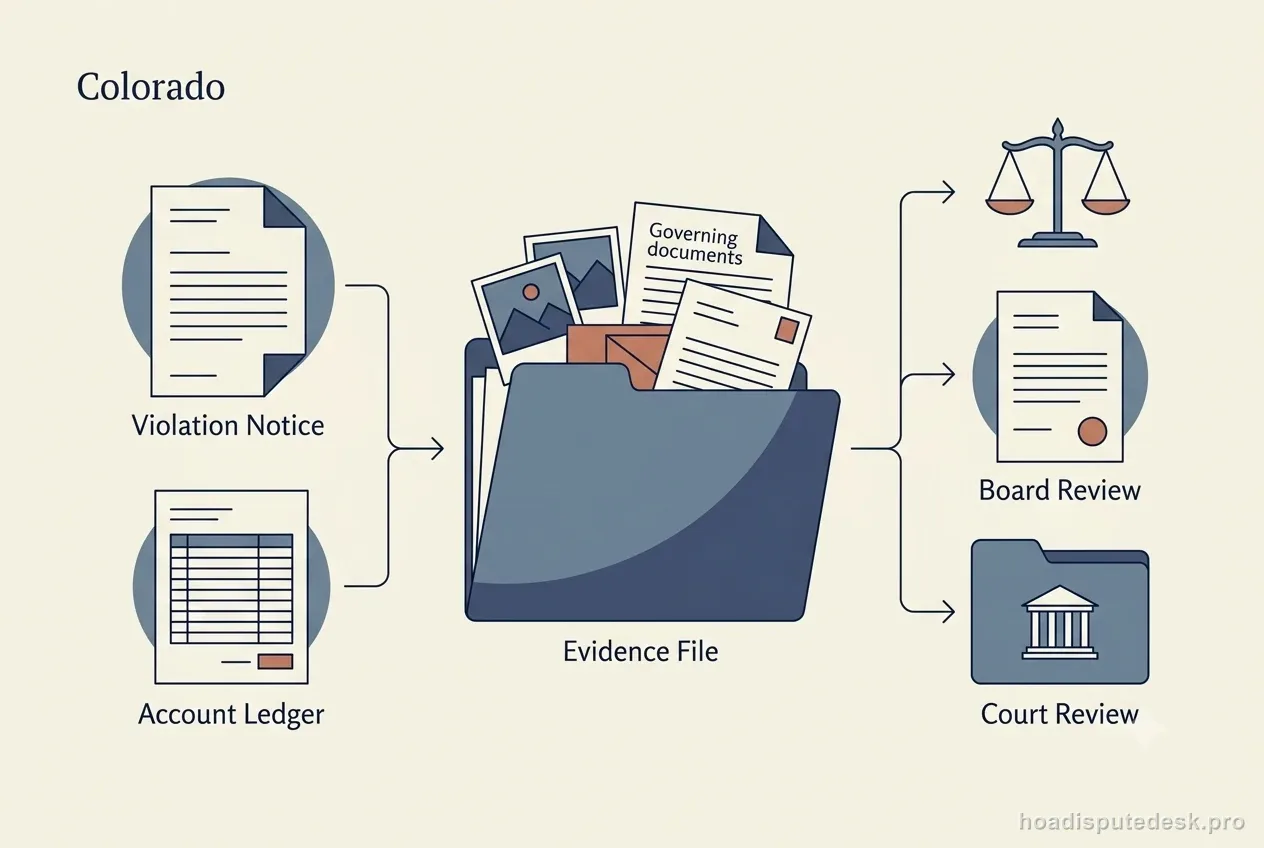
Colorado’s CCIOA gives associations a statutory assessment lien but sharply limits foreclosure. A condominium or planned-community association generally may foreclose only when the foreclosable assessment balance equals at least six months of common-expense assessments and the board has approved that specific unit by recorded vote. Fines, fees, collection charges, and attorney fees may be liened but are not themselves foreclosable under § 38-33.3-316; a compliant payment plan also blocks foreclosure.
Colorado: planned-community law vs. condominium law
Before anything else in a Colorado dispute, pin down the property's legal form and when the declaration was recorded. For planned communities, start with Colorado Common Interest Ownership Act (CCIOA), C.R.S. Title 38, Art. 33.3. For condominiums, start with Colorado Common Interest Ownership Act (CCIOA), C.R.S. Title 38, Art. 33.3; older condominiums may also implicate the Condominium Ownership Act, Art. 33. Do not take the board's or manager's label at face value — an older community may sit under a legacy statute or a transition provision, so confirm what actually applies before you count on a deadline, remedy, or voting rule.
In Colorado, read the recorded declaration, amendments, bylaws, rules, and properly adopted resolutions alongside the statute. Governing documents can fill procedural gaps, but they do not override mandatory law. Before challenging a fine, assessment, records decision, or lien, confirm the declaration date and keep the exact version of every document the association says it relied on.
Disputing a regular or special assessment in Colorado
Break an assessment challenge into authority and math. The association should be able to point to the budget or board action behind the charge, the declaration provision that spreads common expenses, the date notice went out, and any owner vote that Colorado law or the governing documents made a precondition. Do not assume a special assessment cleared the same threshold as the regular budget; the two frequently carry separate voting requirements.
Challenging a Colorado assessment starts with a written objection and a request for the current owner ledger, not a unilateral stop-payment. Pay or set aside the undisputed portion, document the disputed portion, and retain copies of everything. Because the balance can keep drawing collection steps during the dispute, make the association justify both the authority for the charge and the math behind each contested item.
Sources: [1]
What Colorado requires before an association fine sticks
Colorado separates covenant-violation enforcement from assessment collection. Before a fine, verify the current notice, cure, hearing, and collection-policy steps under CCIOA and the association’s responsible-governance policies. Do not let fines or attorney fees blur into assessment principal: § 38-33.3-316 allows several non-assessment charges to be liened but bars foreclosure based on those charges themselves.
For a Colorado enforcement dispute, keep a dated sequence: cited covenant or rule, photos or complaint, first notice, opportunity to cure, your reply, the hearing request and notice, what evidence the board weighed, and the outcome. If the concern is selective enforcement, line up truly similar properties across the same timeframe — documentation of dates and board action matters more than an impression about the neighbors.
Colorado record-inspection rules and refusal remedies
CCIOA gives owners statutory record access subject to listed exclusions. Use the HOA Information & Resource Center for education and complaints, but remember it does not replace a court when an injunction or lien ruling is needed.
A a Colorado records request works best when it is itemized — account ledger, budget, special-assessment resolution, minutes, the applicable rule, violation history for the unit, the supporting contract or invoice, and the recorded declaration and amendments. Put anything implicating another owner's privacy in its own category, and demand a specific legal basis for every withheld document.
When an assessment lien attaches under Colorado law
C.R.S. § 38-33.3-316 creates the association lien and gives a limited priority equal to six months of periodic common-expense assessments over an earlier first security interest. That priority slice is not the same as the full ledger. Fines, fees, charges, collection costs, and attorney fees can be subject to the lien but are not themselves subject to foreclosure under CCIOA, so reconcile assessment principal separately before evaluating a sale threat.
A Colorado lien analysis has four parts that should not be collapsed: the moment the lien arises, the recording or notice conditions, its priority against competing liens, and the enforcement steps. Read the recorded claim itself for owner name, legal description, period covered, amount, signature, filing date, and notice compliance — and remember that priority is not the same as a right to foreclose.
How association foreclosure works in Colorado
Colorado foreclosure has concrete statutory gates. For a condominium or planned community, § 38-33.3-316 generally requires the foreclosable balance to equal or exceed six months of common-expense assessments and the executive board to authorize legal action against the specific unit by recorded vote. The statute also requires advance owner and lienholder notices, and § 38-33.3-316.3 bars foreclosure while the owner is complying with a required payment plan.
When a Colorado foreclosure notice arrives, calendar all of its dates the same day and request a fresh ledger. Scrutinize the charge categories cited, the notices and mailing addresses used, the board's authorization, and any remaining cure, payment-plan, reinstatement, or redemption option. The governing statute, court rule, or declaration — not an internet summary — controls the order of events.
What to complete before filing in Colorado court
Colorado does not impose one universal mediation gate for every association lawsuit. The governing documents, collection policy, and court rules can still create pre-suit steps or settlement opportunities.
Sources: [1]
Where Colorado HOA and condo disputes are decided
The Colorado HOA Information & Resource Center provides homeowner education and complaint resources, but it is not a court and does not adjudicate every private HOA dispute. Use it for guidance and complaint intake where appropriate, while preserving any court, lien, or foreclosure deadline that runs independently.
Sources: [1]
Sources
- Colorado Revised Statutes 2026 — Title 38, PropertyOfficial OLLS compilation; CCIOA is Article 33.3.
- Colorado HB 26-1099 — Protect Financial Condition of HOAsOfficial 2026 legislation adding declarant reserve-study and transition duties.
- Colorado HOA Information & Resource CenterDivision of Real Estate education and HOA registration resource.
- Colorado Revised Statutes 2026 — Title 7, Corporations and AssociationsOfficial nonprofit-corporation provisions relevant to director standards.