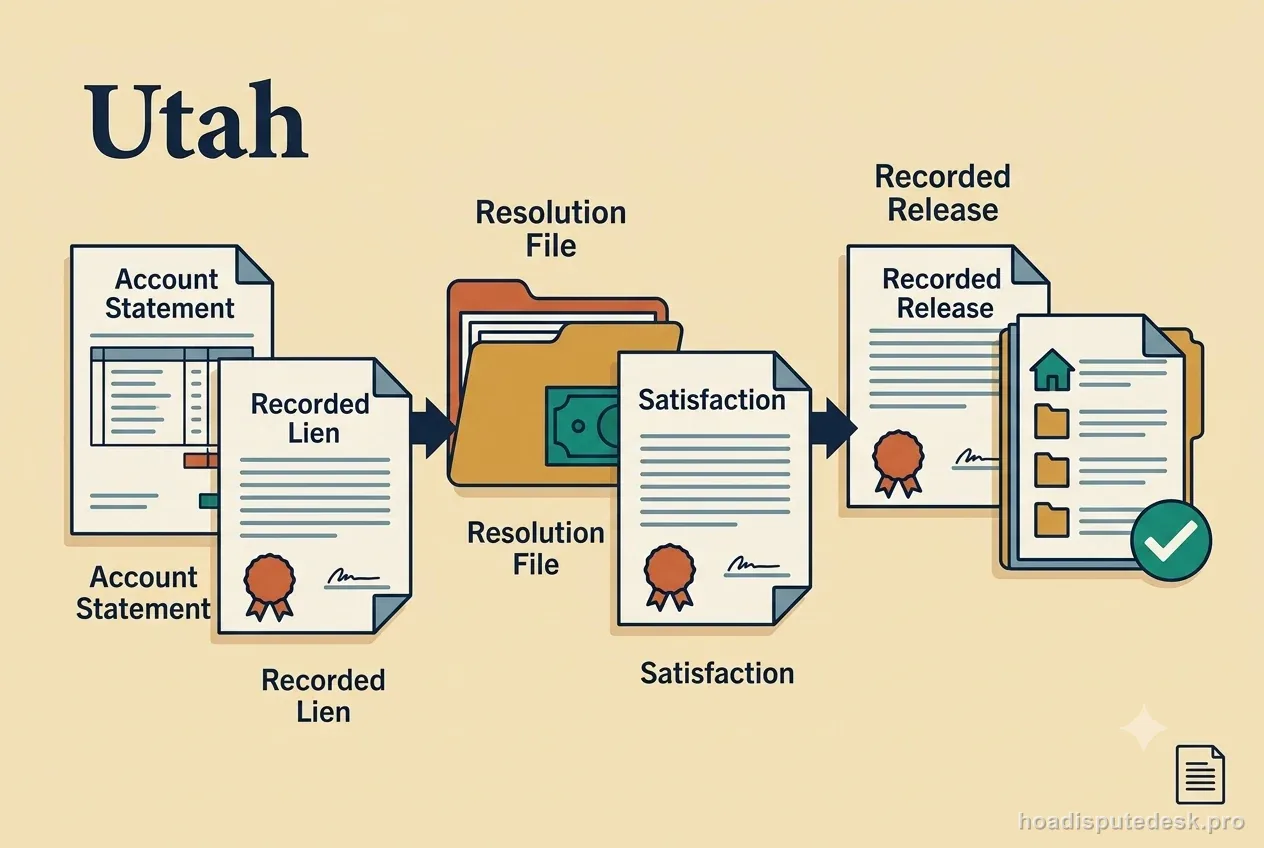
In Utah, first identify whether the property is an HOA or condominium, then apply the correct statute and governing documents. A statutory non-judicial route can apply, but the owner may have a time-limited judicial-election right. Do not presume super-priority over a first mortgage. Do not assume mediation is mandatory for every claim; check the dispute-specific statute and governing documents. Get the ledger, lien, and notices before choosing payment, ADR, or court relief.
Utah: planned-community law vs. condominium law
Start a Utah association dispute by identifying the property's legal form and the declaration's recording date. For planned communities, start with Utah Community Association Act, Utah Code Title 57, ch. 8a. For condominiums, start with Utah Condominium Ownership Act, Utah Code Title 57, ch. 8. The label a board or manager uses is not decisive on its own; older communities can be affected by legacy statutes or transition provisions, so check applicability before relying on a deadline, remedy, or voting rule.
A strong Utah file starts with the source documents: recorded declaration and amendments, bylaws, current rules, and the board action behind the disputed decision. Compare those materials with the statute that applies to the property type and creation date. If the association relies on an older rule or amendment, ask for the adoption and recording history rather than assuming it is valid.
Disputing a regular or special assessment in Utah
Break an assessment challenge into authority and math. The association should be able to point to the budget or board action behind the charge, the declaration provision that spreads common expenses, the date notice went out, and any owner vote that Utah law or the governing documents made a precondition. Do not assume a special assessment cleared the same threshold as the regular budget; the two frequently carry separate voting requirements.
A Utah assessment dispute is easier to evaluate when the numbers are separated. Request the ledger, identify the principal assessment, and list late fees, interest, attorney fees, and other add-ons on their own lines. Put the objection in writing and keep payment records. Do not assume that refusing all payments automatically preserves your position or pauses collection activity.
Sources: [1]
What Utah requires before an association fine sticks
Utah statutes regulate fines, appeal procedures, and when fines can be included in a lien. Homeowners should use the statutory appeal window and preserve proof of the appeal.
Organize a Utah enforcement dispute around what the association knew and did at each step. Save the cited provision, notice, evidence, cure history, hearing request, hearing notice, board materials, and outcome. For selective enforcement, focus on comparable violations under the same rule and period so the comparison can be tested rather than asserted.
Utah record-inspection rules and refusal remedies
Both statutes include disclosure and association obligations. Ask for the ledger, lien notice, governing documents, and the fine/assessment authorization as separate items.
When requesting association records in Utah, define both the category and the date range. The core set often includes the owner ledger, current budget, minutes or resolutions tied to the charge, applicable rule, contracts or invoices, and declaration amendments. If something is withheld, request the statutory or governing-document basis for that decision and keep proof of delivery. Keep the recorded lien, payment proof, satisfaction request, and release document together after resolution.
When an assessment lien attaches under Utah law
Utah gives associations statutory assessment liens and specialized judicial/non-judicial enforcement. Current notices tell owners they can demand a judicial foreclosure within the statutory response period; nonjudicial foreclosure has additional limits.
Do not collapse lien creation and lien enforcement into one issue in Utah. A lien can exist yet still be unperfected, junior in priority, or not presently foreclosable. Obtain the recorded instrument and compare its amount, owner, legal description, charge dates, signature, and filing history with the association ledger and notices.
How association foreclosure works in Utah
Utah permits both judicial and nonjudicial association-lien foreclosure, but the statutory notice procedure gives an owner a limited opportunity to demand judicial foreclosure. For a planned community, the current statute also restricts nonjudicial foreclosure when the lien includes fines or the qualifying assessment delinquency has not aged beyond the statutory period. The exact route should be matched to the property type and notice actually served.
For a planned community, review the current Title 57 notice carefully: the association must give advance notice before recording a notice of default, and the owner may demand judicial foreclosure within the statutory election period after delivery. The nonjudicial route is also restricted when the lien includes fines or the qualifying assessment delinquency has not aged beyond the statutory period. Condominium disputes should be checked separately under the condominium chapter rather than assuming every planned-community rule carries over word for word.
What to complete before filing in Utah court
Utah does not impose one blanket mediation-or-ADR requirement across association disputes. A pre-suit obligation, where it exists, comes from the statute for the particular claim, the declaration and bylaws, or a court's procedural rules, so read those rather than assuming.
Sources: [1]
Where Utah HOA and condo disputes are decided
Utah’s Department of Commerce performs HOA registration and related administrative functions, but it does not act as a general merits tribunal for every association dispute. An owner seeking lien cancellation, declaration interpretation, an injunction, or foreclosure relief may need a court or another claim-specific process.
Sources: [1]
Sources
- Utah Community Association Act, Title 57 ch. 8a — official Code PDFCurrent HOA act, including liens and collection.
- Utah Condominium Ownership Act, Title 57 ch. 8 — official Code PDFCurrent condominium act, including judicial-demand/nonjudicial foreclosure provisions.
- Utah Department of Commerce — HOA registrationAgency/registration context.