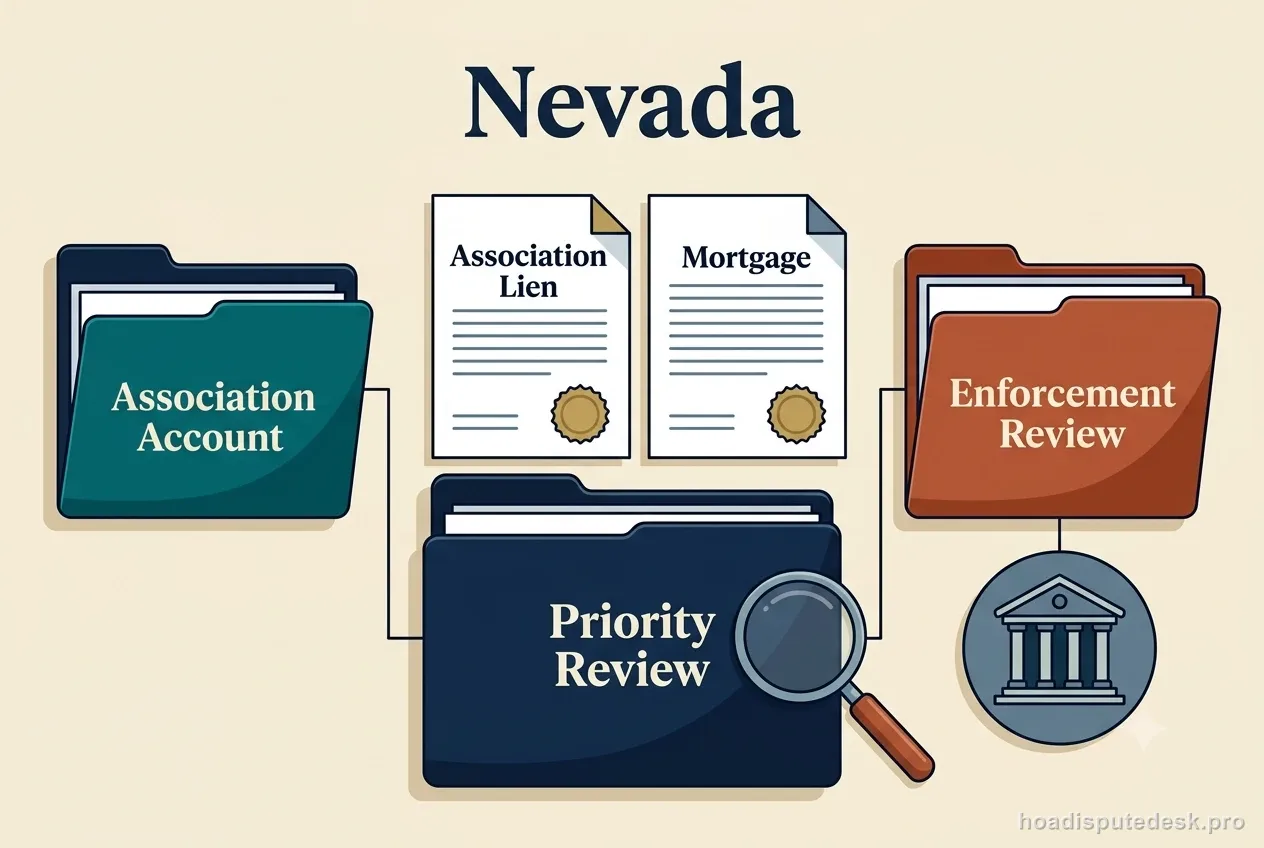
Nevada Chapter 116 supplies a detailed nonjudicial association-lien sale process when its conditions are met. The super-priority portion is limited: current NRS 116.3116 includes specified charges and up to nine months of periodic-budget common-expense assessments, not the entire ledger. Many governing-document claims also have a statutory ADR gate before suit. Obtain the ledger, lien, notices, and ADR record before choosing a response.
Nevada: planned-community law vs. condominium law
Start a Nevada association dispute by identifying the property's legal form and the declaration's recording date. For planned communities, start with Nevada Common-Interest Ownership (Uniform Act), NRS Chapter 116. For condominiums, the same act governs condominiums and planned communities — NRS Chapter 116, subject to statutory exemptions and applicability rules. The label used by a board or manager is not enough by itself; older communities may be affected by legacy statutes or transition provisions, so applicability should be checked before relying on a deadline, remedy, or voting rule.
Do not treat the statute as a substitute for the declaration in Nevada. Pull the declaration and amendments, bylaws, rules, and any resolution tied to the disputed charge or enforcement action. The useful question is whether the association had authority under both mandatory law and its own governing documents, using the versions that were actually in effect when the dispute arose.
Disputing a regular or special assessment in Nevada
Break an assessment challenge into authority and math. The association should be able to point to the budget or board action behind the charge, the declaration provision that spreads common expenses, the date notice went out, and any owner vote that Nevada law or the governing documents made a precondition. Do not assume a special assessment cleared the same threshold as the regular budget; the two frequently carry separate voting requirements.
For a disputed Nevada assessment, build the paper trail before choosing a payment strategy. Ask for the complete ledger, the budget or resolution supporting the charge, and any notice or vote the association relies on. State clearly which part you challenge. That makes it easier to test the association's authority without turning an accounting disagreement into an avoidable delinquency dispute.
Sources: [1]
What Nevada requires before an association fine sticks
Nevada requires notice and an opportunity for a hearing before many violation fines and regulates when fines can support lien remedies. Request the hearing file and the account breakdown.
In Nevada, a useful fine-defense file is a timeline rather than a stack of screenshots. Match the cited covenant to the notice, the notice to any cure period, and the hearing record to the final decision. If unequal treatment is part of the dispute, collect comparable examples that involve the same rule and similar facts; unsupported neighbor comparisons are usually weak evidence.
Nevada record-inspection rules and refusal remedies
Chapter 116 contains detailed records rights, and the Ombudsman provides complaint/intervention resources. A refusal should identify the specific confidentiality or statutory exception.
For records in Nevada, narrow the request to documents that answer the dispute: owner ledger, budget or assessment approval, minutes, governing rule, property-specific enforcement history, supporting invoices, and recorded declaration or amendments. A focused request creates a cleaner record if access is denied. Ask for the basis of any refusal or redaction rather than debating it informally.
When an assessment lien attaches under Nevada law
Nevada’s super-priority lien is real but limited. Under current NRS 116.3116(3), the portion that can outrank an earlier first security interest includes specified maintenance or abatement charges and unpaid periodic-budget common-expense assessments for up to the nine months immediately preceding recordation of the notice of default and election to sell. Fines, late charges, collection costs, and the rest of the ledger should not be casually folded into that priority amount.
A Nevada assessment lien should be audited in layers. First ask whether the debt can become a lien; then whether required notice or recording occurred; then where the lien ranks; finally, whether foreclosure prerequisites are met. Check the recorded document against the ledger, legal description, dates, signatures, and notices. A priority rule does not excuse defects in the enforcement process.
How association foreclosure works in Nevada
Nevada uses a detailed statutory nonjudicial HOA and condominium lien-foreclosure process under Chapter 116, with required notices and collection safeguards before a sale can occur. The association must satisfy the statutory prerequisites for the charges and lien it is enforcing, so owners should audit each notice and amount rather than treat recordation of the lien as an automatic sale right.
Once association foreclosure is threatened in Nevada, preserve the notices and put every deadline on a calendar. Reconcile the debt, identify which charges count toward any foreclosure prerequisite, and check service, board action, payment-plan or cure rights, and the actual court or sale procedure. A generic HOA timeline is not a substitute for the state-specific process.
What to complete before filing in Nevada court
NRS 38.310 bars many civil actions involving governing-document enforcement or assessment procedures unless the dispute is first submitted to the statutory mediation/ADR process and internal remedies are exhausted.
Sources: [1]
Where Nevada HOA and condo disputes are decided
Nevada’s Real Estate Division and Office of the Ombudsman for Common-Interest Communities have an unusually important role in homeowner education, complaints, and statutory dispute processes. Even so, agency procedures do not replace every court remedy, so identify the claim and any required administrative step before filing.
Sources: [1]
Sources
- Nevada Legislature — NRS Chapter 116, Common-Interest Ownership (Uniform Act)Official Nevada statutory chapter; primary source for meetings, reserves, records, insurance, budgets, elections, and enforcement.
- Nevada Legislature — NAC Chapter 116Official administrative regulations, including reserve-study procedures.
- Nevada Real Estate Division — Office of the Ombudsman for CICCH/HOAsOfficial regulator/ombudsman role and association-registration information.
- NRS 38.310 — official LegislatureMandatory mediation/ADR prerequisite for covered claims.