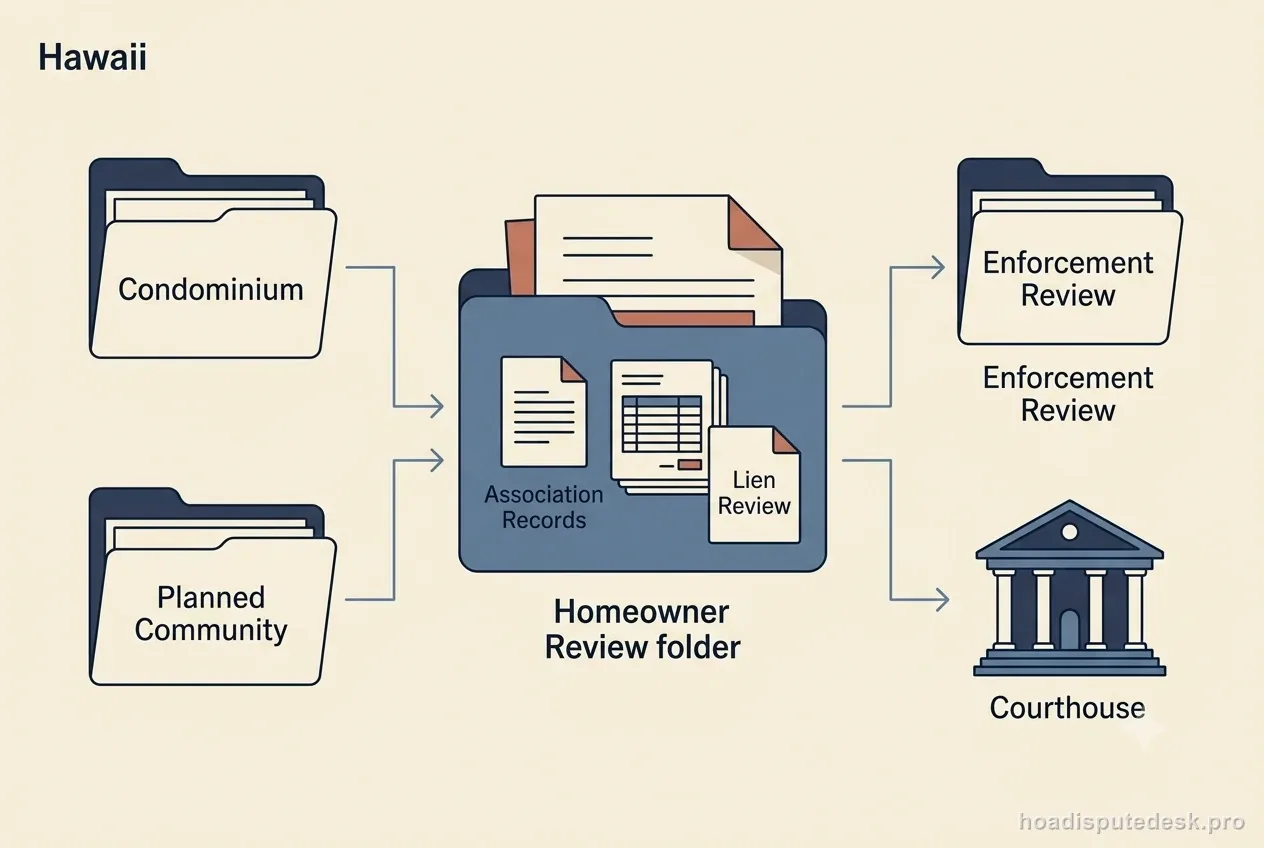
Hawaii separates condominium law in Chapter 514B from planned-community law in Chapter 421J. Both statutes can permit judicial or statutory nonjudicial foreclosure of assessment liens, but a lien arising solely from fines, penalties, legal fees, or late fees cannot use the nonjudicial route. In a condominium nonjudicial foreclosure, § 514B-146.5 gives the owner 30 days to request mediation, which pauses that route while the statutory mediation window runs.
Which Hawaii statute controls your dispute
The first step in a Hawaii dispute is establishing whether the property is a planned community or a condominium, plus the declaration's recording date. For planned communities, start with Planned Community Associations, Haw. Rev. Stat. Ch. 421J. For condominiums, start with Condominiums, Haw. Rev. Stat. Ch. 514B. A label from the board or management company is not conclusive; legacy statutes and transition rules can govern an older community, so verify applicability before relying on any deadline, remedy, or voting rule.
In Hawaii, read the recorded declaration, amendments, bylaws, rules, and properly adopted resolutions alongside the statute. Governing documents can fill procedural gaps, but they do not override mandatory law. Before challenging a fine, assessment, records decision, or lien, confirm the declaration date and keep the exact version of every document the association says it relied on.
How Hawaii owners challenge an assessment vote
Break an assessment challenge into authority and math. The association should be able to point to the budget or board action behind the charge, the declaration provision that spreads common expenses, the date notice went out, and any owner vote that Hawaii law or the governing documents made a precondition. Do not assume a special assessment cleared the same threshold as the regular budget; the two frequently carry separate voting requirements.
Challenging a Hawaii assessment starts with a written objection and a request for the current owner ledger, not a unilateral stop-payment. Pay or set aside the undisputed portion, document the disputed portion, and retain copies of everything. Because the balance can keep drawing collection steps during the dispute, make the association justify both the authority for the charge and the math behind each contested item.
Sources: [1]
Contesting an Hawaii HOA fine and demanding a hearing
Chapter 514B contains detailed condo governance and enforcement rules; Chapter 421J is a different planned-community statute. A homeowner should not copy a condominium remedy into an HOA dispute without checking applicability.
For a Hawaii enforcement dispute, keep a dated sequence: cited covenant or rule, photos or complaint, first notice, opportunity to cure, your reply, the hearing request and notice, what evidence the board weighed, and the outcome. If the concern is selective enforcement, line up truly similar properties across the same timeframe — documentation of dates and board action matters more than an impression about the neighbors.
Records requests and inspection rights in Hawaii
Hawaii condominium owners have statutory record-access rights and DCCA guidance. Planned-community owners should use Chapter 421J and the documents. Ask the association to state the statutory basis for any claimed confidentiality.
A a Hawaii records request works best when it is itemized — account ledger, budget, special-assessment resolution, minutes, the applicable rule, violation history for the unit, the supporting contract or invoice, and the recorded declaration and amendments. Put anything implicating another owner's privacy in its own category, and demand a specific legal basis for every withheld document.
The Hawaii assessment-lien timeline and priority
For a condominium, § 514B-146 creates an automatic assessment lien and permits a recorded notice of lien; a recorded lien generally expires after six years unless enforcement proceedings begin, while the statute preserves the underlying automatic lien subject to its own limitations. Earlier recorded mortgages generally remain senior, but §§ 514B-146(j)-(k) allow a limited special assessment against a mortgagee or other purchaser after foreclosure, capped at six months of regular monthly common assessments. That mechanism is not the same thing as a blanket six-month superpriority lien.
For a planned community, § 421J-10.5 supplies a separate assessment-lien route. In either regime, distinguish assessments from fines, penalties, late fees, and legal fees because the charge mix affects which foreclosure procedure is available. Review the recorded notice, amount, legal description, owner name, and dates rather than assuming every association charge has identical lien status.
Judicial vs. nonjudicial foreclosure for Hawaii HOAs
Hawaii law expressly allows both judicial and statutory nonjudicial foreclosure of qualifying association assessment liens. Condominium associations proceed under § 514B-146 and Chapter 667; planned-community associations have parallel authority under § 421J-10.5. However, when the lien arises solely from fines, penalties, legal fees, or late fees, the association may not use the nonjudicial power-of-sale remedy and must proceed through court.
For a condominium nonjudicial foreclosure, read § 514B-146.5 immediately. The notice must tell the owner about the right to request mediation, and a timely request made within 30 days prevents the association from continuing the nonjudicial process until the statutory mediation process or waiting period is completed. Calendar the notice date, request deadline, sale dates, and any separate Chapter 667 deadlines from the actual papers.
Pre-suit steps Hawaii requires before a lawsuit
Hawaii does not impose one universal ADR gate on every association dispute, but condominium nonjudicial foreclosure has a specific statutory mediation protection. Under § 514B-146.5, an owner who timely requests mediation within 30 days of the notice can stop the association from advancing that nonjudicial foreclosure while the prescribed mediation window runs.
The forums that hear Hawaii association disputes
Hawaii’s DCCA Real Estate Branch provides condominium information and administers selected condominium dispute programs. Its role is not a blanket substitute for court, arbitration, or other claim-specific procedures, so confirm jurisdiction and preserve any independent lien or litigation deadline.
Sources: [1]
Sources
- Hawaii Revised Statutes, Chapter 514B — CondominiumsOfficial Hawaii State Legislature current-statutes chapter page; primary condominium statute.
- Hawaii Revised Statutes, Chapter 421J — Planned Community AssociationsOfficial Hawaii State Legislature chapter page for planned-community HOAs.
- Hawaii DCCA Real Estate Branch — Hawaii Revised StatutesDCCA index linking the official condominium and planned-community statutes and explaining agency jurisdiction.
- Hawaii DCCA — Condominium Governance FAQsState agency guidance on Chapter 514B meeting notice, board procedure, reserves, records, and related governance topics.
- Hawaii Revised Statutes, § 514B-143 — InsuranceOfficial section for condominium property, liability, fidelity, and directors-and-officers insurance requirements.
- Hawaii Revised Statutes § 514B-146 — condominium assessment liensCurrent statutory text for lien priority, six-year enforcement period, judicial/nonjudicial foreclosure, and limits on fines-only nonjudicial foreclosure.
- Hawaii Revised Statutes § 514B-146.5 — condo nonjudicial foreclosure mediationCurrent statutory notice and mediation procedure tied to condominium nonjudicial foreclosure.
- Hawaii Revised Statutes § 421J-10.5 — planned-community assessment liensCurrent planned-community lien and foreclosure authority, including limits on nonjudicial foreclosure of fines-only balances.