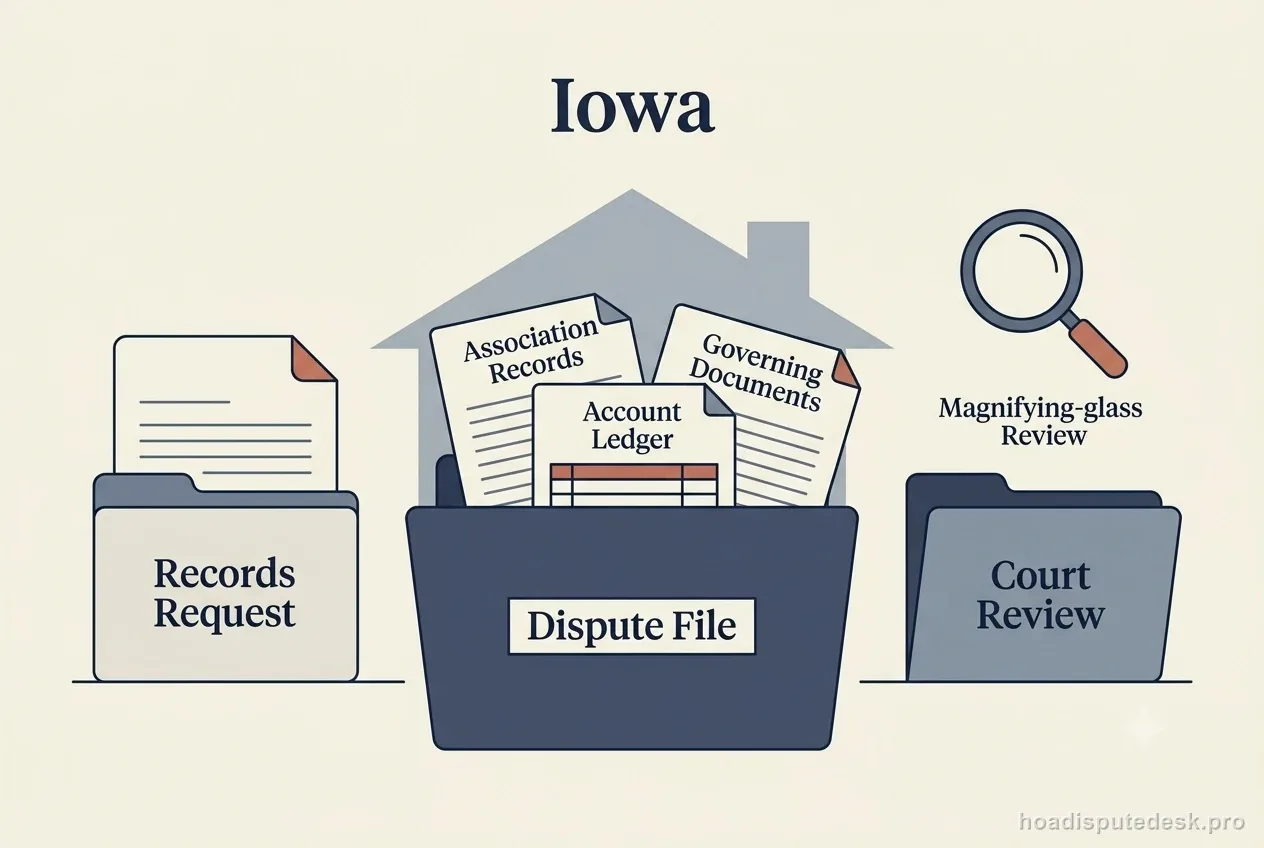
Iowa lacks one comprehensive planned-community HOA act, but § 499C.2 now gives covered unit owners associations a statewide records rule, including access to specified records within 10 business days. Amendments effective July 1, 2026 added assessment-status and transfer-fee information. Condominium collection is more specific: § 499B.17 creates a common-expense lien junior to a prior first mortgage and permits foreclosure by suit like a mortgage.
Which Iowa statute controls your dispute
Start an Iowa association dispute by identifying the property's legal form and the declaration's recording date. Planned communities do not sit under one comprehensive HOA act; Iowa Code ch. 499C now governs records access for covered unit owners associations, and ch. 504 can matter for nonprofit entities. Condominiums use the Horizontal Property Act, Iowa Code ch. 499B. Older communities can raise applicability or transition questions, so confirm the governing regime before relying on a deadline, remedy, or voting rule.
In Iowa, confirm the legal regime before arguing the merits. Obtain the recorded declaration, amendments, bylaws, rules, and any board resolution connected to the dispute, then compare them with the statute applicable to that community type. This prevents a common mistake: applying a condominium rule to a planned community, or a newer statute to a property governed by transition provisions.
How Iowa owners challenge an assessment vote
Treat an assessment dispute as an authority-and-calculation problem. Ask the association to identify the budget or board action that created the charge, the declaration provision that allocates common expenses, the date notice was sent, and the owner vote if the documents or Iowa law required one. A special assessment can have a different approval path from ordinary annual dues, so do not assume the same voting rule applies to both.
When challenging an assessment in Iowa, ask the association to reconcile the account in writing and preserve your objection at the same time. Keep the ledger, notices, proof of payment, and the governing provision the board cites. If only part of the balance is disputed, distinguish that part clearly; a broad payment stoppage can obscure the original issue and create additional collection consequences.
Sources: [1]
Contesting an Iowa HOA fine and demanding a hearing
For ordinary subdivisions, a fine must be grounded in the recorded covenants/bylaws and lawful corporate action. Condominium penalties should be checked against Chapter 499B and the declaration.
The most useful record in an Iowa fine dispute is a dated enforcement file. Include the governing provision, initial notice, evidence, cure communications, hearing request, hearing notice, material considered, and final decision. If the issue is inconsistent enforcement, document comparable cases carefully; visual similarity alone does not establish that the properties were legally or factually alike.
Records requests and inspection rights in Iowa
Iowa records law is no longer well described as mainly a nonprofit-corporation issue. Chapter 499C applies to covered unit owners associations, including planned communities and horizontal-property regimes, and § 499C.2 requires specified association records to be made available within 10 business days of a unit owner’s request.
As of July 1, 2026, SF 2448 expanded the covered information to include, among other items, certification of whether dues, fees, and assessments are paid or delinquent and disclosure of transfer-fee information. Ask for the specific statutory categories you need and preserve the request date, delivery proof, response, and any claimed withholding basis. Save the request, delivery proof, and the association’s written response in the dispute file. Keep a dated copy of every produced record so later amendments are easy to identify.
The Iowa assessment-lien timeline and priority
For condominiums governed by Chapter 499B, § 499B.17 creates a lien for unpaid common expenses. The statute places taxes and assessments and a prior first mortgage ahead of the association lien, so Iowa does not give that condominium lien blanket superpriority over a first mortgage.
Planned-community lien rights outside Chapter 499B still depend heavily on the recorded declaration and other applicable law. Do not turn the Chapter 499C records statute into a lien statute; use it to obtain the documents needed to test the balance and authority.
Judicial vs. nonjudicial foreclosure for Iowa HOAs
Iowa condominium assessment-lien foreclosure is judicial. Section 499B.17 says the lien may be foreclosed by suit by the management body in like manner as a mortgage of real property; the association may also pursue a money judgment without waiving the lien.
For an ordinary planned-community HOA, the foreclosure remedy is more document-driven because Iowa does not provide one comprehensive HOA lien-and-foreclosure act. Trace the recorded covenants, the actual lien instrument, and the statute invoked before assuming the condominium mortgage-style remedy applies.
Pre-suit steps Iowa requires before a lawsuit
Do not assume one statewide mediation or ADR prerequisite applies to every Iowa HOA or condominium dispute. Check the claim-specific statute, governing documents, and court rules for any required pre-suit step.
Sources: [1]
The forums that hear Iowa association disputes
Iowa does not have one statewide HOA merits tribunal that replaces the courts for every association dispute. Depending on the claim, the forum may be a trial court, a small-claims or limited-jurisdiction court for a qualifying money claim, or an arbitration/mediation process created by statute or the governing documents.
Sources: [1]
Sources
- Iowa Code (2026) — official code portalOfficial Iowa Legislature code portal; primary source for current chapters and effective text.
- Iowa Code Chapter 499B — Horizontal PropertyOfficial 2026 Iowa Code chapter listing for condominiums.
- Iowa Code § 499B.15 — Bylaws, board meetings, notice, recordsOfficial Iowa Legislature section source; the Legislature portal may redirect generated PDF links.
- Iowa Code Chapter 499C — Unit Owners Associations: Access to RecordsOfficial 2026 chapter governing records access for unit owners associations, including planned communities and condominiums.
- Iowa Code Chapter 504 — Revised Iowa Nonprofit Corporation ActOfficial 2026 nonprofit-corporation statute, relevant to many incorporated associations.
- Iowa Code § 499C.2 — association records accessCurrent records-access rule for covered unit owners associations, including 10-business-day availability.
- Iowa SF 2448 (2026) — amendments to § 499C.2Signed 2026 legislation effective July 1, 2026 expanding records categories, including assessment-status certification and transfer-fee disclosures.
- Iowa Code § 499B.17 — condominium common-expense lienCondominium assessment lien priority and judicial mortgage-style foreclosure procedure.