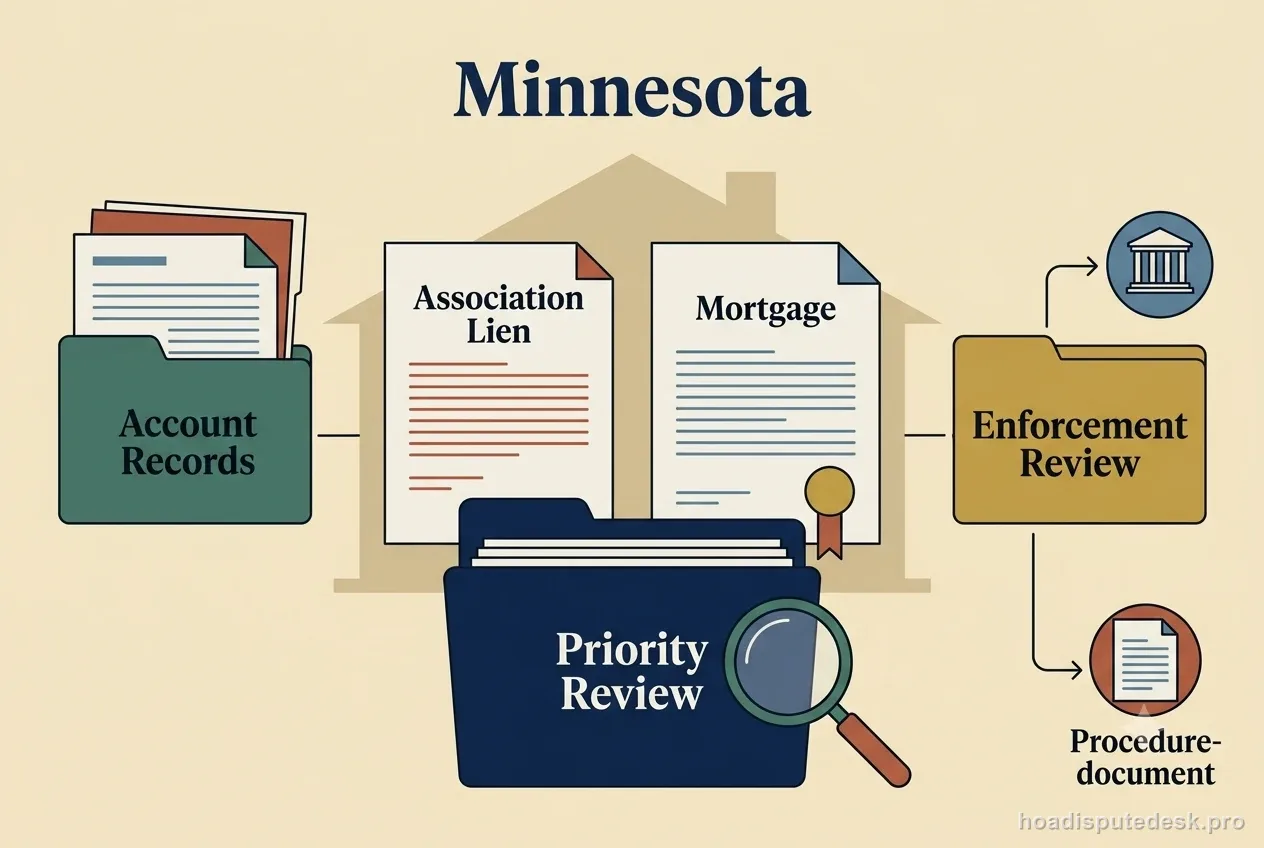
Minnesota’s MCIOA creates an assessment lien and permits both mortgage-style judicial foreclosure and power-of-sale foreclosure. A first mortgage is generally senior, but after a qualifying first-mortgage foreclosure the purchaser can take subject to six months of specified unpaid common-expense assessments. Check the governing documents, ledger, foreclosure notices, and current § 515B.3-116 before treating that six-month protection as a general super-lien.
Minnesota: planned-community law vs. condominium law
Start a Minnesota association dispute by identifying the property's legal form and the declaration's recording date. For planned communities, start with Minnesota Common Interest Ownership Act (MCIOA), Minn. Stat. ch. 515B, for covered common interest communities. For condominiums, start with Minnesota Common Interest Ownership Act, Minn. Stat. ch. 515B; older condominiums may retain Chapter 515 or 515A layers under transition rules. The label a board or manager uses is not decisive on its own; older communities can be affected by legacy statutes or transition provisions, so check applicability before relying on a deadline, remedy, or voting rule.
Do not treat the statute as a substitute for the declaration in Minnesota. Pull the declaration and amendments, bylaws, rules, and any resolution tied to the disputed charge or enforcement action. The useful question is whether the association had authority under both mandatory law and its own governing documents, using the versions that were actually in effect when the dispute arose.
Disputing a regular or special assessment in Minnesota
Break an assessment challenge into authority and math. The association should be able to point to the budget or board action behind the charge, the declaration provision that spreads common expenses, the date notice went out, and any owner vote that Minnesota law or the governing documents made a precondition. Do not assume a special assessment cleared the same threshold as the regular budget; the two frequently carry separate voting requirements.
For a disputed Minnesota assessment, build the paper trail before choosing a payment strategy. Ask for the complete ledger, the budget or resolution supporting the charge, and any notice or vote the association relies on. State clearly which part you challenge. That makes it easier to test the association's authority without turning an accounting disagreement into an avoidable delinquency dispute.
Sources: [1]
What Minnesota requires before an association fine sticks
MCIOA applies an integrated common-interest framework, but legacy communities can involve transition rules. A homeowner should verify which chapter governs before asserting a fine-hearing or lien remedy.
In Minnesota, a useful fine-defense file is a timeline rather than a stack of screenshots. Match the cited covenant to the notice, the notice to any cure period, and the hearing record to the final decision. If unequal treatment is part of the dispute, collect comparable examples that involve the same rule and similar facts; unsupported neighbor comparisons are usually weak evidence.
Minnesota record-inspection rules and refusal remedies
MCIOA contains association-record and disclosure rights. Written requests should identify a statutory category and preserve proof of delivery and any fee demand.
For records in Minnesota, narrow the request to documents that answer the dispute: owner ledger, budget or assessment approval, minutes, governing rule, property-specific enforcement history, supporting invoices, and recorded declaration or amendments. A focused request creates a cleaner record if access is denied. Ask for the basis of any refusal or redaction rather than debating it informally.
When an assessment lien attaches under Minnesota law
MCIOA does not give the association a blanket six-month lien that simply jumps ahead of a first mortgage. Section 515B.3-116(b) generally leaves a first mortgage senior, while subsection (c) provides that after a qualifying first-mortgage foreclosure the purchaser takes title subject to six months of specified unpaid common-expense assessments. That survival rule is narrower than calling the entire association balance a super-priority lien.
A Minnesota assessment lien should be audited in layers. First ask whether the debt can become a lien; then whether required notice or recording occurred; then where the lien ranks; finally, whether foreclosure prerequisites are met. Check the recorded document against the ledger, legal description, dates, signatures, and notices. A priority rule does not excuse defects in the enforcement process.
How association foreclosure works in Minnesota
Minnesota's MCIOA framework allows both mortgage-style judicial foreclosure and power-of-sale foreclosure under Minnesota foreclosure law. Which route applies depends on the declaration, the lien, and the procedure the association actually invokes, so an owner should review the notices and statutory prerequisites for that route rather than assume every assessment lien follows the same sale process.
Once association foreclosure is threatened in Minnesota, preserve the notices and put every deadline on a calendar. Reconcile the debt, identify which charges count toward any foreclosure prerequisite, and check service, board action, payment-plan or cure rights, and the actual court or sale procedure. A generic HOA timeline is not a substitute for the state-specific process.
What to complete before filing in Minnesota court
Minnesota does not impose one blanket mediation-or-ADR requirement across association disputes. A pre-suit obligation, where it exists, comes from the statute for the particular claim, the declaration and bylaws, or a court's procedural rules, so read those rather than assuming.
Sources: [1]
Where Minnesota HOA and condo disputes are decided
Minnesota routes association disputes through the regular court system rather than a dedicated HOA tribunal. The right forum turns on the claim — general trial court, small-claims or limited-jurisdiction court for a money claim under the threshold, or a statute- or document-created arbitration or mediation process.
Sources: [1]
Sources
- Minnesota Common Interest Ownership Act, Chapter 515BOfficial Revisor full chapter; primary source for applicability, open boards, records, budgets, liens, and enforcement.
- Minn. Stat. § 515B.3-1141 — Replacement reservesOfficial reserve-funding and three-year reevaluation provision.
- Minn. Stat. § 515B.3-108 — MeetingsOfficial annual/special owner-meeting notice windows.
- Minn. Stat. § 515B.3-109 — QuorumsOfficial default owner and board quorum rules.
- Minn. Stat. § 515B.2-118 — Amendment of declarationOfficial 67% ordinary declaration-amendment rule and exceptions.
- Minnesota Laws 2026, Chapter 61Official 2026 session law affecting multiple MCIOA sections; confirm effective dates together with Chapter 82.