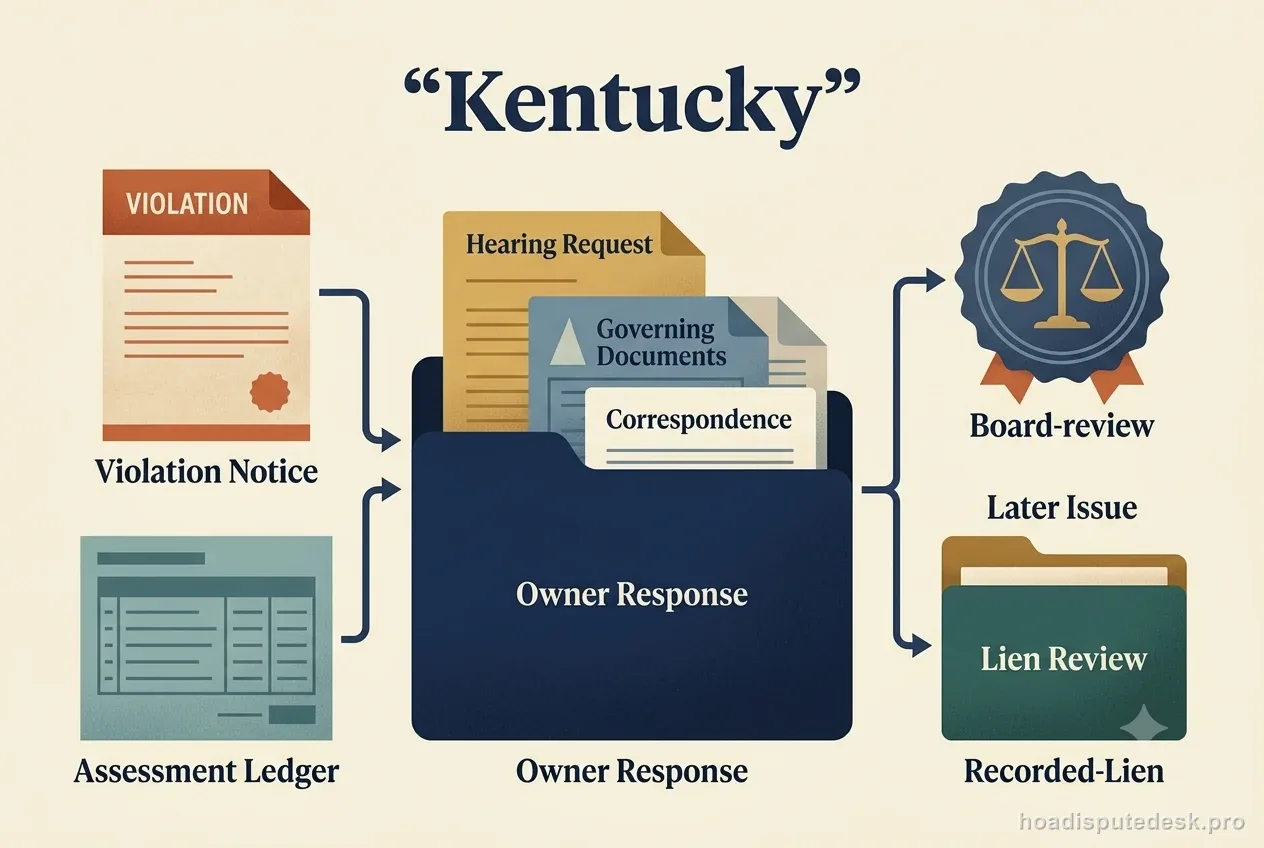
Kentucky has a Planned Community Act in addition to condominium law. KRS 381.797 requires written notice and an opportunity to be heard before planned-community fines, damages, or an individual assessment; a board-approved special assessment also triggers an owner meeting where owners can vote to reduce or rescind it. KRS 381.799 creates a recorded lien for covered delinquent charges, while earlier recorded mortgages remain senior. Condominium liens use a different mortgage-style foreclosure rule.
Kentucky: planned-community law vs. condominium law
Start a Kentucky association dispute by identifying the property's legal form and the declaration's recording date. For planned communities, start with Kentucky Planned Community Act, KRS 381.785–381.801. For condominiums, start with Kentucky Condominium Act, KRS 381.9101–381.9207. The label a board or manager uses is not decisive on its own; older communities can be affected by legacy statutes or transition provisions, so check applicability before relying on a deadline, remedy, or voting rule.
When you work through a Kentucky case, put the recorded declaration and the statute side by side. Ask for every amendment, the bylaws, the rules, and the board resolutions instead of a summary. Older communities in particular can turn on transition provisions, so preserve the records that establish the formation date and the regime the association says applies.
Disputing a regular or special assessment in Kentucky
Kentucky’s 2023 Planned Community Act gives owners a concrete special-assessment checkpoint. After declarant control, a majority of the full board must approve a special assessment; within 30 days after board passage the association must hold an owner meeting at which a majority of all lots voting in person or by proxy can rescind or reduce it. That is separate from the annual-budget procedure and from the condominium statute.
Preserve an assessment challenge in writing in Kentucky and ask for a ledger that shows charges, credits, interest, late fees, and collection costs separately. Withholding every payment can create a second dispute over delinquency, so document what you are contesting and why. If you make a payment while the dispute is open, keep proof and avoid assuming that a particular 'under protest' label has the same legal effect in every claim.
What Kentucky requires before an association fine sticks
For a planned community, KRS 381.797 requires written notice and an opportunity to be heard before the board imposes a charge for fines, damages, or an individual assessment. That is a real statutory process right and should replace the older generic statement that subdivision enforcement is mostly document-driven. Condominium sanctions still must be checked under the Condominium Act and declaration.
For a fine or covenant dispute in Kentucky, preserve the chronology. Keep the cited rule, the alleged violation evidence, notice, any cure deadline, hearing materials, your response, and the final decision. A selective-enforcement argument is fact intensive, so document materially similar examples with dates and records instead of relying on general neighborhood impressions.
Sources: [8]
Kentucky record-inspection rules and refusal remedies
Planned-community owners can examine and copy association books, records, and minutes under KRS 381.795, subject to reasonable standards and listed exclusions such as personnel, privileged legal material, negotiations, certain collection information, and legally protected information. Condominium owners use the separate Condominium Act, including its assessment-statement rights.
A useful Kentucky records request names records and time periods instead of asking for 'everything.' Request the ledger, budget materials, minutes tied to the disputed action, applicable rules, invoices or contracts supporting pass-through charges, and the current declaration and amendments. If the association refuses or redacts material, ask it to state the reason by category and preserve that response.
When an assessment lien attaches under Kentucky law
Kentucky now has separate statutory lien paths. For planned communities, KRS 381.799 creates a continuing lien for covered assessments and charges that remain unpaid 30 days, but the recorded lien is subordinate to taxes/government charges and any mortgage or other encumbrance recorded earlier. For condominiums, KRS 381.9193 creates a different lien that may be foreclosed like a mortgage and likewise does not create a blanket superpriority over an earlier mortgage.
For a Kentucky lien dispute, distinguish attachment, perfection, priority, and foreclosure authority. Those are different legal questions. Compare the ledger with the recorded lien and any pre-lien notice, and check the owner name, property description, covered charge period, stated amount, execution, and recording date before debating who has priority over whom.
How association foreclosure works in Kentucky
Kentucky condominium assessment liens use judicial, mortgage-style foreclosure under the condominium statute, while non-condominium HOA remedies are more dependent on the recorded declaration and other applicable law. The owner should first identify the community type, then match the lien and enforcement steps to the statute and governing documents rather than assuming one statewide HOA foreclosure route.
A Kentucky foreclosure notice should trigger a document audit, not a guess about the timeline. Get the current ledger and every pre-lien and foreclosure notice, then check service, addresses, board authority, charge categories, and any cure or reinstatement option. Court and sale deadlines can be unforgiving, so use the statute and filed papers rather than a national foreclosure checklist.
What to complete before filing in Kentucky court
Kentucky does not impose one blanket mediation-or-ADR requirement across association disputes. A pre-suit obligation, where it exists, comes from the statute for the particular claim, the declaration and bylaws, or a court's procedural rules, so read those rather than assuming.
Sources: [1]
Where Kentucky HOA and condo disputes are decided
Kentucky routes association disputes through the regular court system rather than a dedicated HOA tribunal. The right forum turns on the claim — general trial court, small-claims or limited-jurisdiction court for a money claim under the threshold, or a statute- or document-created arbitration or mediation process.
Sources: [1]
Sources
- Kentucky Revised Statutes, Chapter 381 — Planned Communities and Kentucky Condominium ActOfficial KRS Chapter 381 portal including 2026 Regular Session enactments.
- KRS 381.786 — applicability of Planned Community ActOfficial applicability and June 29, 2023 transition rule.
- KRS 381.792 — owner meetings, notice, quorum, proxyOfficial planned-community meeting procedure.
- KRS 381.793 — open board meetings and board quorumOfficial planned-community board meeting rule.
- KRS 381.794 — financial records and annual financial reportOfficial financial reporting tiers; database checked after the 2026 Regular Session.
- KRS 381.9101 — Kentucky Condominium Act short titleOfficial short-title/effective-date section; use the Chapter 381 index for the Act’s management provisions.
- KRS 381.799 — planned-community continuing lienPlanned-community lien after charges remain unpaid 30 days; priority is recording-based and subordinate to earlier recorded mortgages and other encumbrances.
- KRS 381.797 — planned-community assessments, fines, and special assessmentsWritten notice/opportunity to be heard before fines/damages/individual assessments and owner review procedure for special assessments.
- KRS 381.795 — planned-community recordsOwner examination/copy rights and statutory exclusions for planned-community records.