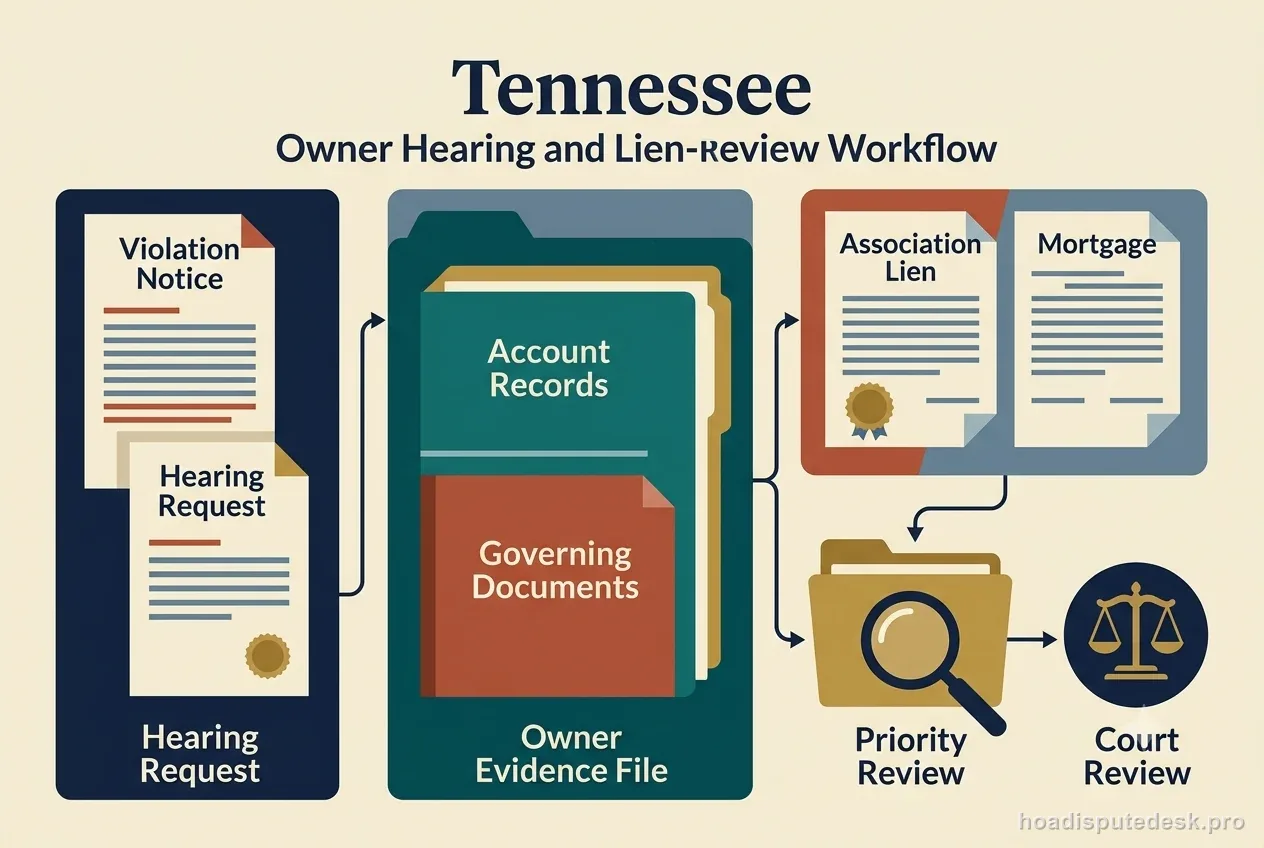
Tennessee separates document-driven subdivision HOAs from condominiums under the 2008 Condominium Act. A condominium lien may be foreclosed judicially or, if the declaration authorizes it, through a deed-of-trust-style power of sale. At foreclosure, qualifying common-expense assessments receive a proceeds priority of up to six months, capped at 1% of the first mortgage’s maximum principal; the association’s foreclosure does not extinguish that prior mortgage.
Identifying the governing law in Tennessee
Start a Tennessee association dispute by identifying the property's legal form and the declaration's recording date. Tennessee does not have one comprehensive HOA act covering every subdivision, so recorded covenants and entity law remain central for many planned communities. Condominiums use the Tennessee Condominium Act of 2008, Tenn. Code Ann. §§ 66-27-201 et seq. Older communities can raise applicability questions, so confirm the governing regime before relying on a deadline, remedy, or voting rule.
In a Tennessee matter, read the recorded declaration next to the current statute rather than trusting a portal summary or a management-company label. Request the amendments, bylaws, rules, and board resolutions. Transition and applicability provisions can decide the outcome in an older community, so keep whatever shows when the community was formed and which regime it now claims.
Assessment and special-assessment challenges under Tennessee law
Read an assessment dispute as two questions: did the association have authority to levy the charge, and is the calculation correct. Ask which budget line or board vote created it, which declaration clause allocates common expenses among units, when owners were notified, and — where Tennessee law or the governing documents required an owner vote — whether that vote actually took place. Ordinary annual dues and a special assessment often follow different approval paths, so confirm which one governs the charge in front of you.
Preserve an assessment challenge in writing in Tennessee and ask for a ledger that shows charges, credits, interest, late fees, and collection costs separately. Withholding every payment can create a second dispute over delinquency, so document what you are contesting and why. If you make a payment while the dispute is open, keep proof and avoid assuming that a particular 'under protest' label has the same legal effect in every claim.
Sources: [1]
Fine notices and hearing rights in Tennessee
For subdivisions, fine authority comes primarily from the documents. For condos, the 2008 Act integrates association powers, but owners should separate fines from common-expense assessments before analyzing the lien.
For a fine or covenant dispute in Tennessee, preserve the chronology. Keep the cited rule, the alleged violation evidence, notice, any cure deadline, hearing materials, your response, and the final decision. A selective-enforcement argument is fact intensive, so document materially similar examples with dates and records instead of relying on general neighborhood impressions.
How to get board records from an Tennessee association
Condominium owners should use the 2008 Act and the governing documents; ordinary HOA owners may need nonprofit/corporate records law as well.
A useful Tennessee records request names records and time periods instead of asking for 'everything.' Request the ledger, budget materials, minutes tied to the disputed action, applicable rules, invoices or contracts supporting pass-through charges, and the current declaration and amendments. If the association refuses or redacts material, ask it to state the reason by category and preserve that response.
How Tennessee associations perfect an assessment lien
Tenn. Code Ann. § 66-27-415 lets a condominium lien be foreclosed judicially and permits a deed-of-trust-style power of sale when the declaration authorizes it, with statutory notice to owners and lienholders. At foreclosure, qualifying common-expense assessments receive a priority in sale proceeds for up to six months, capped at 1% of the maximum principal indebtedness secured by the first mortgage or deed of trust. An association foreclosure remains subject to prior mortgages and does not extinguish them.
For a Tennessee lien dispute, distinguish attachment, perfection, priority, and foreclosure authority. Those are different legal questions. Compare the ledger with the recorded lien and any pre-lien notice, and check the owner name, property description, covered charge period, stated amount, execution, and recording date before debating who has priority over whom.
The Tennessee HOA foreclosure route, step by step
Tennessee condominium liens may be foreclosed judicially or, when the declaration authorizes it, through a deed-of-trust-style power of sale. The association's foreclosure remains subject to prior mortgages, and the proceeds priority for qualifying common-expense assessments is limited rather than a blanket super-lien. Subdivision-HOA remedies outside the condominium statute remain more dependent on the recorded governing documents and other applicable law.
A Tennessee foreclosure notice should trigger a document audit, not a guess about the timeline. Get the current ledger and every pre-lien and foreclosure notice, then check service, addresses, board authority, charge categories, and any cure or reinstatement option. Court and sale deadlines can be unforgiving, so use the statute and filed papers rather than a national foreclosure checklist.
Mandatory ADR and notice before suing in Tennessee
There is no single Tennessee rule that pushes every HOA or condominium dispute through mediation or arbitration before filing. Whether a pre-suit step is mandatory depends on the specific claim, what the governing documents say, and the court's own rules — check all three.
Sources: [1]
Tennessee: courts, agencies, and ADR panels for these cases
Tennessee routes association disputes through the regular court system rather than a dedicated HOA tribunal. The right forum turns on the claim — general trial court, small-claims or limited-jurisdiction court for a money claim under the threshold, or a statute- or document-created arbitration or mediation process.
Sources: [1]
Sources
- Tennessee Condominium Act of 2008 — Public Chapter 766 (official)Official enactment containing the Tenn. Code § 66-27-415 lien/foreclosure framework; current codified text controls.
- Tennessee General Assembly — legislation portalOfficial session-law and bill source for amendments.
- Tennessee Courts — self-help / court informationCourt forum information.
- Tennessee General Assembly HB 2401 / Public Chapter 866 (2016) — condominium lien amendmentsOfficial bill history and enacted-summary page describing the six-month / 1% proceeds-priority rule and prior-mortgage protection added to § 66-27-415.