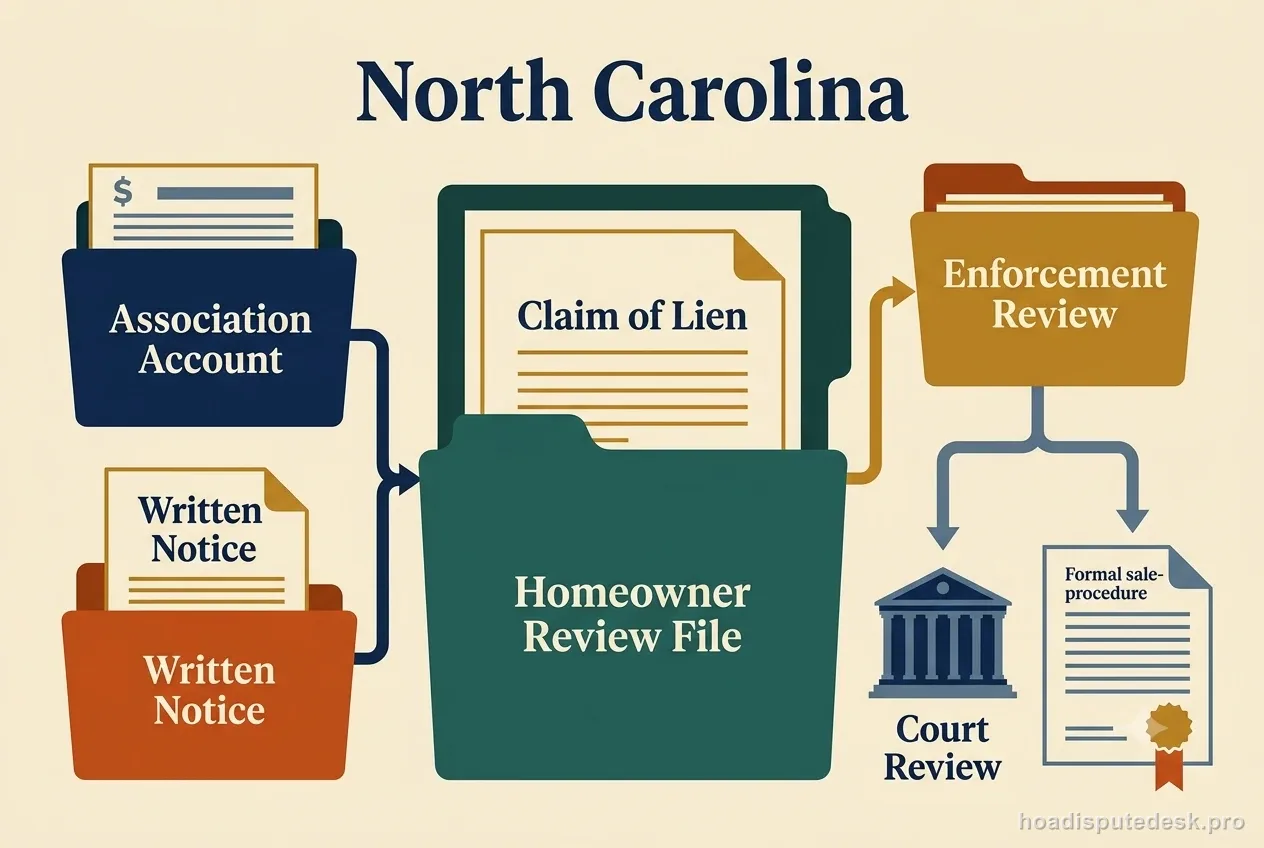
North Carolina gives both planned-community and condominium associations a detailed lien process. An assessment unpaid 30 days can support a recorded claim of lien after at least 15 days' advance statement notice. If the assessment remains unpaid 90 days, the board may vote to start clerk-supervised power-of-sale foreclosure. A lien consisting solely of fines and related fine-collection charges cannot use that nonjudicial route and must be foreclosed judicially.
Identifying the governing law in North Carolina
Start a North Carolina association dispute by identifying the property's legal form and the declaration's recording date. For planned communities, start with North Carolina Planned Community Act, N.C. Gen. Stat. Ch. 47F. For condominiums, start with North Carolina Condominium Act, N.C. Gen. Stat. Ch. 47C. The label a board or manager uses is not decisive on its own; older communities can be affected by legacy statutes or transition provisions, so check applicability before relying on a deadline, remedy, or voting rule.
Do not treat the statute as a substitute for the declaration in North Carolina. Pull the declaration and amendments, bylaws, rules, and any resolution tied to the disputed charge or enforcement action. The useful question is whether the association had authority under both mandatory law and its own governing documents, using the versions that were actually in effect when the dispute arose.
Assessment and special-assessment challenges under North Carolina law
Read an assessment dispute as two questions: did the association have authority to levy the charge, and is the calculation correct. Ask which budget line or board vote created it, which declaration clause allocates common expenses among units, when owners were notified, and — where North Carolina law or the governing documents required an owner vote — whether that vote actually took place. Ordinary annual dues and a special assessment often follow different approval paths, so confirm which one governs the charge in front of you.
For a disputed North Carolina assessment, build the paper trail before choosing a payment strategy. Ask for the complete ledger, the budget or resolution supporting the charge, and any notice or vote the association relies on. State clearly which part you challenge. That makes it easier to test the association's authority without turning an accounting disagreement into an avoidable delinquency dispute.
Fine notices and hearing rights in North Carolina
Unless the declaration supplies a specific lawful procedure, §§ 47F-3-107.1 and 47C-3-107.1 require a hearing before the board or a qualifying adjudicatory panel before a fine or suspension is imposed. The owner must receive notice of the charge, an opportunity to be heard and present evidence, and notice of the decision. A fine may not exceed $100 for the violation and may continue at up to $100 per day after five days if the violation persists without another hearing.
If an adjudicatory panel rather than the full board decides the case, the owner may appeal to the executive board by written notice within 15 days after the decision. Preserve the original violation notice, evidence, hearing materials, decision, and appeal date. Also remember that a lien made up solely of fines and the related fine-only collection charges cannot be pushed through North Carolina's nonjudicial association foreclosure route.
How to get board records from an North Carolina association
Sections 47F-3-118 and 47C-3-118 require financial and other association records, including meeting records, to be made reasonably available for owner examination under the bylaws and applicable nonprofit-corporation rules. The association must also make an annual income-and-expense statement and balance sheet available without charge within 75 days after the fiscal year closes.
For condominiums, § 47C-3-118 also requires a written statement of unpaid assessments and other charges within 10 business days after a request, subject to statutory fee limits. A practical request should identify the ledger, budget, minutes tied to the disputed action, rules, contracts or invoices supporting charges, and the current declaration and amendments.
Sources: [5]
How North Carolina associations perfect an assessment lien
Under §§ 47F-3-116 and 47C-3-116, an assessment unpaid for 30 days or more becomes a lien when the association files a claim of lien with the clerk of superior court. At least 15 days before filing, the association must mail a statement of the assessment amount due to the addresses specified by statute. The filed lien secures sums already due and later sums, and it generally expires unless enforcement proceedings begin within three years after filing.
Priority is not a super-lien: the association claim is behind liens and encumbrances recorded before it, including a prior mortgage or deed of trust, and behind real-estate tax and governmental assessment liens. Check the filed claim, service certificate, ledger, owner name, property description, and mailing record before analyzing foreclosure.
The North Carolina HOA foreclosure route, step by step
If the assessment remains unpaid for 90 days or more, the executive board may vote to foreclose the recorded claim of lien through the nonjudicial power-of-sale procedure, with a trustee and a clerk-of-superior-court hearing under Chapter 45. The board must vote to commence the proceeding against the specific lot or unit; the statute does not make foreclosure automatic merely because a lien exists.
There are important carve-outs. A claim of lien securing only fines, interest on unpaid fines, or attorneys' fees solely associated with fines may be enforced only by judicial foreclosure. Judicial foreclosure and other civil collection remedies also remain available generally. In an uncontested nonjudicial case, the statute caps the combined attorneys' fees and trustee commission at $1,200, excluding costs and expenses.
Mandatory ADR and notice before suing in North Carolina
There is no single North Carolina rule that pushes every HOA or condominium dispute through mediation or arbitration before filing. Whether a pre-suit step is mandatory depends on the specific claim, what the governing documents say, and the court's own rules — check all three.
North Carolina: courts, agencies, and ADR panels for these cases
There is no single North Carolina agency or tribunal that decides the merits of association disputes in place of the courts. Where a claim lands depends on what it is: a trial court for most disputes, small-claims or a limited-jurisdiction court for a qualifying money amount, or an arbitration or mediation track created by statute or the governing documents.
Sources
- N.C. Gen. Stat. § 47F-3-116 — official General AssemblyPlanned-community lien, notice, priority, 90-day foreclosure trigger, fine-only carve-out, and fee cap.
- N.C. Gen. Stat. § 47C-3-116 — official General AssemblyParallel condominium lien and foreclosure procedure.
- N.C. Gen. Stat. § 47F-3-107.1 — official General AssemblyPlanned-community fine hearing, $100 cap, continuing fine, and 15-day panel appeal.
- N.C. Gen. Stat. § 47C-3-107.1 — official General AssemblyCondominium fine hearing procedure.
- N.C. Gen. Stat. § 47F-3-118 / § 47C-3-118 — official records provisionsAssociation records and annual financial statement requirements; condo statute has parallel rule.