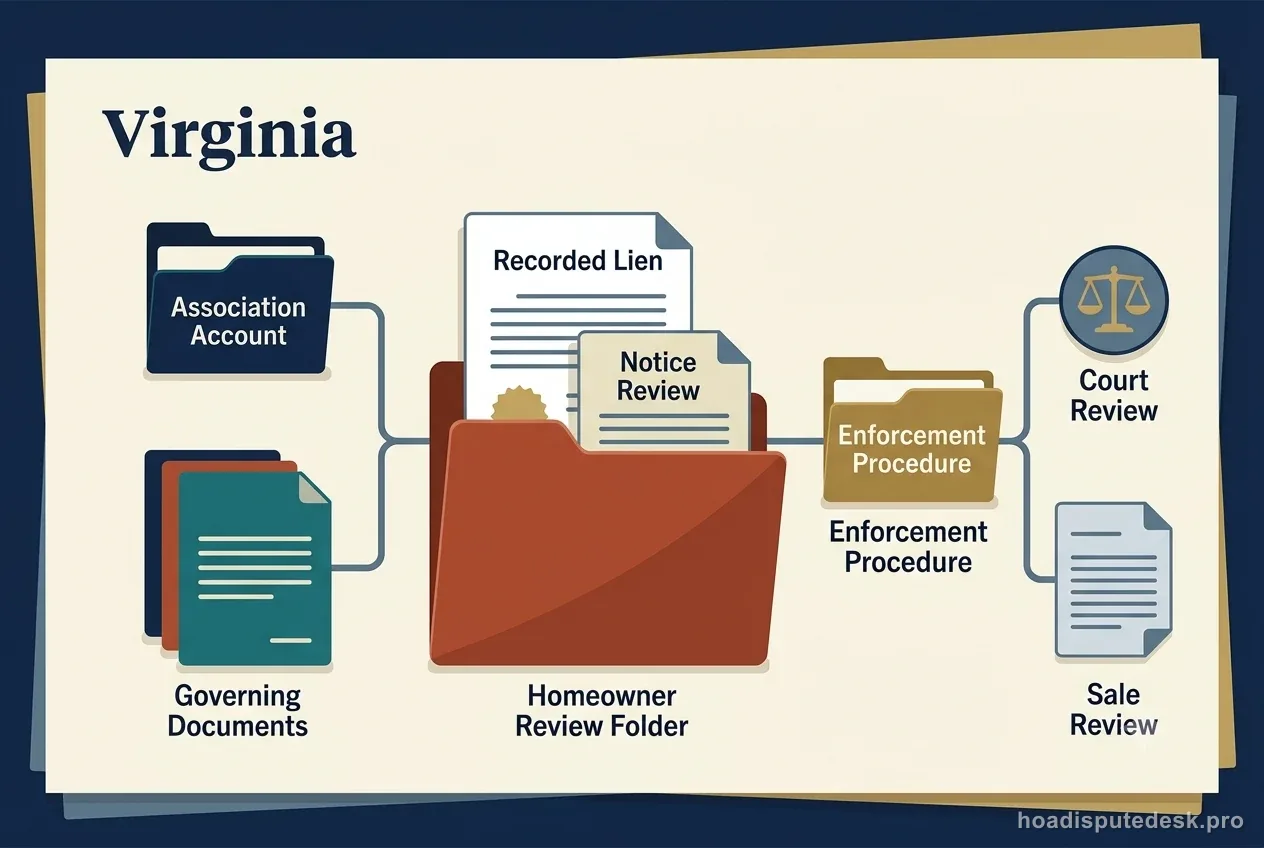
Virginia HOA and condominium disputes turn on the governing declaration plus the Property Owners' Association Act or Condominium Act. Assessment liens can be enforced judicially or nonjudicially, but current law places notice and debt-threshold limits on foreclosure and preserves priority for earlier recorded first mortgages or deeds of trust. Request the ledger, lien record, notices, board materials, and governing documents before evaluating any threatened sale.
Virginia: planned-community law vs. condominium law
Before anything else in a Virginia dispute, pin down the property's legal form and when the declaration was recorded. For planned communities, start with Virginia Property Owners' Association Act, Va. Code §§ 55.1-1800 et seq. For condominiums, start with Virginia Condominium Act, Va. Code §§ 55.1-1900 et seq. Do not take the board's or manager's label at face value — an older community may sit under a legacy statute or a transition provision, so confirm what actually applies before you count on a deadline, remedy, or voting rule.
In Virginia, read the recorded declaration, amendments, bylaws, rules, and properly adopted resolutions alongside the statute. Governing documents can fill procedural gaps, but they do not override mandatory law. Before challenging a fine, assessment, records decision, or lien, confirm the declaration date and keep the exact version of every document the association says it relied on.
Disputing a regular or special assessment in Virginia
Break an assessment challenge into authority and math. The association should be able to point to the budget or board action behind the charge, the declaration provision that spreads common expenses, the date notice went out, and any owner vote that Virginia law or the governing documents made a precondition. Do not assume a special assessment cleared the same threshold as the regular budget; the two frequently carry separate voting requirements.
Challenging a Virginia assessment starts with a written objection and a request for the current owner ledger, not a unilateral stop-payment. Pay or set aside the undisputed portion, document the disputed portion, and retain copies of everything. Because the balance can keep drawing collection steps during the dispute, make the association justify both the authority for the charge and the math behind each contested item.
Sources: [1]
What Virginia requires before an association fine sticks
Virginia common-interest statutes require due process for many charges and provide owner complaint procedures. A homeowner should use the association’s internal complaint process before escalating where required.
For a Virginia enforcement dispute, keep a dated sequence: cited covenant or rule, photos or complaint, first notice, opportunity to cure, your reply, the hearing request and notice, what evidence the board weighed, and the outcome. If the concern is selective enforcement, line up truly similar properties across the same timeframe — documentation of dates and board action matters more than an impression about the neighbors.
Virginia record-inspection rules and refusal remedies
Both acts provide owner records rights, and the CIC Ombudsman administers the statutory association complaint process. A denial should identify a statutory exclusion.
A a Virginia records request works best when it is itemized — account ledger, budget, special-assessment resolution, minutes, the applicable rule, violation history for the unit, the supporting contract or invoice, and the recorded declaration and amendments. Put anything implicating another owner's privacy in its own category, and demand a specific legal basis for every withheld document.
When an assessment lien attaches under Virginia law
Virginia's current HOA and condominium statutes allow judicial or nonjudicial foreclosure only when the total perfected-lien debt exceeds $5,000, excluding attorney fees and costs. Sections 55.1-1833 and 55.1-1966 also require substantial advance notice before the nonjudicial route can proceed, and earlier recorded first mortgages or deeds of trust retain priority under the statutory lien rules. Keep assessment principal, fines, interest, collection charges, attorney fees, and costs separated when testing the threshold and lien balance.
A Virginia lien analysis has four parts that should not be collapsed: the moment the lien arises, the recording or notice conditions, its priority against competing liens, and the enforcement steps. Read the recorded claim itself for owner name, legal description, period covered, amount, signature, filing date, and notice compliance — and remember that priority is not the same as a right to foreclose.
How association foreclosure works in Virginia
Virginia permits both judicial and statutory nonjudicial foreclosure of association liens, subject to the notice, debt-threshold, and trustee requirements in the Property Owners' Association Act and Condominium Act. Current law limits a foreclosure sale to liens exceeding the statutory secured-debt threshold, excluding attorney fees and costs, and the nonjudicial route requires advance cure notice. Earlier recorded first mortgages or deeds of trust retain their statutory priority.
When a Virginia foreclosure notice arrives, calendar all of its dates the same day and request a fresh ledger. Scrutinize the charge categories cited, the notices and mailing addresses used, the board's authorization, and any remaining cure, payment-plan, reinstatement, or redemption option. The governing statute, court rule, or declaration — not an internet summary — controls the order of events.
What to complete before filing in Virginia court
Virginia’s required association complaint procedure is different from mediation. The Ombudsman can review final adverse decisions within its authority, while lien injunctions and title issues remain court matters.
Sources: [1]
Where Virginia HOA and condo disputes are decided
Virginia’s Common Interest Community Board and Office of the Common Interest Community Ombudsman provide a formal complaint framework and regulatory oversight within their statutory roles. They do not replace the courts for every lien, title, injunction, or foreclosure issue, so preserve independent legal deadlines while using the complaint process.
Sources: [1]
Sources
- Va. Code § 55.1-1833 — official Code of VirginiaProperty Owners Association lien and judicial/nonjudicial foreclosure.
- Va. Code § 55.1-1966 — official Code of VirginiaCondominium lien and foreclosure.
- Virginia CIC OmbudsmanAssociation complaint procedure and consumer information.