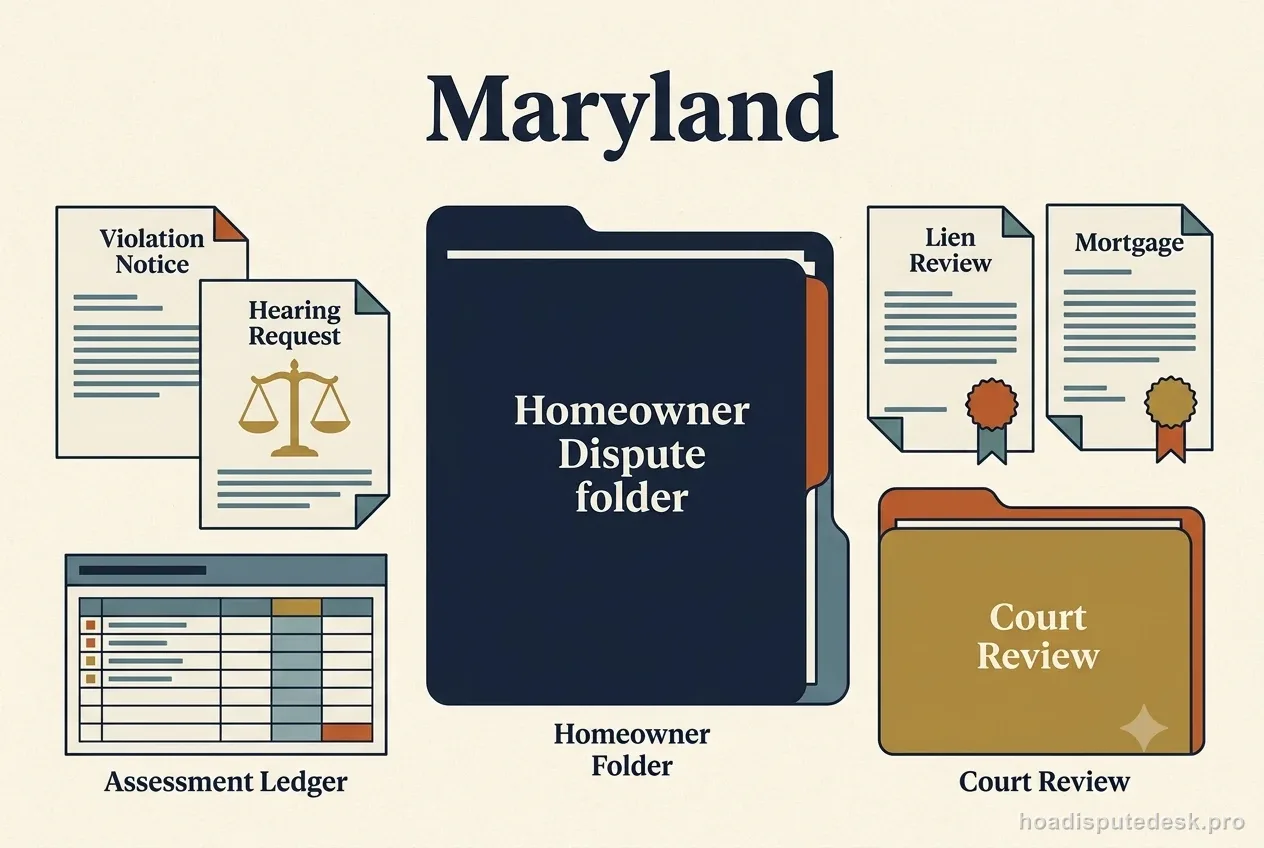
Maryland HOA liens use the Contract Lien Act, and § 11B-117 gives a limited priority slice of up to four months of regular common-expense assessments, capped at $1,200, over certain first mortgages. Section 14-204 bars common-ownership foreclosure when the lien debt includes fines or fine-collection costs. Fine enforcement also has cure-and-hearing protections, while requested HOA financial statements or minutes have statutory delivery periods that depend on the age of the records.
Identifying the governing law in Maryland
Before anything else in a Maryland dispute, pin down the property's legal form and when the declaration was recorded. For planned communities, start with Maryland Homeowners Association Act, Md. Code, Real Property Title 11B. For condominiums, start with Maryland Condominium Act, Md. Code, Real Property Title 11. Do not take the board's or manager's label at face value — an older community may sit under a legacy statute or a transition provision, so confirm what actually applies before you count on a deadline, remedy, or voting rule.
In Maryland, confirm the legal regime before arguing the merits. Obtain the recorded declaration, amendments, bylaws, rules, and any board resolution connected to the dispute, then compare them with the statute applicable to that community type. This prevents a common mistake: applying a condominium rule to a planned community, or a newer statute to a property governed by transition provisions.
Assessment and special-assessment challenges under Maryland law
Read an assessment dispute as two questions: did the association have authority to levy the charge, and is the calculation correct. Ask which budget line or board vote created it, which declaration clause allocates common expenses among units, when owners were notified, and — where Maryland law or the governing documents required an owner vote — whether that vote actually took place. Ordinary annual dues and a special assessment often follow different approval paths, so confirm which one governs the charge in front of you.
When challenging an assessment in Maryland, ask the association to reconcile the account in writing and preserve your objection at the same time. Keep the ledger, notices, proof of payment, and the governing provision the board cites. If only part of the balance is disputed, distinguish that part clearly; a broad payment stoppage can obscure the original issue and create additional collection consequences.
Sources: [1]
Fine notices and hearing rights in Maryland
Maryland has a detailed dispute-settlement procedure for sanctions. For HOAs, §11B-111.10 generally requires a written cease-and-desist demand, at least a 15-day cure period for a continuing violation, and then a written opportunity to request a hearing if the violation continues or recurs. If requested, the hearing must provide a reasonable opportunity to present evidence and cross-examine witnesses. Condominiums have a parallel mechanism in §11-113.
This process matters twice: first when deciding whether the fine itself was lawfully imposed, and again at collection. Under the Contract Lien Act foreclosure rule, fines and attorney fees or costs tied to recovering fines cannot be part of the damages used to foreclose a common-ownership lien.
How to get board records from an Maryland association
For an HOA, §11B-112 makes association books and records available for examination/copying after reasonable notice and gives specific delivery deadlines for written requests for financial statements or governing-body minutes: 21 days if prepared within the prior three years, 45 days if older. Condominiums use the separate Title 11 records provisions, so the two regimes should not be merged.
Treat a Maryland records request as an evidence request, not a fishing expedition. Ask for the ledger, approval records, relevant minutes, rules, invoices, contracts, and recorded governing documents that bear on the issue. Separate categories that may contain other owners' private information. A written refusal should identify what was withheld and why so the dispute is defined.
How Maryland associations perfect an assessment lien
Maryland HOA assessments may be secured through the Contract Lien Act under §11B-117. The old “no super-lien” label was wrong: when a qualifying first mortgage or deed of trust is foreclosed, a limited portion of the HOA lien can take priority—no more than four months of regular common-expense assessments and no more than $1,200. Interest, collection costs, late charges, fines, attorney fees, special assessments, and other sums are excluded from that priority slice.
That limited priority does not mean every association lien outranks every mortgage. Verify the mortgage recordation date, lien filing, requested priority information, amount composition, and the Contract Lien Act notice/perfection steps before calculating priority.
The Maryland HOA foreclosure route, step by step
Section 14-204 says a Contract Lien Act lien may be foreclosed in the same manner and subject to the same requirements as Maryland mortgage or deed-of-trust foreclosure with a power of sale or assent to decree. For a common-ownership community, however, the damages supporting foreclosure are limited to delinquent periodic or special assessments and interest plus reasonable lien-filing costs and attorney fees capped by the delinquent assessments; fines and the costs of recovering fines are excluded.
So do not describe the route simply as an ordinary judicial lien suit, and do not assume a mixed assessment-and-fine balance is fully foreclosable. Read the statement of lien, itemized ledger, notice chain, and foreclosure filing together, and calendar the actual Maryland foreclosure deadlines.
Mandatory ADR and notice before suing in Maryland
There is no single Maryland rule that pushes every HOA or condominium dispute through mediation or arbitration before filing. Whether a pre-suit step is mandatory depends on the specific claim, what the governing documents say, and the court's own rules — check all three.
Sources: [1]
Maryland: courts, agencies, and ADR panels for these cases
Maryland has local common-ownership commissions in some jurisdictions, but there is no single statewide merits tribunal for every HOA or condominium dispute. Check whether the property is in a county or city with a commission and whether that body has jurisdiction over the requested remedy before filing elsewhere.
Sources: [1]
Sources
- Maryland Code, Real Property Article — official 2026 statute PDF (Titles 11 and 11B)Official 2026 Real Property Article containing the Condominium Act and Homeowners Association Act; use the cited section numbers within the article.
- Md. Code, Real Property §11B-111 — open HOA meetingsOfficial open-meeting and closed-session provisions for HOAs.
- Md. Code, Real Property §§11B-112.2 and 11B-112.3 — HOA budget, reserve study and fundingOfficial HOA budget and reserve-funding rule; §11B-112.3 sets reserve-study details.
- Maryland Condominium Act, Md. Code, Real Property Title 11, including §11-109.4Official condominium reserve-study and funding-plan statute.
- Md. Code, Real Property §11B-112 — HOA records access and delivery deadlinesOfficial HOA records rule; condominium records are in §11-116.
- Md. Code, Real Property §11B-111.6 — HOA fidelity insuranceOfficial HOA fidelity-insurance rule; condominium counterpart is §11-114.1.
- Md. Real Property §11B-117 — HOA assessments and limited lien priorityHOA Contract Lien Act authority and limited four-month/$1,200 priority over qualifying first mortgages in mortgage foreclosure.
- Md. Real Property §14-204 — Contract Lien Act foreclosureForeclosure procedure and common-ownership limitation excluding fines and fine-recovery costs from foreclosure-supporting damages.
- Md. Real Property §11B-111.10 — HOA dispute-settlement procedureHOA cure-demand, hearing request, hearing, evidence, and sanction procedure.
- Md. Real Property §11-113 — condominium dispute-settlement procedureCondominium cure-demand and hearing procedure before fines or other sanctions.