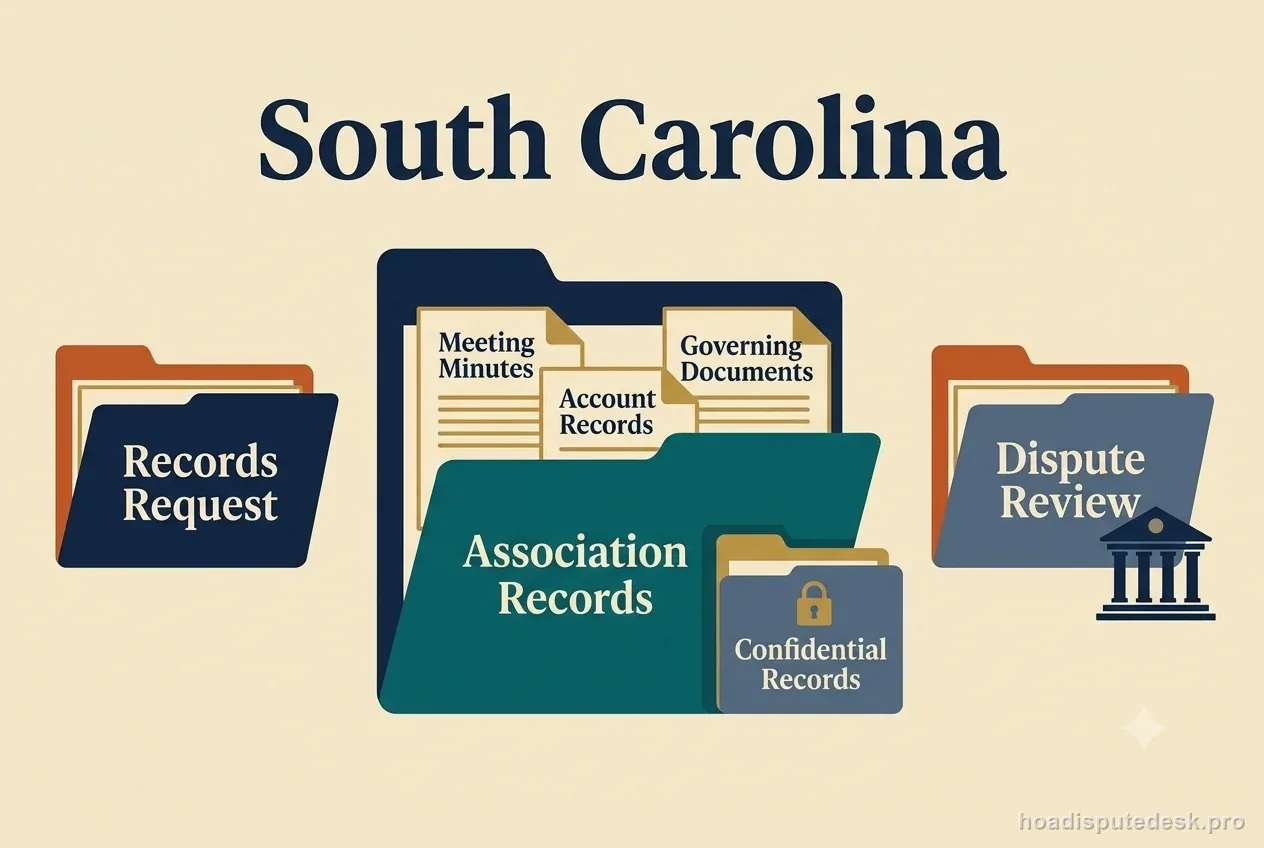
South Carolina does not have a comprehensive HOA operating code. The Homeowners Association Act chiefly adds recording, notice, access and complaint rules, while subdivision assessment and foreclosure power often comes from recorded covenants. Condominiums are different: § 27-31-210 creates a statutory common-expense lien that is junior to duly recorded mortgages and may be foreclosed only by suit like a real-property mortgage. The Department of Consumer Affairs accepts HOA complaints but does not replace the courts.
Which South Carolina statute controls your dispute
For subdivision HOAs, begin with the South Carolina Homeowners Association Act, S.C. Code §§ 27-30-110 through 27-30-170, but do not treat it as a comprehensive uniform common-interest statute. The Department of Consumer Affairs itself describes South Carolina as lacking a comprehensive law detailing HOA operations. Section 27-30-130 makes recording central to enforceability of governing documents and requires adopted rules and amendments to remain accessible and to be recorded on the statutory schedule.
Condominiums organized as horizontal property regimes use the separate Horizontal Property Act, Title 27, Chapter 31. That Act contains its own records, common-expense and lien rules. The first task in a South Carolina dispute is therefore to identify whether the property is a subdivision lot or a horizontal-property apartment, then collect the recorded declaration/master deed, bylaws, rules and amendments that actually apply.
How South Carolina owners challenge an assessment vote
Read an assessment dispute as two questions: did the association have authority to levy the charge, and is the calculation correct. Ask which budget line or board vote created it, which declaration clause allocates common expenses among units, when owners were notified, and — where South Carolina law or the governing documents required an owner vote — whether that vote actually took place. Ordinary annual dues and a special assessment often follow different approval paths, so confirm which one governs the charge in front of you.
When challenging an assessment in South Carolina, ask the association to reconcile the account in writing and preserve your objection at the same time. Keep the ledger, notices, proof of payment, and the governing provision the board cites. If only part of the balance is disputed, distinguish that part clearly; a broad payment stoppage can obscure the original issue and create additional collection consequences.
Sources: [1]
Contesting an South Carolina HOA fine and demanding a hearing
The Homeowners Association Act does not create one statewide fine schedule or a universal hearing procedure. For a subdivision HOA fine, verify first that the governing provision is enforceable under § 27-30-130: governing documents must be recorded, and rules, regulations and amendments must be made accessible to members and recorded as the statute requires. Then check the declaration and bylaws for notice, cure, hearing, vote and appeal procedures.
For a horizontal-property condominium, § 27-31-170 authorizes civil actions for noncompliance with bylaws, rules, regulations and covenants, but the chapter does not supply the kind of detailed pre-fine hearing timetable found in some states. Keep the cited rule, adoption/recording history where relevant, violation evidence, notices, owner response, board decision and ledger together so a collection demand can be tested against the actual authority.
Records requests and inspection rights in South Carolina
Section 27-30-150 applies the nonprofit-corporation access provisions to HOAs not otherwise subject to that Act for the purpose of allowing owners to inspect and copy the annual budget and membership lists. Section 27-30-130 also requires HOA rules and amendments to be made accessible to members on request unless an authorized alternative method makes them available. If the association is a nonprofit corporation, Chapter 31 of Title 33 may provide the governing inspection route.
Horizontal-property condominium owners have a separate concrete right in § 27-31-180: the administrator or board must keep a chronological book of receipts and expenditures affecting the property and the supporting vouchers, and both are available for examination by co-owners at convenient announced hours on working days. For a disputed charge, request the owner ledger plus the budget, resolution/minutes and supporting vouchers that explain the entry.
The South Carolina assessment-lien timeline and priority
For a horizontal-property condominium, § 27-31-210 makes unpaid common-expense assessments a lien on the apartment. The statute expressly places tax liens and duly recorded mortgage and other liens ahead of the association lien. It therefore does not create a condominium super-priority over a prior first mortgage. Section 27-31-200 likewise protects specified taxes and recorded mortgage obligations when unpaid assessments are handled at a sale or conveyance.
A subdivision HOA should not automatically cite § 27-31-210 because that section belongs to the Horizontal Property Act. Its assessment-lien authority commonly must be traced through the recorded declaration and applicable real-property or entity law. Before treating a demand as a secured lien, obtain the recorded covenant provision authorizing assessments and liens, the recorded lien instrument if one was filed, and a ledger separating assessments from fines, interest and collection charges.
Sources: [2]
Judicial vs. nonjudicial foreclosure for South Carolina HOAs
For a horizontal-property condominium, § 27-31-210 is explicit: the statutory assessment lien may be foreclosed by suit in like manner as a mortgage of real property. The association may instead sue for a money judgment without starting foreclosure. Because prior recorded mortgages remain senior, a homeowner should not describe this as a super-lien or assume the association can use a nonjudicial condominium sale procedure.
For a subdivision HOA, foreclosure authority depends on the recorded governing documents and other applicable South Carolina law; the Homeowners Association Act itself is not a standalone foreclosure code. As of August 31, 2026, H.3447—which would add a rule-to-show-cause step before certain HOA foreclosure sales—has passed the House but remains referred to the Senate Judiciary Committee, so its proposed January 1, 2026 language is not current law and should not be written into a published guide as if enacted.
Pre-suit steps South Carolina requires before a lawsuit
There is no single South Carolina rule that pushes every HOA or condominium dispute through mediation or arbitration before filing. Whether a pre-suit step is mandatory depends on the specific claim, what the governing documents say, and the court's own rules — check all three.
Sources: [1]
The forums that hear South Carolina association disputes
The South Carolina Department of Consumer Affairs receives and records HOA complaints and publishes homeowner education under §§ 27-30-330 and 27-30-340. That is useful for complaint intake and pattern reporting, but the agency does not become a general HOA merits tribunal with power to cancel every lien or award every remedy. The Homeowners Association Act also gives magistrates court concurrent jurisdiction over qualifying monetary disputes under § 27-30-160, subject to the ordinary jurisdictional requirements.
Sources
- South Carolina Legislature — Homeowners Association Act, Title 27 Chapter 30Current HOA recording, access, budget-notice, magistrates-court and Consumer Affairs provisions.
- South Carolina Legislature — Horizontal Property Act, Title 27 Chapter 31Current condominium records, common-expense and lien provisions.
- South Carolina Department of Consumer Affairs — HOA InformationCurrent state guidance and complaint resources; notes that South Carolina lacks a comprehensive HOA operating law.
- South Carolina H.3447 (2025–2026) statusPending bill; not current law as of August 31, 2026.