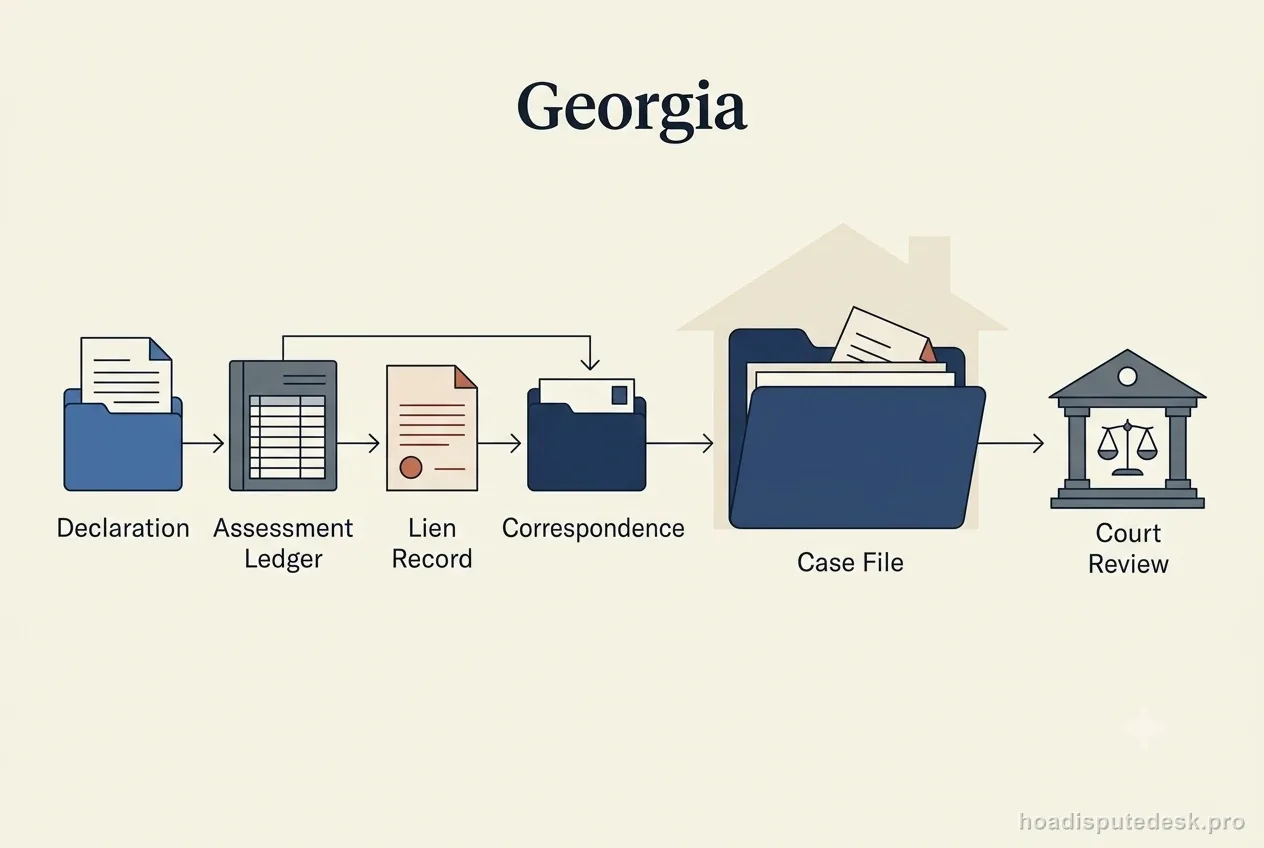
Georgia has two statutory tracks: the Condominium Act for condominiums and the Property Owners’ Association Act for subdivisions submitted to it. Under current 2026 law, both assessment liens are judicially foreclosed after at least 30 days’ notice, and foreclosure is unavailable unless the lien is at least $2,000. A qualifying first mortgage is senior. POAA rules change again on January 1, 2027 under SB 406, so do not apply those future thresholds early.
Georgia: planned-community law vs. condominium law
Georgia requires a threshold classification before any lien analysis. Every condominium uses the Georgia Condominium Act, but a subdivision HOA receives the Property Owners’ Association Act’s statutory powers only if the declaration submits the community to the POAA. A non-POAA subdivision may rely much more heavily on recorded covenants, contract law, and corporate law. Also keep effective dates straight: SB 406 was enacted in 2026 but its principal POAA collection changes do not take effect until January 1, 2027.
In Georgia, confirm the legal regime before arguing the merits. Obtain the recorded declaration, amendments, bylaws, rules, and any board resolution connected to the dispute, then compare them with the statute applicable to that community type. This prevents a common mistake: applying a condominium rule to a planned community, or a newer statute to a property governed by transition provisions.
Disputing a regular or special assessment in Georgia
Break an assessment challenge into authority and math. The association should be able to point to the budget or board action behind the charge, the declaration provision that spreads common expenses, the date notice went out, and any owner vote that Georgia law or the governing documents made a precondition. Do not assume a special assessment cleared the same threshold as the regular budget; the two frequently carry separate voting requirements.
When challenging an assessment in Georgia, ask the association to reconcile the account in writing and preserve your objection at the same time. Keep the ledger, notices, proof of payment, and the governing provision the board cites. If only part of the balance is disputed, distinguish that part clearly; a broad payment stoppage can obscure the original issue and create additional collection consequences.
Sources: [1]
What Georgia requires before an association fine sticks
First ask whether the subdivision is submitted to the POAA. If it is not, enforcement authority may come primarily from the recorded covenants. For condos, use the Condominium Act rather than POAA provisions.
The most useful record in a Georgia fine dispute is a dated enforcement file. Include the governing provision, initial notice, evidence, cure communications, hearing request, hearing notice, material considered, and final decision. If the issue is inconsistent enforcement, document comparable cases carefully; visual similarity alone does not establish that the properties were legally or factually alike.
Georgia record-inspection rules and refusal remedies
Georgia access rights can come from the property statute, nonprofit-corporation law, and the governing documents. A homeowner should identify the legal entity and the recorded declaration before asserting a specific production deadline.
Treat a Georgia records request as an evidence request, not a fishing expedition. Ask for the ledger, approval records, relevant minutes, rules, invoices, contracts, and recorded governing documents that bear on the issue. Separate categories that may contain other owners' private information. A written refusal should identify what was withheld and why so the dispute is defined.
When an assessment lien attaches under Georgia law
For a POAA community, O.C.G.A. § 44-3-232 gives the association a statutory lien when covered sums become due; for a condominium, § 44-3-109 supplies the parallel lien. Both are generally subordinate to a qualifying first-priority mortgage and certain other superior liens. The declaration’s recording supplies notice of the statutory lien, so the analysis is not simply “was a claim of lien recorded?” Check which Act applies, what charges are included, priority, and the four-year lapse rule for assessment installments.
When reviewing an association lien in Georgia, separate the debt from the lien and the lien from foreclosure. Check the assessment ledger, any pre-lien notice, the recorded claim, legal description, amount, execution, and filing date. Then analyze priority and enforcement. This sequence avoids assuming that a recorded lien automatically outranks a mortgage or automatically permits a sale.
How association foreclosure works in Georgia
Current Georgia law uses judicial foreclosure for both statutory tracks. Sections 44-3-232(c) and 44-3-109(c) require at least 30 days’ notice sent by the prescribed certified-mail or statutory-overnight method before the association seeks an action, judgment, and court order of foreclosure, and no foreclosure action is permitted unless the lien is at least $2,000. For POAA communities, do not prematurely apply SB 406’s January 1, 2027 collection changes to a 2026 dispute.
If a lien moves toward foreclosure in Georgia, work from the actual documents. Calendar the dates, reconcile the ledger, identify any statutory minimum or excluded charges, and check notice, board approval, cure, payment-plan, and redemption rules that apply. National summaries can miss a state-specific court, trustee, or filing step.
What to complete before filing in Georgia court
Georgia does not impose one blanket mediation-or-ADR requirement across association disputes. A pre-suit obligation, where it exists, comes from the statute for the particular claim, the declaration and bylaws, or a court's procedural rules, so read those rather than assuming.
Sources: [1]
Where Georgia HOA and condo disputes are decided
Georgia routes association disputes through the regular court system rather than a dedicated HOA tribunal. The right forum turns on the claim — general trial court, small-claims or limited-jurisdiction court for a money claim under the threshold, or a statute- or document-created arbitration or mediation process.
Sources: [1]
Sources
- Official Code of Georgia Annotated — state-provided LexisNexis portalGeorgia state agencies direct users here for the current O.C.G.A.; cross-check 2026 session changes against signed acts because recently enacted legislation may not yet be incorporated.
- Georgia General Assembly — General Statutes / annual statutory materialsOfficial General Assembly portal for statutory materials and annual updates.
- O.C.G.A. § 44-3-107 — condominium insurance (secondary mirror)Secondary mirror used only as a navigation aid; confirm against the official O.C.G.A. portal under the current statute before relying on it.
- O.C.G.A. § 44-3-226 — POAA amendments (secondary mirror)Secondary mirror shows the version in force before the January 1, 2027 changes; confirm against official current code.
- Georgia SB 406 (2026) — signed actOfficial signed legislation; principal HOA-governance changes take effect January 1, 2027, while specified provisions have earlier effective dates.
- Georgia General Assembly — 2026 Session SummaryOfficial session summary used to cross-check the scope and timing of 2026 HOA legislation.