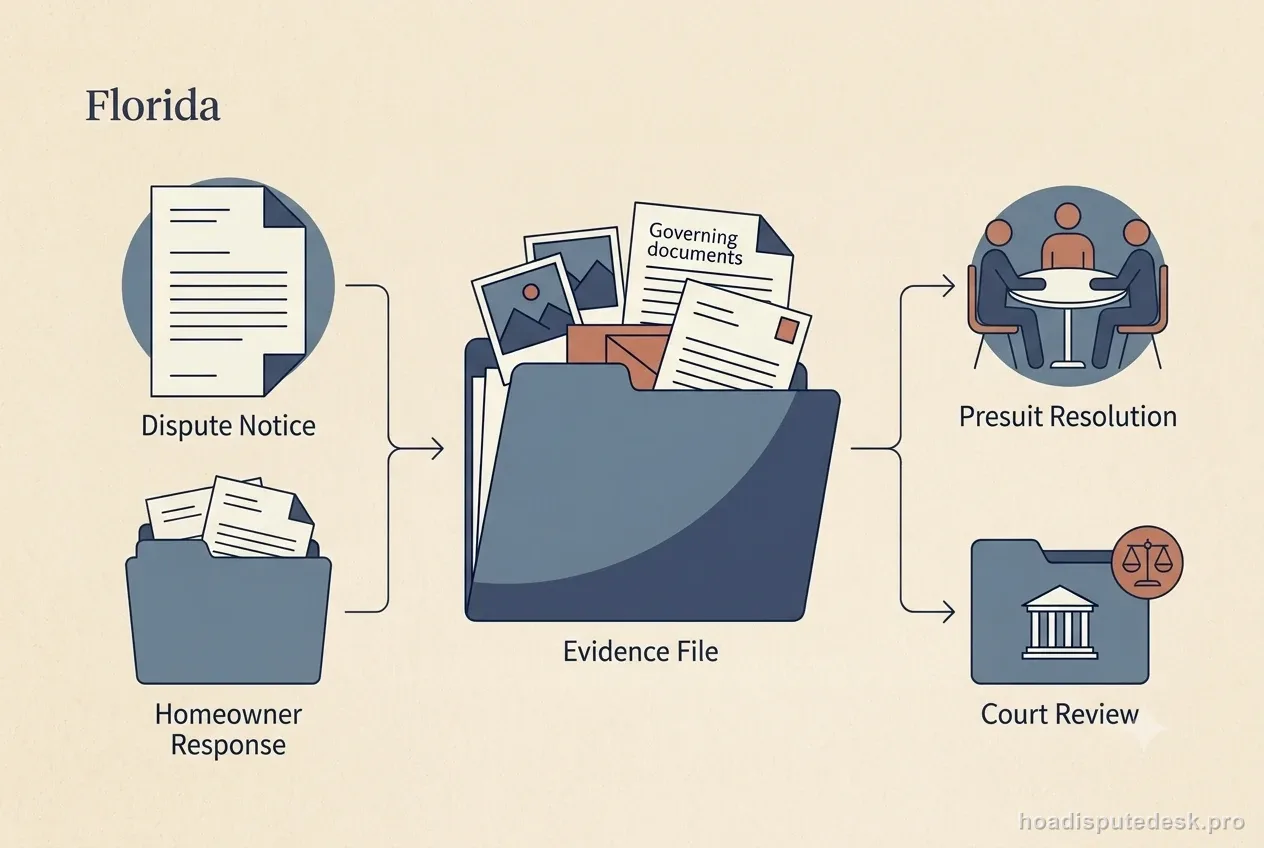
Florida separates Chapter 720 HOAs from Chapter 718 condominiums. For a Chapter 720 HOA fine, the owner generally gets at least 14 days’ notice and a committee hearing, and a fine below $1,000 cannot become a lien. HOA official records generally must be available within 10 business days of a written request. Unpaid HOA assessments use a 45-day pre-lien notice and a separate 45-day notice of intent to foreclose before judicial foreclosure.
Florida: planned-community law vs. condominium law
Before anything else in a Florida dispute, pin down the property's legal form and when the declaration was recorded. For planned communities, start with Florida Homeowners’ Association Act, Fla. Stat. Ch. 720. For condominiums, start with Florida Condominium Act, Fla. Stat. Ch. 718. Do not take the board's or manager's label at face value — an older community may sit under a legacy statute or a transition provision, so confirm what actually applies before you count on a deadline, remedy, or voting rule.
A strong Florida file starts with the source documents: recorded declaration and amendments, bylaws, current rules, and the board action behind the disputed decision. Compare those materials with the statute that applies to the property type and creation date. If the association relies on an older rule or amendment, ask for the adoption and recording history rather than assuming it is valid.
Disputing a regular or special assessment in Florida
Break an assessment challenge into authority and math. The association should be able to point to the budget or board action behind the charge, the declaration provision that spreads common expenses, the date notice went out, and any owner vote that Florida law or the governing documents made a precondition. Do not assume a special assessment cleared the same threshold as the regular budget; the two frequently carry separate voting requirements.
A Florida assessment dispute is easier to evaluate when the numbers are separated. Request the ledger, identify the principal assessment, and list late fees, interest, attorney fees, and other add-ons on their own lines. Put the objection in writing and keep payment records. Do not assume that refusing all payments automatically preserves your position or pauses collection activity.
Sources: [1]
What Florida requires before an association fine sticks
Florida gives owners concrete fine-hearing protections. Under § 720.305, a Chapter 720 HOA must provide at least 14 days’ written notice of the right to a hearing before an independent three-member committee; current law also specifies hearing timing, written findings, cure treatment, and a later payment date. A fine below $1,000 may not become a lien. Condominium § 718.303 likewise requires at least 14 days’ written notice and a committee hearing, but condominium fines may not become liens at all.
Organize a Florida enforcement dispute around what the association knew and did at each step. Save the cited provision, notice, evidence, cure history, hearing request, hearing notice, board materials, and outcome. For selective enforcement, focus on comparable violations under the same rule and period so the comparison can be tested rather than asserted.
Florida record-inspection rules and refusal remedies
Florida’s records deadlines are worth stating precisely. Chapter 720 HOA official records generally must be made available within 10 business days after receipt of a written request, and a certified-mail request can trigger the statutory presumption and minimum-damages framework for a willful failure. Chapter 718 condominiums likewise use a 10-working-day access period. Use the correct chapter because the record lists, website duties, exemptions, and remedies are not identical.
When requesting association records in Florida, define both the category and the date range. The core set often includes the owner ledger, current budget, minutes or resolutions tied to the charge, applicable rule, contracts or invoices, and declaration amendments. If something is withheld, request the statutory or governing-document basis for that decision and keep proof of delivery.
When an assessment lien attaches under Florida law
For a Chapter 720 HOA, § 720.3085 requires a written notice of intent to record a claim of lien that gives the owner 45 days to pay before the lien is recorded. Florida does not use a UCIOA-style assessment super-priority; first-mortgage priority and post-foreclosure liability are separate questions. For condominiums, use § 718.116 rather than importing the HOA notice sequence word for word.
Do not collapse lien creation and lien enforcement into one issue in Florida. A lien can exist yet still be unperfected, junior in priority, or not presently foreclosable. Obtain the recorded instrument and compare its amount, owner, legal description, charge dates, signature, and filing history with the association ledger and notices.
How association foreclosure works in Florida
A Chapter 720 HOA forecloses an assessment lien in the same manner as a mortgage, through court. Section 720.3085 requires a separate notice of intent to foreclose and at least 45 days after that notice before the foreclosure action is filed; that notice follows the earlier 45-day pre-lien process. Condominium assessment foreclosure is also judicial, but its notice and collection provisions are in Chapter 718 and should be checked separately.
For a threatened Florida HOA or condo foreclosure, request an updated ledger and the complete notice chain immediately. Test the amount, charge categories, addresses, required board decision, and any cure, reinstatement, or redemption step against the governing law. Treat dates in a complaint, trustee notice, or court order as controlling until counsel confirms otherwise.
What to complete before filing in Florida court
Florida is a major pre-suit-process state. Section 720.311 requires presuit mediation for many HOA disputes, while condominium disputes may fall under Chapter 718 arbitration/mediation provisions depending on the claim.
Sources: [1]
Where Florida HOA and condo disputes are decided
Florida DBPR’s Division of Condominiums, Timeshares and Mobile Homes has substantial condominium jurisdiction, while its authority over Chapter 720 HOA disputes is narrower and claim-specific. Confirm that the division can hear the particular issue before relying on an administrative complaint instead of a court or presuit process.
Sources: [1]
Sources
- Florida Statutes — Chapter 718, CondominiumsOfficial Florida Legislature chapter; includes current 2026-amended text as posted.
- Florida Statutes — Chapter 720, Homeowners’ AssociationsOfficial Florida Legislature HOA chapter; current page includes 2026 amendment history.
- Florida DBPR — Division of Condominiums, Timeshares and Mobile HomesOfficial regulator and education portal, including SIRS reporting resources.
- Florida DBPR — SIRS guidance and reportingOfficial SIRS reporting resource; useful for current implementation details.
- Fla. Stat. § 720.311 — dispute resolution (official chapter)Presuit mediation and election/recall dispute procedures.
- Fla. Stat. § 720.3085 — HOA lien/collection (official)HOA assessment lien and foreclosure collection rules.