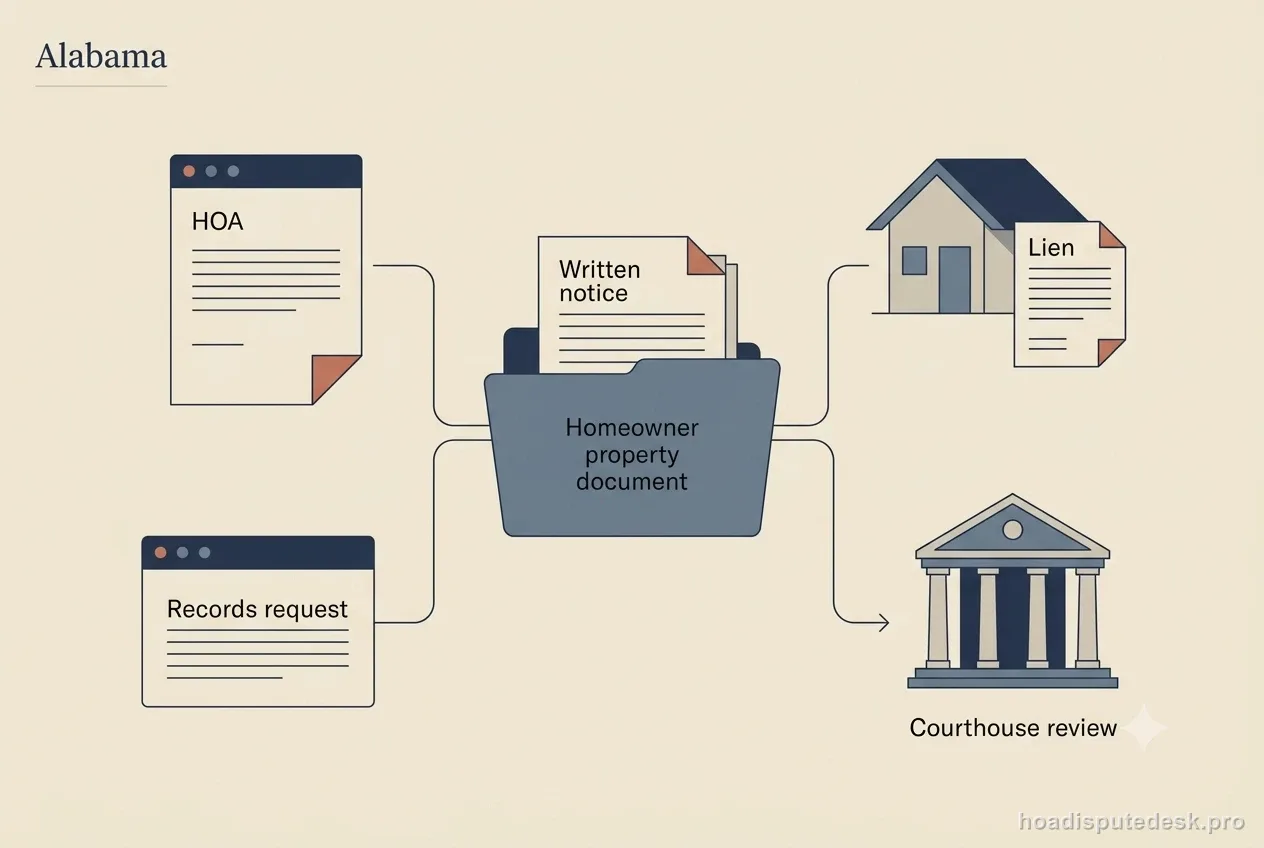
In Alabama, first separate a subdivision HOA from a condominium because the lien rules are materially different. A Chapter 20 HOA lien is recorded after advance notice and enforced through a court action, while a condominium lien can be foreclosed under the mortgage-style procedure in § 35-8A-316. Condominiums also have a limited six-month assessment priority; ordinary HOA liens do not get that same statutory super-priority.
Identifying the governing law in Alabama
Start an Alabama association dispute by identifying the property's legal form and the declaration's recording date. For planned communities, start with Alabama Homeowners’ Association Act, Ala. Code §§ 35-20-1 to 35-20-14. For condominiums, start with Alabama Uniform Condominium Act, Ala. Code §§ 35-8A-101 to 35-8A-417. The label a board or manager uses is not decisive on its own; older communities can be affected by legacy statutes or transition provisions, so check applicability before relying on a deadline, remedy, or voting rule.
In Alabama, read the recorded declaration, amendments, bylaws, rules, and properly adopted resolutions alongside the statute. Governing documents can fill procedural gaps, but they do not override mandatory law. Before challenging a fine, assessment, records decision, or lien, confirm the declaration date and keep the exact version of every document the association says it relied on.
Assessment and special-assessment challenges under Alabama law
Read an assessment dispute as two questions: did the association have authority to levy the charge, and is the calculation correct. Ask which budget line or board vote created it, which declaration clause allocates common expenses among units, when owners were notified, and — where Alabama law or the governing documents required an owner vote — whether that vote actually took place. Ordinary annual dues and a special assessment often follow different approval paths, so confirm which one governs the charge in front of you.
To contest an Alabama assessment, put the objection in writing and ask for a current owner ledger instead of just withholding payment. Split what you concede from what you dispute, and keep every payment record and objection. Collection activity can continue on the unpaid balance while the dispute runs, so require the association to show the authority and the calculation for each line you challenge.
Sources: [1]
Fine notices and hearing rights in Alabama
For a Chapter 20 HOA, Alabama law allows reasonable penalties only to the extent authorized by the declaration and governing documents, and the member must receive written notice, a reasonable opportunity to cure, and an opportunity to be heard and represented by counsel before the board. For condominiums, § 35-8A-302 likewise requires notice and an opportunity to be heard before reasonable fines.
Assemble the Alabama enforcement record chronologically — the covenant or rule cited, any photos or complaint, the first notice, the cure window, your response, the hearing request and its notice, the evidence the board considered, and the final decision. A selective-enforcement argument needs genuinely comparable properties over a comparable period; dated notices and board minutes carry more weight than a list of neighbors who merely look similar.
How to get board records from an Alabama association
For a Chapter 20 HOA, § 35-20-13 requires covered records to be made available on written request within a reasonable time that may not exceed 30 days. Condominium owners should not import that 30-day rule automatically; the Uniform Condominium Act has its own records and assessment-statement provisions, including a separate 10-business-day rule for a requested statement of amounts due under § 35-8A-316(h).
Write an Alabama records request so it can actually be enforced: name the account ledger, the budget, any special-assessment resolution, the relevant minutes, the rule at issue, the property's violation history, the underlying contract or invoice, and the recorded declaration with amendments. List any private-owner information separately, and if the association withholds something, require a stated legal basis for each item.
How Alabama associations perfect an assessment lien
A Chapter 20 HOA may claim a lien for unpaid assessments, but § 35-20-12 requires a verified lien statement to be recorded within the statutory period and at least 30 days of advance certified-mail warning before recording. Condominium assessments receive a separate statutory lien under § 35-8A-316; qualifying periodic common-expense assessments can receive a limited six-month priority over an earlier first mortgage. Do not transfer that condominium super-priority rule to an ordinary subdivision HOA.
For Alabama, treat the lien as four distinct questions — when it attaches, what recording or notice the law requires, how it ranks against other liens, and which steps make it enforceable. Check any recorded claim for the owner's name, the legal description, the charge period, the amount, a signature, the filing date, and the required notices. Rank alone is not a right to foreclose.
The Alabama HOA foreclosure route, step by step
Alabama uses different enforcement routes for the two community types. Under § 35-20-12, a Chapter 20 HOA enforces its assessment lien by filing a court action, and the court may order a sale after the statutory notice and publication steps. A condominium lien under § 35-8A-316 may be foreclosed in the same manner as a mortgage on real estate. In either setting, a recorded lien is not by itself permission to skip the statute’s notice and enforcement procedure.
A Alabama foreclosure notice means two immediate steps: put every deadline on a calendar and get a current ledger. Then test the notice — which charge categories it rests on, whether the required notices and mailing addresses are right, whether the board actually authorized the action, and what cure, payment-plan, reinstatement, or redemption right is still open. Use the statute, court rule, or declaration for the sequence, not a generic online timeline.
Mandatory ADR and notice before suing in Alabama
There is no single Alabama rule that pushes every HOA or condominium dispute through mediation or arbitration before filing. Whether a pre-suit step is mandatory depends on the specific claim, what the governing documents say, and the court's own rules — check all three.
Sources: [1]
Alabama: courts, agencies, and ADR panels for these cases
There is no single Alabama agency or tribunal that decides the merits of association disputes in place of the courts. Where a claim lands depends on what it is: a trial court for most disputes, small-claims or a limited-jurisdiction court for a qualifying money amount, or an arbitration or mediation track created by statute or the governing documents.
Sources: [1]
Sources
- Alabama Homeowners’ Association Act — official Code of Alabama portalPrimary HOA statute; Chapter 20 runs from §§ 35-20-1 to 35-20-14.
- Alabama Uniform Condominium Act — official Code of Alabama portalPrimary condominium act and applicability/transition section.
- Ala. Code § 35-20-13 — HOA recordsOfficial records-access section; includes the 30-day outside limit.
- Ala. Code § 35-8A-308 — condominium meetingsOfficial annual/special meeting and 10–60 day notice rule.
- Ala. Code § 35-8A-313 — condominium insuranceOfficial insurance section; check the current subsection text and amendment history before relying on a specific requirement.
- Ala. Code § 35-20-11 — HOA enforcement and penaltiesOfficial Alabama Legislature section governing HOA enforcement procedures and reasonable penalties, including owner process protections.
- Ala. Code § 35-20-12 — HOA assessment liens and judicial enforcementOfficial Alabama Legislature section governing HOA liens, advance notice, recording, and court enforcement.