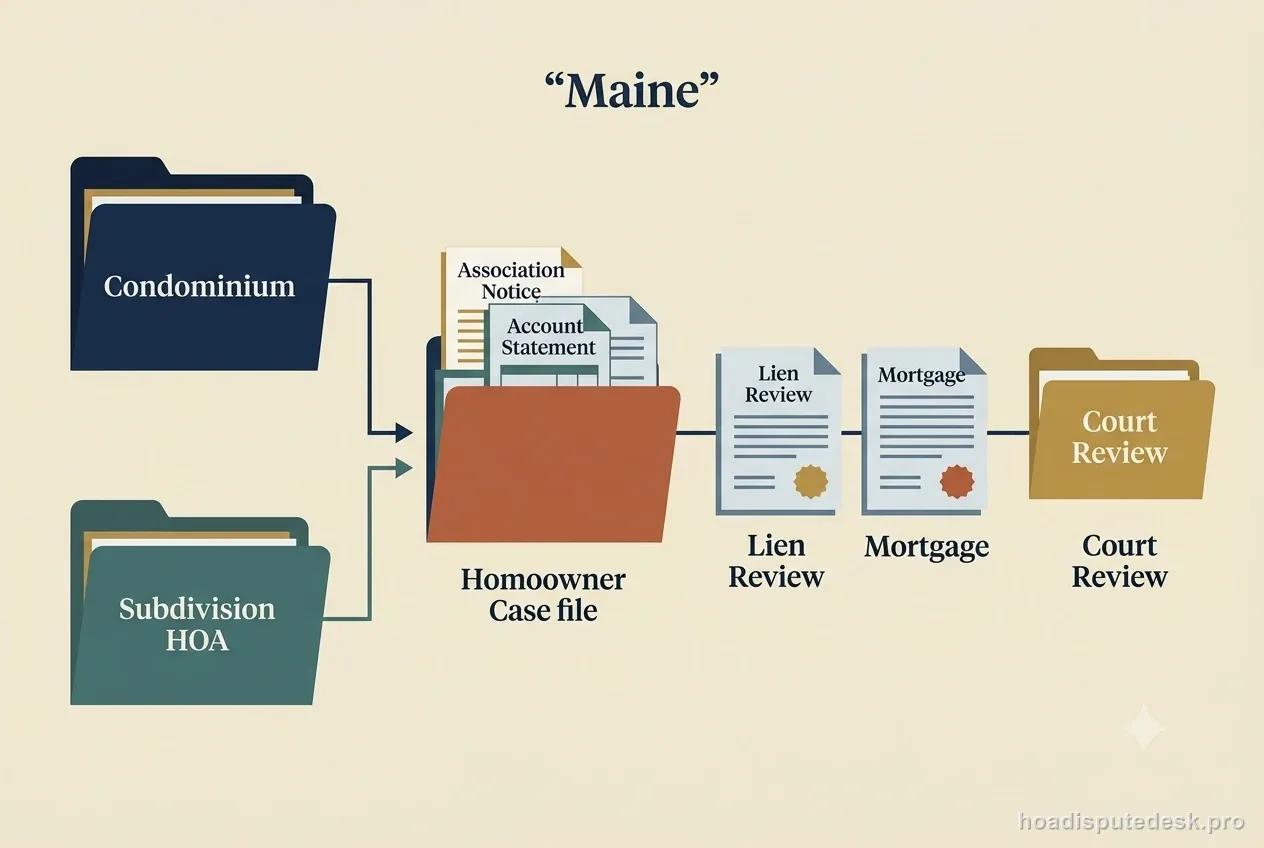
Maine’s detailed statutory route is mainly for condominiums. Under 33 M.R.S. §1603-102, an association may levy a reasonable fine only after notice and an opportunity to be heard. Section 1603-116 creates the assessment and fine lien, leaves a first mortgage ahead of it, permits mortgage-style foreclosure, and requires a binding unpaid-assessment statement within 10 business days of written request. Ordinary subdivision HOA remedies remain more document-driven.
Which Maine statute controls your dispute
Start a Maine association dispute by identifying the property's legal form and the declaration's recording date. Maine does not have one comprehensive planned-community HOA act, so recorded covenants and, when applicable, the Maine Nonprofit Corporation Act can be central. Condominiums use the Maine Condominium Act, 33 M.R.S. ch. 31. Older projects can raise transition questions, so confirm the governing regime before relying on a deadline, remedy, or voting rule.
A strong Maine file starts with the source documents: recorded declaration and amendments, bylaws, current rules, and the board action behind the disputed decision. Compare those materials with the statute that applies to the property type and creation date. If the association relies on an older rule or amendment, ask for the adoption and recording history rather than assuming it is valid.
How Maine owners challenge an assessment vote
Break an assessment challenge into authority and math. The association should be able to point to the budget or board action behind the charge, the declaration provision that spreads common expenses, the date notice went out, and any owner vote that Maine law or the governing documents made a precondition. Do not assume a special assessment cleared the same threshold as the regular budget; the two frequently carry separate voting requirements.
A Maine assessment dispute is easier to evaluate when the numbers are separated. Request the ledger, identify the principal assessment, and list late fees, interest, attorney fees, and other add-ons on their own lines. Put the objection in writing and keep payment records. Do not assume that refusing all payments automatically preserves your position or pauses collection activity.
Sources: [1]
Contesting an Maine HOA fine and demanding a hearing
For a Maine condominium, §1603-102(a)(11) is explicit: after notice and an opportunity to be heard, the association may levy reasonable fines for violations of the declaration, bylaws, or rules. An ordinary subdivision HOA is not automatically governed by that condominium provision, so identify the community type before invoking it.
Organize a Maine enforcement dispute around what the association knew and did at each step. Save the cited provision, notice, evidence, cure history, hearing request, hearing notice, board materials, and outcome. For selective enforcement, focus on comparable violations under the same rule and period so the comparison can be tested rather than asserted.
Records requests and inspection rights in Maine
Maine condominium owners have both general association-record rights under §1603-118 and a particularly useful account tool under §1603-116(h): on written request the association must furnish a recordable statement of unpaid assessments within 10 business days, and the statement binds the association, executive board, and owners.
When requesting association records in Maine, define both the category and the date range. The core set often includes the owner ledger, current budget, minutes or resolutions tied to the charge, applicable rule, contracts or invoices, and declaration amendments. If something is withheld, request the statutory or governing-document basis for that decision and keep proof of delivery.
The Maine assessment-lien timeline and priority
Section 1603-116 creates the condominium lien from the time an assessment or fine becomes due and perfects it through recordation of the declaration; no additional claim-of-lien filing is generally required for that statutory lien. A first mortgage remains ahead of the association lien. Proceedings to enforce unpaid assessments generally must begin within six years after the full assessment becomes due.
Do not collapse lien creation and lien enforcement into one issue in Maine. A lien can exist yet still be unperfected, junior in priority, or not presently foreclosable. Obtain the recorded instrument and compare its amount, owner, legal description, charge dates, signature, and filing history with the association ledger and notices.
Sources: [7]
Judicial vs. nonjudicial foreclosure for Maine HOAs
Maine condominium assessment liens are expressly foreclosed “in like manner as a mortgage on real estate” under §1603-116. That is a judicial, mortgage-style route, not a power-of-sale shortcut created merely by the declaration. Subdivision associations outside the Condominium Act still require a separate analysis of the recorded covenants and other law.
For a threatened Maine HOA or condo foreclosure, request an updated ledger and the complete notice chain immediately. Test the amount, charge categories, addresses, required board decision, and any cure, reinstatement, or redemption step against the governing law. Treat dates in a complaint, trustee notice, or court order as controlling until counsel confirms otherwise.
Sources: [7]
Pre-suit steps Maine requires before a lawsuit
Maine does not impose one blanket mediation-or-ADR requirement across association disputes. A pre-suit obligation, where it exists, comes from the statute for the particular claim, the declaration and bylaws, or a court's procedural rules, so read those rather than assuming.
Sources: [1]
The forums that hear Maine association disputes
Maine routes association disputes through the regular court system rather than a dedicated HOA tribunal. The right forum turns on the claim — general trial court, small-claims or limited-jurisdiction court for a money claim under the threshold, or a statute- or document-created arbitration or mediation process.
Sources: [1]
Sources
- Maine Condominium Act, 33 M.R.S. ch. 31Official Maine Legislature chapter index for the Condominium Act.
- 33 M.R.S. §1601-102 — condominium applicabilityOfficial applicability and pre-1983 condominium transition provisions.
- 33 M.R.S. §1603-108 — condominium meetingsOfficial annual-meeting and 10–60 day notice rule.
- 33 M.R.S. §1603-118 — condominium recordsOfficial records retention and owner-access requirements.
- 33 M.R.S. §1603-113 — condominium insuranceOfficial master-property and liability insurance requirements.
- Maine Nonprofit Corporation Act, 13-B M.R.S. §§602–715Official nonprofit-corporation law relevant to incorporated HOAs, including meetings, director procedure, and records.
- 33 M.R.S. §1603-116 — condominium assessment lienCurrent lien attachment, first-mortgage priority, mortgage-style foreclosure, six-year enforcement period, and 10-business-day statement.
- 33 M.R.S. §1603-102 — association powers and finesCondominium association may levy reasonable fines only after notice and an opportunity to be heard.