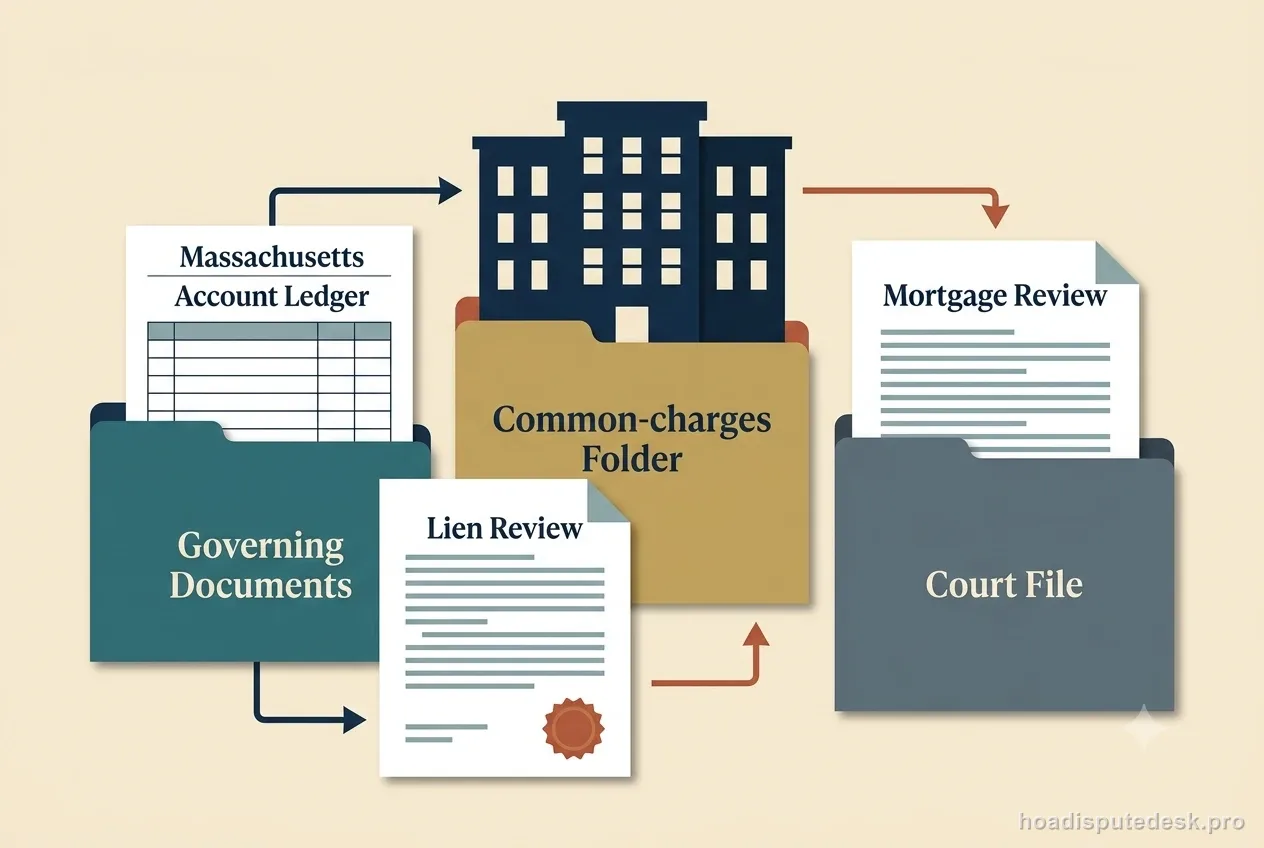
In Massachusetts, first identify whether the property is an HOA or condominium, then apply the correct statute and governing documents. The foreclosure route is judicial or otherwise court-supervised. A limited six-month priority component can protect qualifying assessments. Do not assume mediation is mandatory for every claim; check the dispute-specific statute and governing documents. Get the ledger, lien, and notices before choosing payment, ADR, or court relief.
Which Massachusetts statute controls your dispute
Before anything else in a Massachusetts dispute, pin down the property's legal form and when the declaration was recorded. For planned communities, no comprehensive Massachusetts HOA act; governing documents and applicable corporate law control, with selected statutes applying to associations. For condominiums, start with Massachusetts Condominium Act, Mass. Gen. Laws ch. 183A. Do not take the board's or manager's label at face value — an older community may sit under a legacy statute or a transition provision, so confirm what actually applies before you count on a deadline, remedy, or voting rule.
In Massachusetts, read the recorded declaration, amendments, bylaws, rules, and properly adopted resolutions alongside the statute. Governing documents can fill procedural gaps, but they do not override mandatory law. Before challenging a fine, assessment, records decision, or lien, confirm the declaration date and keep the exact version of every document the association says it relied on.
How Massachusetts owners challenge an assessment vote
Read an assessment dispute as two questions: did the association have authority to levy the charge, and is the calculation correct. Ask which budget line or board vote created it, which declaration clause allocates common expenses among units, when owners were notified, and — where Massachusetts law or the governing documents required an owner vote — whether that vote actually took place. Ordinary annual dues and a special assessment often follow different approval paths, so confirm which one governs the charge in front of you.
To contest a Massachusetts assessment, put the objection in writing and ask for a current owner ledger instead of just withholding payment. Split what you concede from what you dispute, and keep every payment record and objection. Collection activity can continue on the unpaid balance while the dispute runs, so require the association to show the authority and the calculation for each line you challenge.
Sources: [1]
Contesting an Massachusetts HOA fine and demanding a hearing
Subdivision HOA penalties are primarily document-driven. Condominium charges should be checked against ch. 183A, the master deed, trust/bylaws, and the association’s notice procedure.
Assemble the Massachusetts enforcement record chronologically — the covenant or rule cited, any photos or complaint, the first notice, the cure window, your response, the hearing request and its notice, the evidence the board considered, and the final decision. A selective-enforcement argument needs genuinely comparable properties over a comparable period; dated notices and board minutes carry more weight than a list of neighbors who merely look similar.
Records requests and inspection rights in Massachusetts
Condominium record and financial rights arise from ch. 183A and the governing trust/bylaws; ordinary subdivision HOA records can depend on corporate law and the documents.
Write a Massachusetts records request so it can actually be enforced: name the account ledger, the budget, any special-assessment resolution, the relevant minutes, the rule at issue, the property's violation history, the underlying contract or invoice, and the recorded declaration with amendments. List any private-owner information separately, and if the association withholds something, require a stated legal basis for each item.
The Massachusetts assessment-lien timeline and priority
Massachusetts is distinctive for the strong condominium common-charge lien in ch. 183A § 6, including a limited priority component that can sit ahead of a first mortgage when statutory conditions are met. 183A, § 6. For Massachusetts, 6-month condominium priority lien for qualifying common charges under ch. 183A, § 6.
For Massachusetts, treat the lien as four distinct questions — when it attaches, what recording or notice the law requires, how it ranks against other liens, and which steps make it enforceable. Check any recorded claim for the owner's name, the legal description, the charge period, the amount, a signature, the filing date, and the required notices. Rank alone is not a right to foreclose.
Judicial vs. nonjudicial foreclosure for Massachusetts HOAs
Massachusetts condominium lien enforcement is judicial under Mass. Gen. Laws ch. 183A. The association must use the statutory court process and satisfy the notice and lien requirements that apply to the claimed common expenses. A recorded lien does not by itself create a private power of sale outside that process.
A Massachusetts foreclosure notice means two immediate steps: put every deadline on a calendar and get a current ledger. Then test the notice — which charge categories it rests on, whether the required notices and mailing addresses are right, whether the board actually authorized the action, and what cure, payment-plan, reinstatement, or redemption right is still open. Use the statute, court rule, or declaration for the sequence, not a generic online timeline.
Pre-suit steps Massachusetts requires before a lawsuit
There is no single Massachusetts rule that pushes every HOA or condominium dispute through mediation or arbitration before filing. Whether a pre-suit step is mandatory depends on the specific claim, what the governing documents say, and the court's own rules — check all three.
Sources: [1]
The forums that hear Massachusetts association disputes
There is no single Massachusetts agency or tribunal that decides the merits of association disputes in place of the courts. Where a claim lands depends on what it is: a trial court for most disputes, small-claims or a limited-jurisdiction court for a qualifying money amount, or an arbitration or mediation track created by statute or the governing documents.
Sources: [1]
Sources
- Massachusetts General Laws, Chapter 183A — CondominiumsOfficial Legislature chapter portal; primary condominium statute.
- Mass. Gen. Laws ch. 183A, § 10Official text for records, fidelity insurance, reserve fund, management controls, and 67% modification vote.
- Mass. Gen. Laws ch. 183A, § 6Official text for annual budget-based common expenses and condominium liens.
- Mass. Gen. Laws ch. 183A, § 24Official text authorizing electronic condo meetings and voting.
- Massachusetts General Laws, Chapter 180Official nonprofit-corporation chapter; applicability depends on association legal form.
- Mass.gov — CondominiumsState guidance confirming no Commonwealth regulatory oversight over condominiums.