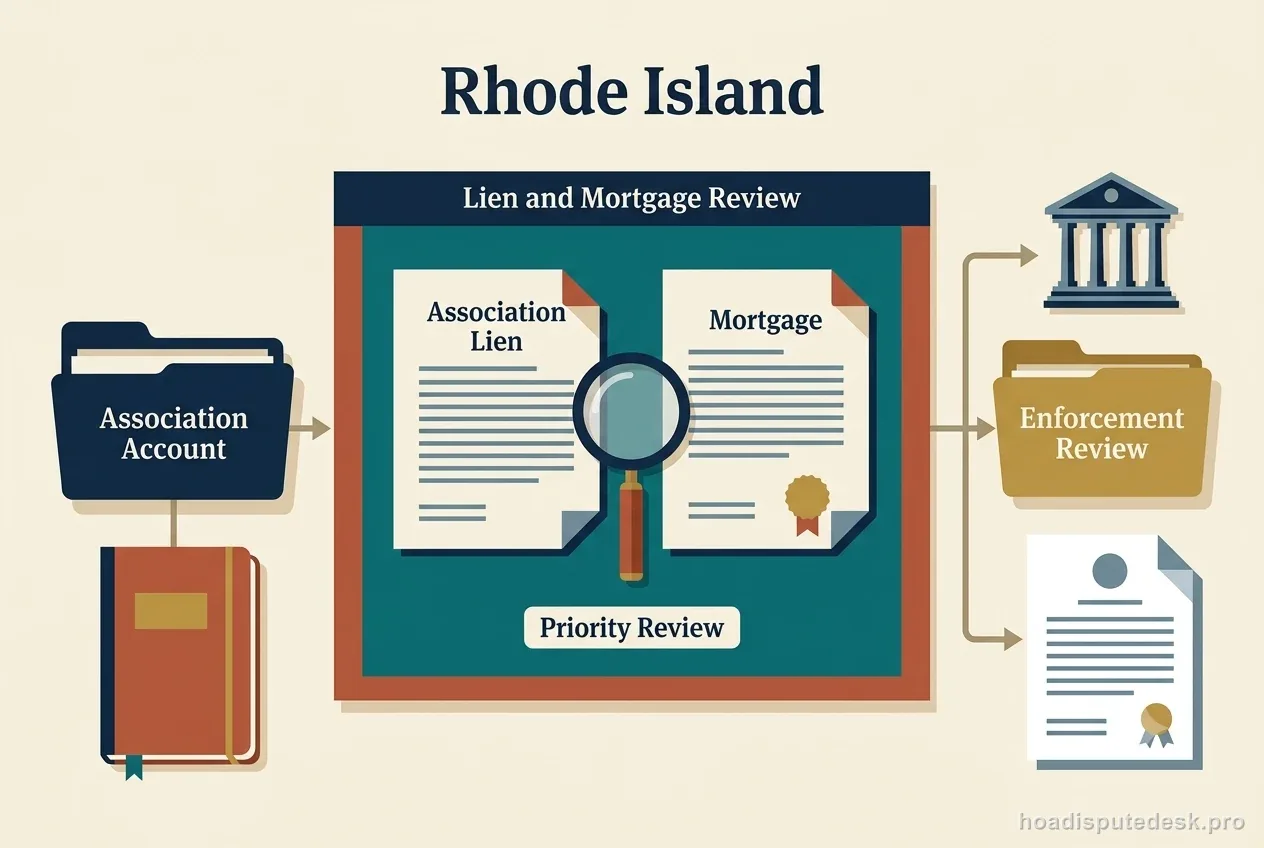
Rhode Island condominium law gives associations a real six-month super-priority component, but it is tightly defined. Section 34-36.1-3.16 excludes special assessments, late charges, fines, penalties and interest from that priority amount and caps included attorney and foreclosure costs. A condominium lien may be foreclosed by public auction under § 34-36.1-3.21, with statutory delinquency and sale notices to the owner and first mortgagee. Non-condominium HOA rights remain more document-driven.
Identifying the governing law in Rhode Island
Start a Rhode Island association dispute by identifying the property's legal form and the declaration's recording date. Rhode Island does not have a broad modern planned-community act comparable to its condominium statute, so many non-condominium HOAs rely heavily on recorded covenants and entity law. Condominiums use the Rhode Island Condominium Law, R.I. Gen. Laws ch. 34-36.1. Confirm the governing regime before relying on a lien, notice, voting, or enforcement rule.
A strong Rhode Island file starts with the source documents: recorded declaration and amendments, bylaws, current rules, and the board action behind the disputed decision. Compare those materials with the statute that applies to the property type and creation date. If the association relies on an older rule or amendment, ask for the adoption and recording history rather than assuming it is valid.
Assessment and special-assessment challenges under Rhode Island law
Read an assessment dispute as two questions: did the association have authority to levy the charge, and is the calculation correct. Ask which budget line or board vote created it, which declaration clause allocates common expenses among units, when owners were notified, and — where Rhode Island law or the governing documents required an owner vote — whether that vote actually took place. Ordinary annual dues and a special assessment often follow different approval paths, so confirm which one governs the charge in front of you.
A Rhode Island assessment dispute is easier to evaluate when the numbers are separated. Request the ledger, identify the principal assessment, and list late fees, interest, attorney fees, and other add-ons on their own lines. Put the objection in writing and keep payment records. Do not assume that refusing all payments automatically preserves your position or pauses collection activity.
Sources: [1]
Fine notices and hearing rights in Rhode Island
Condominium fines can be part of the statutory lien framework, but priority and foreclosure restrictions should be checked separately. Non-condo HOA fine authority is more document-driven.
Organize a Rhode Island enforcement dispute around what the association knew and did at each step. Save the cited provision, notice, evidence, cure history, hearing request, hearing notice, board materials, and outcome. For selective enforcement, focus on comparable violations under the same rule and period so the comparison can be tested rather than asserted.
How to get board records from an Rhode Island association
Condominium § 34-36.1-3.18 supplies statutory association-record rights, and the 2025 applicability provisions extend that section to older condominiums for later events as specified in § 34-36.1-1.02. A focused request should seek the owner ledger, current budget, minutes or resolutions supporting the assessment, delinquency notices, collection charges, contracts relevant to the disputed expense, and records necessary to reproduce the claimed six-month priority calculation.
For a non-condominium HOA, inspect the declaration, bylaws and entity law rather than assuming the condominium records statute controls. In either setting, preserve the request, proof of delivery and the response. If a lien sale is threatened, records supporting the mailing dates and publication schedule are often more immediately useful than a broad request for every association document.
Sources: [1]
How Rhode Island associations perfect an assessment lien
For a condominium, § 34-36.1-3.16 creates a lien when an assessment or fine becomes due and generally leaves an earlier first mortgage ahead of the association. Subsection (b)(2), however, makes the lien prior to that first mortgage for six months of qualifying periodic-budget common expenses immediately preceding foreclosure, plus limited collection and foreclosure costs. The current statute caps qualifying attorney fees at $2,500 and foreclosure costs at $5,000, for a $7,500 aggregate cap on those two categories.
The priority slice does not include special assessments, late charges, fines, penalties or interest. Once common expenses have been delinquent at least 60 days, the association must send the statutory delinquency notice to both the owner and the first mortgagee. Missing the mortgagee notice does not erase the six-month assessment priority, but it removes costs and attorney fees from the priority amount. Non-condominium planned communities should not automatically import this condominium rule.
The Rhode Island HOA foreclosure route, step by step
Section 34-36.1-3.21 authorizes a condominium association to foreclose its lien by public auction rather than requiring an ordinary mortgage-foreclosure lawsuit. The notice sequence matters. The statute requires advance notice of the time and place of sale to the unit owner and first mortgagee before publication, followed by publication requirements and post-sale notice to the mortgagee. A homeowner should compare each mailed and published notice against the current statute instead of relying on a manager's summary.
Rhode Island Supreme Court precedent recognizes that foreclosure of the statutory super-priority portion can extinguish a first mortgage, which is why the lender-notice and redemption protections are not technical details. If the file involves a threatened sale, obtain the 60-day delinquency notices, the sale notices, publication proofs, payoff calculation distinguishing priority from nonpriority amounts, and the first mortgage information before evaluating settlement or emergency court relief.
Mandatory ADR and notice before suing in Rhode Island
There is no single Rhode Island rule that pushes every HOA or condominium dispute through mediation or arbitration before filing. Whether a pre-suit step is mandatory depends on the specific claim, what the governing documents say, and the court's own rules — check all three.
Sources: [1]
Rhode Island: courts, agencies, and ADR panels for these cases
Rhode Island does not have one statewide HOA merits tribunal that replaces the courts for every association dispute. Depending on the claim, the forum may be a trial court, a small-claims or limited-jurisdiction court for a qualifying money claim, or an arbitration/mediation process created by statute or the governing documents.
Sources: [1]
Sources
- Rhode Island General Assembly — Condominium Law, Article IIIOfficial current index for association management, lien, records and foreclosure sections.
- R.I. Gen. Laws § 34-36.1-3.16 — lien for assessmentsSix-month priority component, exclusions, notice requirements and cost caps.
- R.I. Gen. Laws § 34-36.1-3.21 — foreclosure of condominium lienPublic-auction foreclosure, sale notice and redemption procedure.
- Twenty Eleven, LLC v. Botelho, 127 A.3d 897 (R.I. 2015)Rhode Island Supreme Court decision addressing the effect of condominium super-priority foreclosure on a first mortgage.