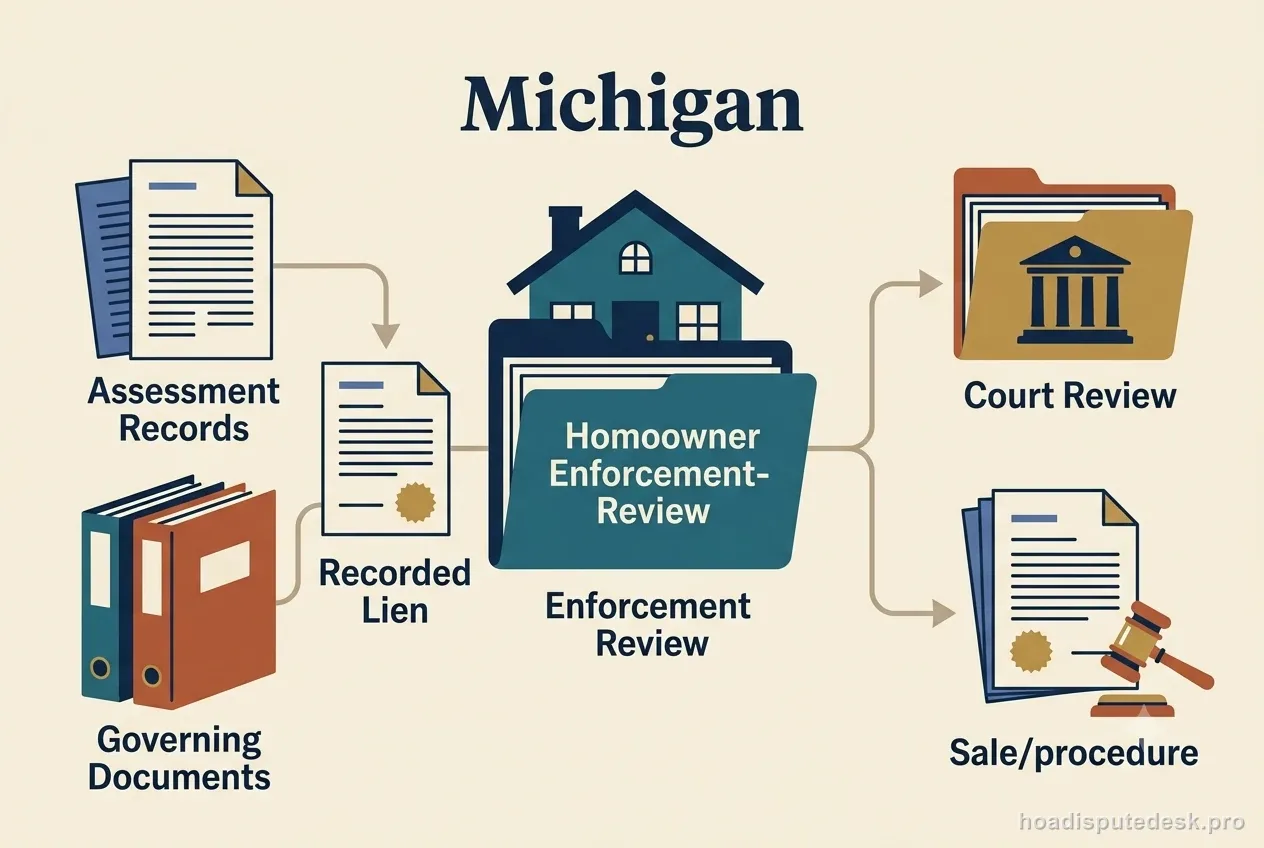
In Michigan, first identify whether the property is an HOA or condominium, then apply the correct statute and governing documents. Both judicial and non-judicial enforcement can apply, depending on the statute and recorded documents. Do not presume super-priority over a first mortgage. Do not assume mediation is mandatory for every claim; check the dispute-specific statute and governing documents. Get the ledger, lien, and notices before choosing payment, ADR, or court relief.
Identifying the governing law in Michigan
The first step in a Michigan dispute is establishing whether the property is a planned community or a condominium, plus the declaration's recording date. For planned communities, no comprehensive Michigan HOA act; recorded restrictions, bylaws, and applicable nonprofit-corporation law generally control. For condominiums, start with Michigan Condominium Act, 1978 PA 59, MCL 559.101 et seq., plus Condominium Administrative Rules R 559.101 et seq. A label from the board or management company is not conclusive; legacy statutes and transition rules can govern an older community, so verify applicability before relying on any deadline, remedy, or voting rule.
In a Michigan matter, read the recorded declaration next to the current statute rather than trusting a portal summary or a management-company label. Request the amendments, bylaws, rules, and board resolutions. Transition and applicability provisions can decide the outcome in an older community, so keep whatever shows when the community was formed and which regime it now claims.
Assessment and special-assessment challenges under Michigan law
Read an assessment dispute as two questions: did the association have authority to levy the charge, and is the calculation correct. Ask which budget line or board vote created it, which declaration clause allocates common expenses among units, when owners were notified, and — where Michigan law or the governing documents required an owner vote — whether that vote actually took place. Ordinary annual dues and a special assessment often follow different approval paths, so confirm which one governs the charge in front of you.
Preserve an assessment challenge in writing in Michigan and ask for a ledger that shows charges, credits, interest, late fees, and collection costs separately. Withholding every payment can create a second dispute over delinquency, so document what you are contesting and why. If you make a payment while the dispute is open, keep proof and avoid assuming that a particular 'under protest' label has the same legal effect in every claim.
Sources: [1]
Fine notices and hearing rights in Michigan
A conventional subdivision HOA must ground penalties in recorded restrictions and corporate authority. Condominiums are governed by the Act, administrative rules, master deed, and bylaws.
For a fine or covenant dispute in Michigan, preserve the chronology. Keep the cited rule, the alleged violation evidence, notice, any cure deadline, hearing materials, your response, and the final decision. A selective-enforcement argument is fact intensive, so document materially similar examples with dates and records instead of relying on general neighborhood impressions.
How to get board records from an Michigan association
Michigan condominium owners should use the Act, administrative rules, and association records. Subdivision HOA owners may need corporate-record statutes and the recorded documents.
A useful Michigan records request names records and time periods instead of asking for 'everything.' Request the ledger, budget materials, minutes tied to the disputed action, applicable rules, invoices or contracts supporting pass-through charges, and the current declaration and amendments. If the association refuses or redacts material, ask it to state the reason by category and preserve that response.
How Michigan associations perfect an assessment lien
The Condominium Act creates an assessment lien. Michigan allows both judicial foreclosure and foreclosure by advertisement for qualifying condominium liens; first-mortgage priority must be analyzed separately.
For a Michigan lien dispute, distinguish attachment, perfection, priority, and foreclosure authority. Those are different legal questions. Compare the ledger with the recorded lien and any pre-lien notice, and check the owner name, property description, covered charge period, stated amount, execution, and recording date before debating who has priority over whom.
The Michigan HOA foreclosure route, step by step
Michigan condominium liens can be foreclosed either by court action or by advertisement when the statutory conditions for the selected route are met. The owner should identify which route the association actually invoked and then audit the notices, recordation, amount claimed, and timing against that procedure instead of treating the existence of a lien as a completed foreclosure step.
A Michigan foreclosure notice should trigger a document audit, not a guess about the timeline. Get the current ledger and every pre-lien and foreclosure notice, then check service, addresses, board authority, charge categories, and any cure or reinstatement option. Court and sale deadlines can be unforgiving, so use the statute and filed papers rather than a national foreclosure checklist.
Mandatory ADR and notice before suing in Michigan
There is no single Michigan rule that pushes every HOA or condominium dispute through mediation or arbitration before filing. Whether a pre-suit step is mandatory depends on the specific claim, what the governing documents say, and the court's own rules — check all three.
Sources: [1]
Michigan: courts, agencies, and ADR panels for these cases
Michigan LARA provides condominium information and performs administrative functions under state law, but it is not a general HOA dispute court. Use the agency only for matters within its authority and preserve any separate lien, foreclosure, limitations, or court deadline.
Sources: [1]
Sources
- Michigan Condominium Act, 1978 PA 59Official Michigan Legislature full Act; confirm current PA update under the current statute before relying on it.
- Michigan Condominium Administrative RulesOfficial LARA administrative rules; R 559.511 contains the 10% reserve minimum.
- Michigan LARA — CondominiumsOfficial agency page explaining LARA’s limited role and linking condominium resources.
- Michigan Condominium Buyer’s HandbookOfficial LARA handbook summarizing reserve, records, financial-statement, and project-type rules.
- Michigan LARA Condominium FAQsOfficial FAQ confirming association reserve and records responsibilities.
- Michigan Legislature — Condominium Act section indexOfficial section index useful for MCL 559.154, 559.190 and related current text checks.