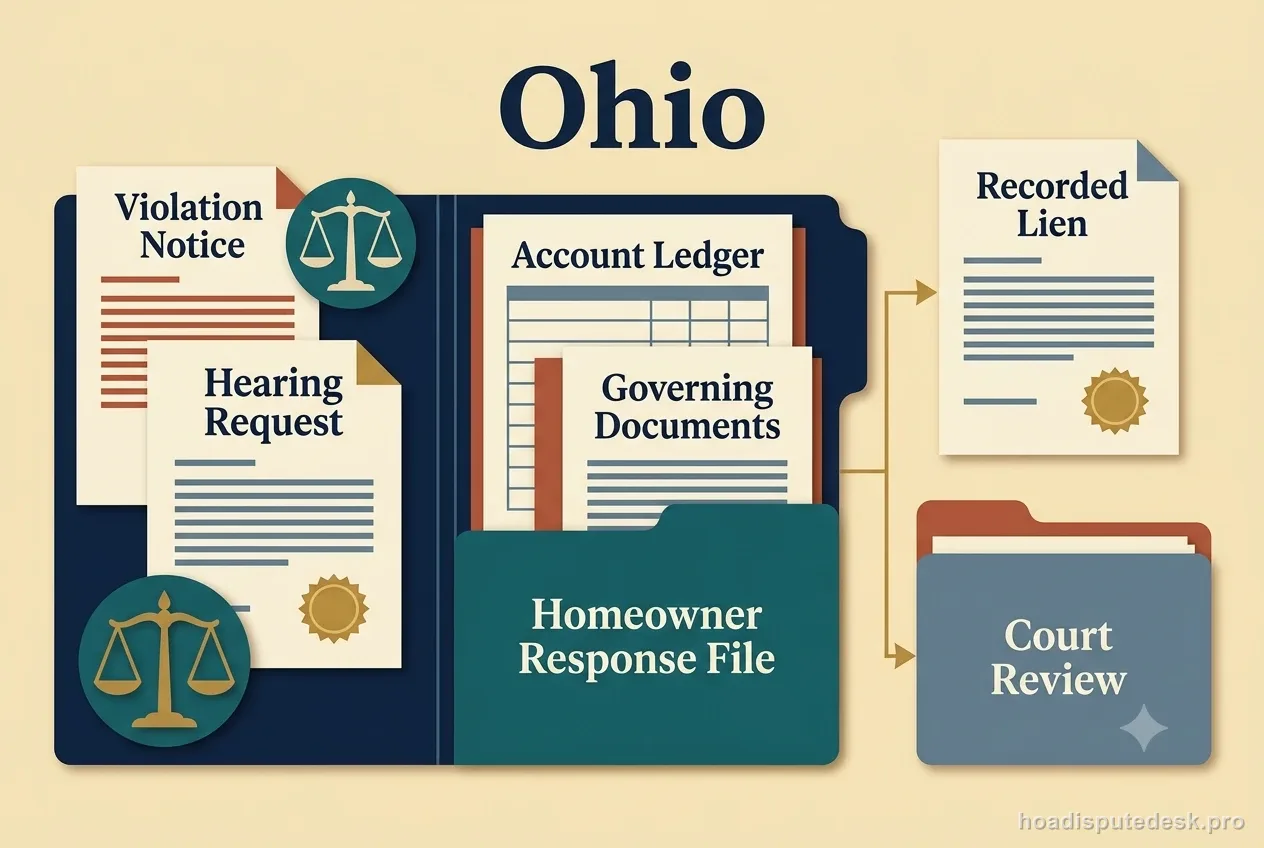
Ohio gives both planned communities and condominium associations statutory assessment liens. In each regime, qualifying charges unpaid for 10 days can be included in a recorded lien; a prior recorded first mortgage remains superior, and the association may foreclose the lien like a real-property mortgage. For enforcement assessments, an owner generally has 10 days after notice to request a hearing, with at least 7 days' notice of the hearing itself.
Ohio: planned-community law vs. condominium law
Before anything else in an Ohio dispute, pin down the property's legal form and when the declaration was recorded. For planned communities, start with Ohio Planned Community Law, Ohio Rev. Code Ch. 5312. For condominiums, start with Ohio Condominium Property Act, Ohio Rev. Code Ch. 5311. Do not take the board's or manager's label at face value — an older community may sit under a legacy statute or a transition provision, so confirm what actually applies before you count on a deadline, remedy, or voting rule.
In Ohio, confirm the legal regime before arguing the merits. Obtain the recorded declaration, amendments, bylaws, rules, and any board resolution connected to the dispute, then compare them with the statute applicable to that community type. This prevents a common mistake: applying a condominium rule to a planned community, or a newer statute to a property governed by transition provisions.
Disputing a regular or special assessment in Ohio
Break an assessment challenge into authority and math. The association should be able to point to the budget or board action behind the charge, the declaration provision that spreads common expenses, the date notice went out, and any owner vote that Ohio law or the governing documents made a precondition. Do not assume a special assessment cleared the same threshold as the regular budget; the two frequently carry separate voting requirements.
When challenging an assessment in Ohio, ask the association to reconcile the account in writing and preserve your objection at the same time. Keep the ledger, notices, proof of payment, and the governing provision the board cites. If only part of the balance is disputed, distinguish that part clearly; a broad payment stoppage can obscure the original issue and create additional collection consequences.
What Ohio requires before an association fine sticks
Ohio uses the term 'enforcement assessment' for many covenant-rule penalties. Under § 5312.11 for planned communities and § 5311.081 for condominiums, the board must give written notice describing the violation or damage, the proposed charge, the right to a hearing, the hearing-request procedure, and a reasonable cure date when cure is applicable. The owner has 10 days after receiving that notice to request a hearing.
If the owner timely requests a hearing, the board must give at least 7 days' written notice of the date, time, and location and cannot levy the charge before the requested hearing occurs. If the board imposes the charge after the hearing, it must send written notice of the charge within 30 days. Preserve each notice and delivery date because the statutory hearing window is short.
Ohio record-inspection rules and refusal remedies
Ohio has parallel statutory inspection rights. Planned-community owners may examine and copy association books, records, and minutes under § 5312.07; condominium owners have a similar right under § 5311.091. Both allow reasonable association standards for inspection and copying, but—unless the board approves otherwise—records older than five years and several protected categories can be withheld.
A targeted request should identify the ledger, budget, relevant minutes, rule, invoice or contract supporting the charge, and current declaration and amendments. Expect exclusions for personnel material, privileged or attorney work product, negotiations or confidentiality-protected contracts, enforcement information concerning other owners, and material whose disclosure is barred by law.
When an assessment lien attaches under Ohio law
For planned communities, § 5312.12 covers assessments and authorized charges that remain unpaid for 10 days; the lien becomes effective when the board-authorized certificate of lien is recorded and is valid for five years unless sooner released, satisfied, or discharged. For condominiums, § 5311.18 uses a parallel 10-day delinquency and recorded-certificate structure, also with a five-year lien period.
Neither statute creates a general super-lien over a prior first mortgage. The association lien is ahead of later liens but remains subject to real-estate taxes and qualifying first mortgages already filed of record. Check the certificate's owner name, legal description, amount, authorization, recording date, and the ledger entries that support it.
How association foreclosure works in Ohio
Both the planned-community lien statute, § 5312.12, and the condominium lien statute, § 5311.18, authorize foreclosure in the same manner as a mortgage on real property. That is a judicial foreclosure route, not an automatic trustee sale. An owner who believes a planned-community lien was improperly charged may bring a common-pleas action to discharge it; § 5311.18 provides a comparable discharge action for condominium owners.
If foreclosure begins, match the complaint to the recorded lien and ledger, and check the status of any prior mortgage and tax liens. Ohio's statutes also contemplate receivers in foreclosure cases, so an owner should not assume that possession of the property or rental income will remain untouched while the action is pending.
What to complete before filing in Ohio court
Ohio does not impose one blanket mediation-or-ADR requirement across association disputes. A pre-suit obligation, where it exists, comes from the statute for the particular claim, the declaration and bylaws, or a court's procedural rules, so read those rather than assuming.
Where Ohio HOA and condo disputes are decided
There is no single Ohio agency or tribunal that decides the merits of association disputes in place of the courts. Where a claim lands depends on what it is: a trial court for most disputes, small-claims or a limited-jurisdiction court for a qualifying money amount, or an arbitration or mediation track created by statute or the governing documents.
Sources
- Ohio Rev. Code § 5312.11 — official Ohio LawsPlanned-community enforcement assessments and 10-day hearing request process.
- Ohio Rev. Code § 5312.12 — official Ohio LawsPlanned-community lien, five-year duration, first-mortgage priority, and mortgage-style foreclosure.
- Ohio Rev. Code § 5312.07 — official Ohio LawsPlanned-community owner inspection rights and exclusions.
- Ohio Rev. Code § 5311.081 — official Ohio LawsCondominium enforcement assessments and hearing procedure.
- Ohio Rev. Code § 5311.18 — official Ohio LawsCondominium lien, priority, five-year duration, and judicial foreclosure.
- Ohio Rev. Code § 5311.091 — official Ohio LawsCondominium records inspection rights and exclusions.