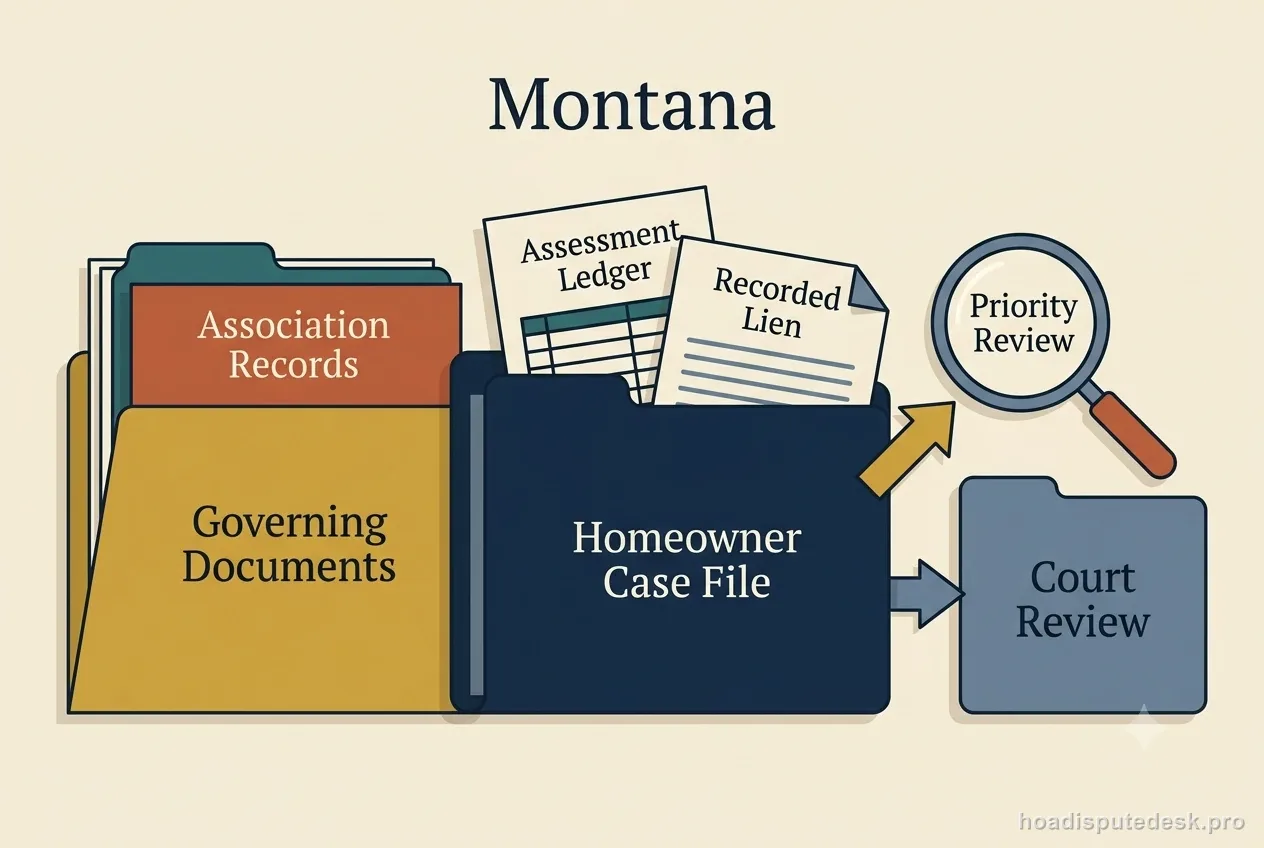
In Montana, first identify whether the property is an HOA or condominium, then apply the correct statute and governing documents. The foreclosure route is judicial or otherwise court-supervised. Do not presume super-priority over a first mortgage. Do not assume mediation is mandatory for every claim; check the dispute-specific statute and governing documents. Get the ledger, lien, and notices before choosing payment, ADR, or court relief.
Which Montana statute controls your dispute
Start a Montana association dispute by identifying the property's legal form and the declaration's recording date. For planned communities, no comprehensive Montana HOA act; nonprofit HOAs commonly operate under Mont. Code Ann. Title 35, ch. 2 plus recorded covenants and bylaws. For condominiums, start with Montana Unit Ownership Act — Condominiums, Mont. Code Ann. Title 70, ch. 23. The label a board or manager uses is not decisive on its own; older communities can be affected by legacy statutes or transition provisions, so check applicability before relying on a deadline, remedy, or voting rule.
In Montana, read the recorded declaration, amendments, bylaws, rules, and properly adopted resolutions alongside the statute. Governing documents can fill procedural gaps, but they do not override mandatory law. Before challenging a fine, assessment, records decision, or lien, confirm the declaration date and keep the exact version of every document the association says it relied on.
How Montana owners challenge an assessment vote
In Montana, an assessment challenge turns on authority and arithmetic. Because there is no comprehensive HOA act, the authority for a planned-community charge usually comes from the recorded declaration and the nonprofit corporation's bylaws rather than a statute; for a condominium, look to the Unit Ownership Act and the bylaws. Ask which budget or board action created the charge, which declaration clause allocates it, when notice went out, and whether any required owner vote actually occurred. A special assessment and the annual budget can carry different approval thresholds.
To contest a Montana charge, send a written objection and ask for the current owner ledger instead of withholding payment outright. Pay or escrow the part you concede, document the part you dispute, and keep every receipt and letter. Collection steps can proceed on the balance while the dispute runs, so require the board to show both its authority and its math for each contested line.
Sources: [1]
Contesting an Montana HOA fine and demanding a hearing
Montana subdivision enforcement rests heavily on covenants and nonprofit procedures. Condominium bylaws have statutory required contents, but the Act is not a modern UCIOA-style collection code.
Assemble the Montana enforcement record in date order — cited covenant or rule, any photos or complaint, first notice, the chance to cure, your response, the hearing request and its notice, the evidence the board weighed, and the outcome. Montana subdivision enforcement leans heavily on covenants and nonprofit procedure, so the covenant text and the board's own process are the center of the file. A selective-enforcement argument needs genuinely comparable properties over a comparable period, not an impression about the neighbors.
Records requests and inspection rights in Montana
Nonprofit corporate records statutes are especially important for ordinary HOAs. Condominium owners should also inspect the recorded declaration and bylaws.
Make a Montana records request specific enough to enforce. Identify the account ledger, budget, special-assessment resolution, relevant minutes, applicable rule, violation history for the property, supporting contract or invoice, and recorded declaration or amendments. Keep private-owner information in a separate category and, if records are withheld, ask the association to identify the legal basis for each withheld item.
The Montana assessment-lien timeline and priority
Do not assume an automatic statutory super-lien. Ask the association to identify the recorded instrument and statute supporting the lien, its priority, and the foreclosure method.
For a Montana lien, separate four questions: when it attaches, what recording or notice is required, how it ranks against other liens, and which steps make it enforceable. The Unit Ownership Act is not a modern UCIOA-style collection code, so a condominium lien's mechanics still come largely from the declaration. Read any recorded claim for owner name, legal description, charge period, amount, signature, filing date, and notice compliance — and remember priority is not the same as a right to foreclose.
Judicial vs. nonjudicial foreclosure for Montana HOAs
Montana is largely document-driven for association enforcement. A court-supervised foreclosure is the conservative default for a recorded assessment lien unless the declaration and other applicable law clearly support another valid mechanism. Owners should confirm the exact recorded covenant, lien language, and enforcement procedure before treating a collection notice as authority for a sale.
A Montana foreclosure notice calls for two immediate moves: calendar every date and pull a current ledger. Because association enforcement here is document-driven, confirm the recorded covenant or lien language that supposedly authorizes a sale before treating the notice as valid. Then check the charge categories, the required notices and addresses, the board's authorization, and any cure, payment-plan, reinstatement, or redemption right. The statute, court rule, or declaration — not an online timeline — sets the sequence.
Pre-suit steps Montana requires before a lawsuit
Do not assume one statewide mediation or ADR prerequisite applies to every Montana HOA or condominium dispute. Check the claim-specific statute, governing documents, and court rules for any required pre-suit step.
Sources: [1]
The forums that hear Montana association disputes
Montana does not have one statewide HOA merits tribunal that replaces the courts for every association dispute. Depending on the claim, the forum may be a trial court, a small-claims or limited-jurisdiction court for a qualifying money claim, or an arbitration/mediation process created by statute or the governing documents.
Sources: [1]
Sources
- Montana Legislature — Montana Code Annotated statute portalOfficial Montana statute portal; navigate to Title 70, chapter 23 for the Unit Ownership Act.
- MCA 70-23-307 — condominium bylaws; 75% amendment approvalOfficial Montana statute.
- MCA 70-23-308 — required contents of condominium bylawsOfficial Montana statute.
- MCA 35-2-906 — nonprofit corporate recordsOfficial Montana nonprofit-corporation record requirements.
- MCA 35-2-907 — member inspection of recordsOfficial Montana inspection provision.
- MCA 35-2-525 — HOA and unit-owner association remote meetingsOfficial Montana remote-meeting provision.