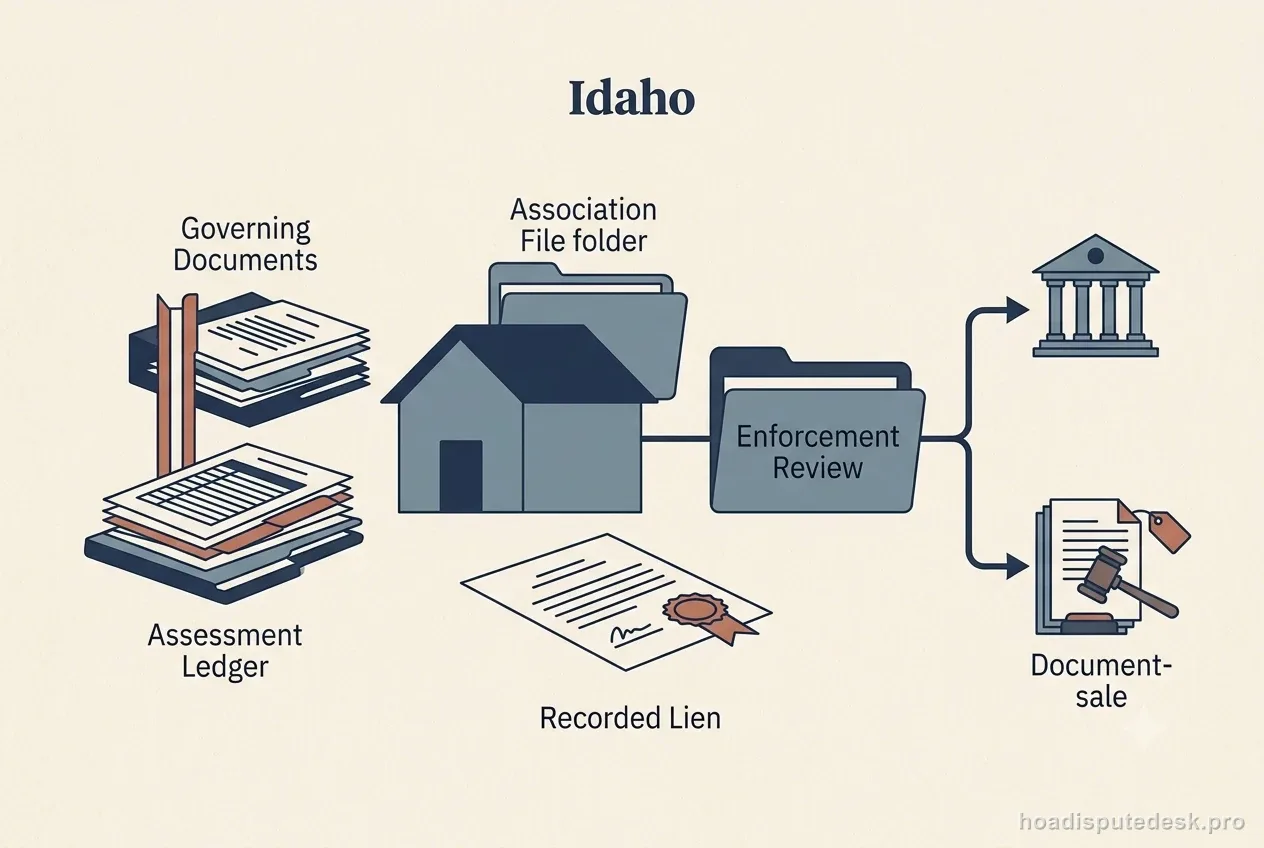
Idaho now gives owners unusually concrete process rights. A planned-community fine requires clear covenant authority, a majority board vote, and written notice at least 30 days before the meeting where the fine will be considered; a good-faith cure begun before that meeting can block the fine. HOA owners can also request a current assessment statement on a short statutory timetable. Condominium assessment liens are different: § 55-1518 permits enforcement by sale using deed-of-trust power-of-sale procedures.
Identifying the governing law in Idaho
Start an Idaho association dispute by identifying the property's legal form and the declaration's recording date. For planned communities, start with Homeowner's Association Act, Idaho Code tit. 55, ch. 32. For condominiums, start with Condominium Property Act, Idaho Code tit. 55, ch. 15. The label a board or manager uses is not decisive on its own; older communities can be affected by legacy statutes or transition provisions, so check applicability before relying on a deadline, remedy, or voting rule.
In an Idaho matter, read the recorded declaration next to the current statute rather than trusting a portal summary or a management-company label. Request the amendments, bylaws, rules, and board resolutions. Transition and applicability provisions can decide the outcome in an older community, so keep whatever shows when the community was formed and which regime it now claims.
Assessment and special-assessment challenges under Idaho law
Read an assessment dispute as two questions: did the association have authority to levy the charge, and is the calculation correct. Ask which budget line or board vote created it, which declaration clause allocates common expenses among units, when owners were notified, and — where Idaho law or the governing documents required an owner vote — whether that vote actually took place. Ordinary annual dues and a special assessment often follow different approval paths, so confirm which one governs the charge in front of you.
Preserve an assessment challenge in writing in Idaho and ask for a ledger that shows charges, credits, interest, late fees, and collection costs separately. Withholding every payment can create a second dispute over delinquency, so document what you are contesting and why. If you make a payment while the dispute is open, keep proof and avoid assuming that a particular 'under protest' label has the same legal effect in every claim.
Sources: [1]
Fine notices and hearing rights in Idaho
For a planned-community HOA, § 55-3206 is much more specific than a generic “notice and hearing” rule. The covenant must clearly authorize the fine, the board must approve it by majority vote, and the owner must receive written notice at least 30 days before the board meeting at which the fine will be considered. If the owner begins curing the violation before that meeting and continues the cure in good faith, the statute limits the association’s ability to impose the fine.
Build the file around those statutory checkpoints: the exact covenant, the date and method of notice, the scheduled board meeting, evidence of any cure, and the board vote. Do not mix this planned-community procedure with the separate Condominium Property Act, which uses its own declaration and management-body framework.
Sources: [8]
How to get board records from an Idaho association
Idaho gives planned-community owners concrete financial-disclosure tools. Under § 55-3205, an owner can request a statement of the amount of assessments owed and the association must provide the statutory statement within five business days; the section also sets a ten-business-day timetable for specified updated financial disclosure. Condominium owners have a parallel account-statement provision in § 55-1528.
Use those short deadlines before arguing from a portal balance. Request the owner ledger, current assessment statement, annual budget and fee disclosures, the rule or covenant supporting the charge, and the board record tied to any fine or special assessment. Preserve proof of the request and the date the association responded.
How Idaho associations perfect an assessment lien
Idaho uses different lien statutes for the two community types. For condominiums, § 55-1518 says a lien arises when the management body records a notice of assessment with the county recorder. It generally has priority over liens recorded later, subject to statutory and declaration-based exceptions, and expires one year after recording unless enforcement begins or a written extension of up to one additional year is recorded.
For planned-community HOAs, § 55-3207 creates a separate assessment-lien procedure. Verify the claim, recording, service of the recorded lien, amount, and charge categories under that statute and the declaration. Neither regime should be summarized as a universal superpriority over a previously recorded first mortgage.
The Idaho HOA foreclosure route, step by step
Idaho condominium law is not purely judicial. Section 55-1518 expressly allows the management body to enforce a recorded condominium assessment lien by sale in the manner permitted for exercising a power of sale in a deed of trust, or by another lawful method. That is materially different from the prior generic “court-supervised” description.
Planned-community HOA enforcement follows the separate Chapter 32 lien statute and the recorded governing documents, so do not import the condominium power-of-sale language automatically. For either type, obtain the actual lien and sale papers, verify recording and service, and calendar every cure, trustee-sale, or court deadline.
Mandatory ADR and notice before suing in Idaho
There is no single Idaho rule that pushes every HOA or condominium dispute through mediation or arbitration before filing. Whether a pre-suit step is mandatory depends on the specific claim, what the governing documents say, and the court's own rules — check all three.
Sources: [1]
Idaho: courts, agencies, and ADR panels for these cases
There is no single Idaho agency or tribunal that decides the merits of association disputes in place of the courts. Where a claim lands depends on what it is: a trial court for most disputes, small-claims or a limited-jurisdiction court for a qualifying money amount, or an arbitration or mediation track created by statute or the governing documents.
Sources: [1]
Sources
- Idaho Code, Title 55, Chapter 32 — Homeowner’s Association ActOfficial Idaho Legislature statute portal for the primary HOA act.
- Idaho Code, Title 55, Chapter 15 — Condominium Property ActOfficial Idaho Legislature statute portal for condominiums.
- 2025 Idaho Code § 55-3204 — Meetings and governanceSecondary section-text mirror; the official Idaho Legislature code should control if the texts differ.
- 2025 Idaho Code § 55-3205 — Financial disclosures and recordsSecondary section-text mirror; use the official Idaho Legislature code as the controlling text.
- 2025 Idaho Code § 55-3206 — FinesSecondary mirror for fine procedure; recheck current official text and 2026 amendments.
- Idaho House Bill 361 (2025) — HOA governance changesOfficial Idaho Legislature bill page for post-declarant board and proxy changes applying to certain HOAs formed after July 1, 2025.
- Idaho Code § 55-1518 — condominium assessment lien and saleCondominium assessment lien, recording, priority, one-year duration/extension, and enforcement by sale using deed-of-trust power-of-sale procedures.
- Idaho Code § 55-3206 — HOA finesCurrent HOA fine procedure, including governing-document authority, board vote, advance notice, and cure protection.
- Idaho Code § 55-3205 — HOA disclosures and account statementCurrent disclosure and account-statement deadlines for homeowners associations.
- Idaho Code § 55-3207 — HOA assessment lienCurrent planned-community assessment lien procedure, including filing/recording and service requirements.