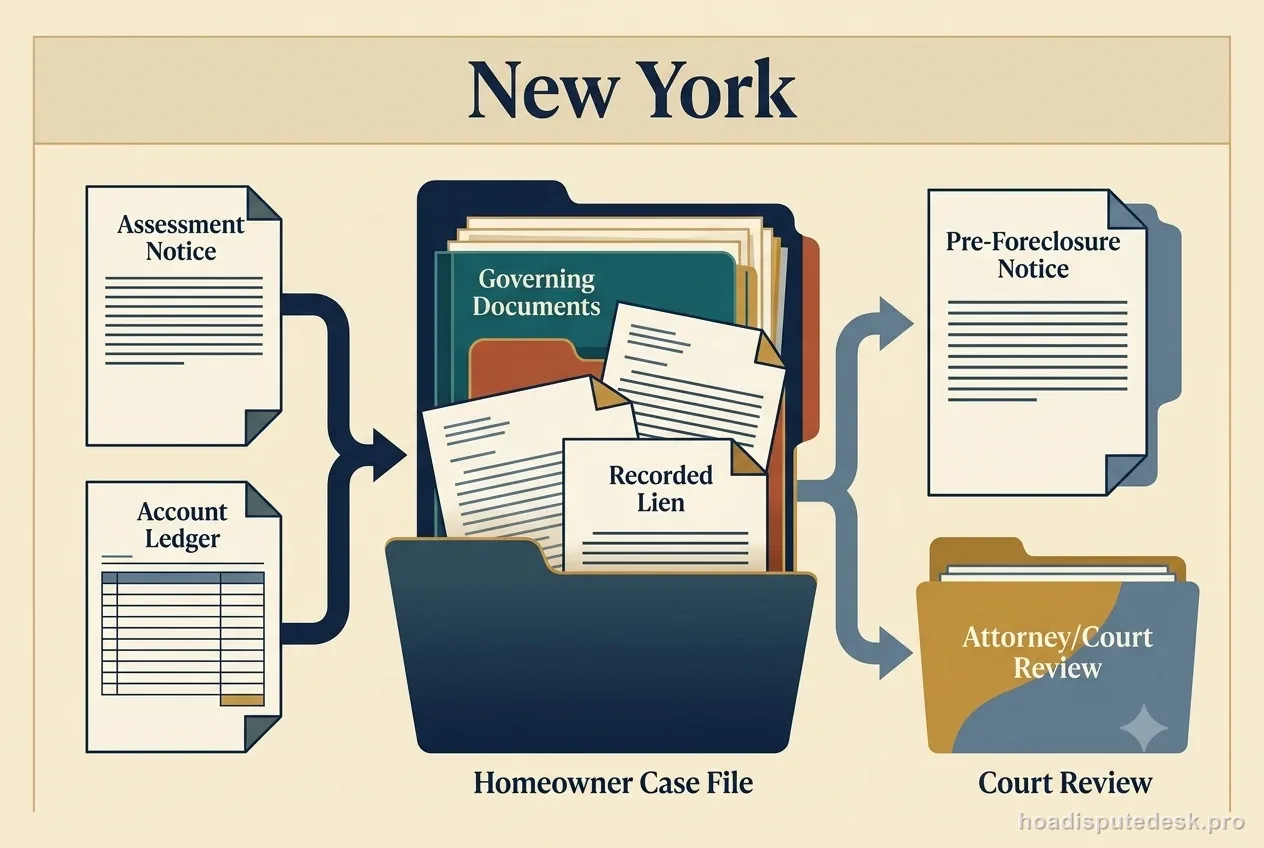
New York has no single statewide HOA act for ordinary subdivisions, while condominiums are governed by Real Property Law Article 9-B. A condo common-charge lien is filed under § 339-aa, remains subordinate to a prior first mortgage under § 339-z, and is foreclosed by judicial suit like a mortgage. Current law requires at least 90 days' notice to the unit owner before the board starts that foreclosure action.
Which New York statute controls your dispute
Before anything else in a New York dispute, pin down the property's legal form and when the declaration was recorded. For planned communities, no comprehensive New York HOA act; recorded declarations/bylaws plus nonprofit or business-corporation law commonly control. For condominiums, start with New York Condominium Act, Real Property Law Article 9-B, §§ 339-d et seq. Do not take the board's or manager's label at face value — an older community may sit under a legacy statute or a transition provision, so confirm what actually applies before you count on a deadline, remedy, or voting rule.
In a New York matter, read the recorded declaration next to the current statute rather than trusting a portal summary or a management-company label. Request the amendments, bylaws, rules, and board resolutions. Transition and applicability provisions can decide the outcome in an older community, so keep whatever shows when the community was formed and which regime it now claims.
Sources: [4]
How New York owners challenge an assessment vote
Read an assessment dispute as two questions: did the association have authority to levy the charge, and is the calculation correct. Ask which budget line or board vote created it, which declaration clause allocates common expenses among units, when owners were notified, and — where New York law or the governing documents required an owner vote — whether that vote actually took place. Ordinary annual dues and a special assessment often follow different approval paths, so confirm which one governs the charge in front of you.
Preserve an assessment challenge in writing in New York and ask for a ledger that shows charges, credits, interest, late fees, and collection costs separately. Withholding every payment can create a second dispute over delinquency, so document what you are contesting and why. If you make a payment while the dispute is open, keep proof and avoid assuming that a particular 'under protest' label has the same legal effect in every claim.
Sources: [4]
Contesting an New York HOA fine and demanding a hearing
Subdivision HOA fines are primarily contract/document based. Condominium boards should identify authority in Article 9-B and the bylaws, and owners should request the notice and decision record.
For a fine or covenant dispute in New York, preserve the chronology. Keep the cited rule, the alleged violation evidence, notice, any cure deadline, hearing materials, your response, and the final decision. A selective-enforcement argument is fact intensive, so document materially similar examples with dates and records instead of relying on general neighborhood impressions.
Sources: [4]
Records requests and inspection rights in New York
For condominiums, RPL § 339-w requires detailed chronological records of receipts and expenditures and the vouchers authorizing payments to be available for unit-owner examination at convenient weekday hours. The board must also provide a written summary of receipts and expenditures at least annually. Subdivision HOA inspection rights may instead come from the association's governing documents and the corporate statute under which it is organized.
A useful New York request names the account ledger, annual financial report, vouchers or invoices supporting the disputed charge, relevant minutes, rules, and the current declaration and amendments. If the association is not a condominium, identify whether it is organized under the Not-for-Profit Corporation Law or another entity statute before citing a corporate inspection right.
Sources: [3]
The New York assessment-lien timeline and priority
For condominiums, RPL § 339-z gives the board a lien for unpaid common charges but expressly leaves recorded first-mortgage debt ahead of that lien in the ordinary residential case. Section 339-aa makes the lien effective after a verified notice of lien is filed with the recording officer and generally limits its duration to six years from filing unless it is sooner paid or enforcement changes that result.
Check the filed notice itself: property address, declaration recording reference, record owner, unit designation, amount and purpose, and due date. A subdivision HOA does not automatically receive Article 9-B's condo lien powers; its assessment remedies depend on the recorded covenants and other applicable law.
Judicial vs. nonjudicial foreclosure for New York HOAs
RPL § 339-aa authorizes the condominium board to foreclose its common-charge lien by suit in the same manner as a mortgage foreclosure under RPAPL Article 13. Current § 339-aa also requires the board to give the unit owner at least 90 days' notice before commencing the foreclosure proceeding, sent to the property address and any other address of record, stating the property and the specific amount due.
Once a New York condo foreclosure threat appears, preserve the filed lien and the 90-day notice, then compare the amount in each with the ledger. A subdivision HOA may have a different enforcement route because Article 9-B does not supply a universal foreclosure mechanism for every deed-restricted community.
Pre-suit steps New York requires before a lawsuit
There is no single New York rule that pushes every HOA or condominium dispute through mediation or arbitration before filing. Whether a pre-suit step is mandatory depends on the specific claim, what the governing documents say, and the court's own rules — check all three.
Sources: [4]
The forums that hear New York association disputes
There is no single New York agency or tribunal that decides the merits of association disputes in place of the courts. Where a claim lands depends on what it is: a trial court for most disputes, small-claims or a limited-jurisdiction court for a qualifying money amount, or an arbitration or mediation track created by statute or the governing documents.
Sources: [4]
Sources
- N.Y. Real Property Law § 339-z — official NY SenateCondominium common-charge lien and priority; prior first mortgage remains superior.
- N.Y. Real Property Law § 339-aa — official NY SenateLien filing, six-year duration, judicial foreclosure, and current 90-day pre-foreclosure notice.
- N.Y. Real Property Law § 339-w — official NY SenateCondominium receipt/expenditure records and annual written report.
- New York Real Property Law Article 9-B — official NY SenateCondominium Act index and surrounding provisions.