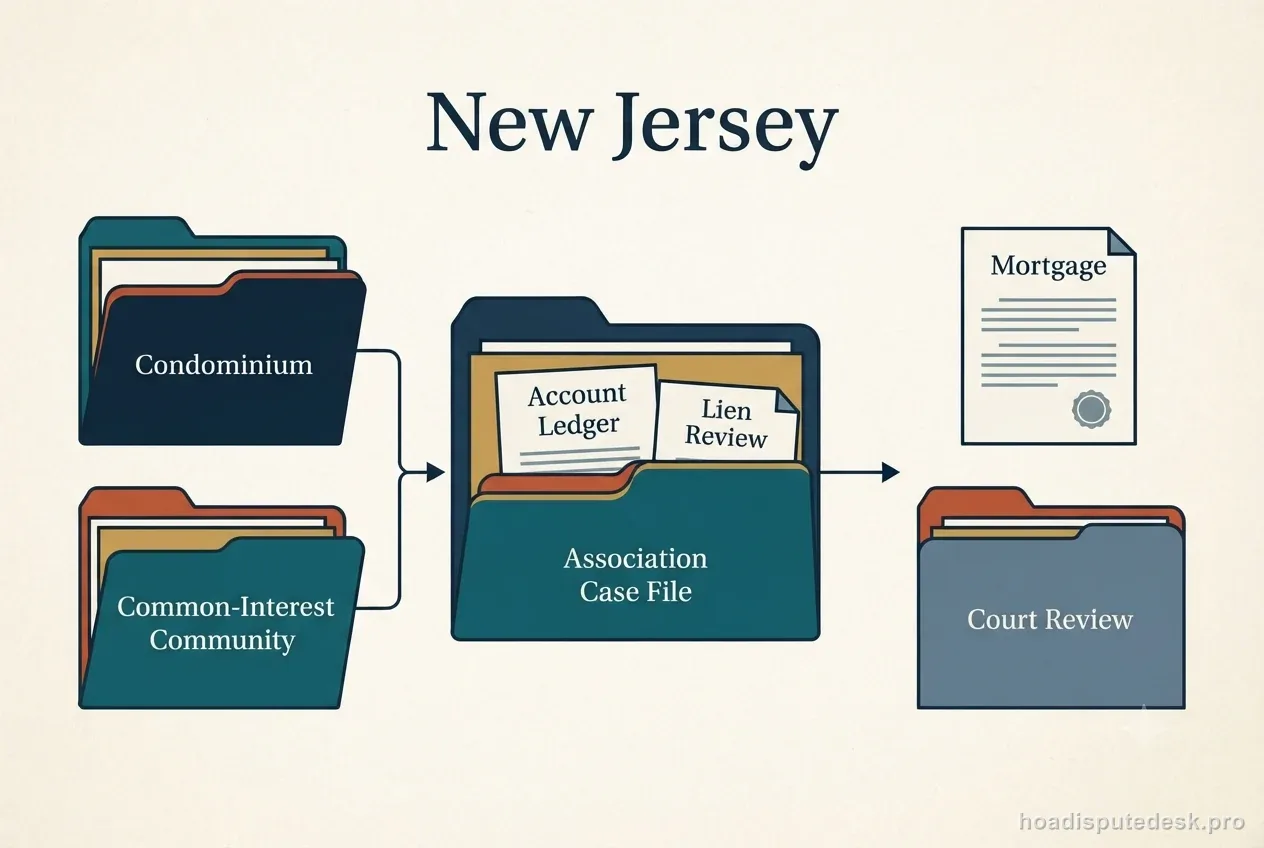
New Jersey uses separate condominium and planned-real-estate statutes, but both can provide a narrow six-month lien priority for qualifying customary assessments. Condominiums use N.J.S.A. 46:8B-21; qualifying non-cooperative common-interest communities use the parallel rule in N.J.S.A. 45:22A-44.1. Association liens are enforced through court proceedings, and many common-interest disputes also carry statutory alternative-dispute-resolution rights.
Identifying the governing law in New Jersey
The first step in a New Jersey dispute is establishing whether the property is a planned community or a condominium, plus the declaration's recording date. For planned communities, start with Planned Real Estate Development Full Disclosure Act, N.J.S.A. 45:22A-21 et seq., including association-governance provisions at 45:22A-43 et seq. For condominiums, start with New Jersey Condominium Act, N.J.S.A. 46:8B-1 et seq., plus PREDFA governance provisions that reach planned real estate development associations. A label from the board or management company is not conclusive; legacy statutes and transition rules can govern an older community, so verify applicability before relying on any deadline, remedy, or voting rule.
In New Jersey, confirm the legal regime before arguing the merits. Obtain the recorded declaration, amendments, bylaws, rules, and any board resolution connected to the dispute, then compare them with the statute applicable to that community type. This prevents a common mistake: applying a condominium rule to a planned community, or a newer statute to a property governed by transition provisions.
Assessment and special-assessment challenges under New Jersey law
Read an assessment dispute as two questions: did the association have authority to levy the charge, and is the calculation correct. Ask which budget line or board vote created it, which declaration clause allocates common expenses among units, when owners were notified, and — where New Jersey law or the governing documents required an owner vote — whether that vote actually took place. Ordinary annual dues and a special assessment often follow different approval paths, so confirm which one governs the charge in front of you.
When challenging an assessment in New Jersey, ask the association to reconcile the account in writing and preserve your objection at the same time. Keep the ledger, notices, proof of payment, and the governing provision the board cites. If only part of the balance is disputed, distinguish that part clearly; a broad payment stoppage can obscure the original issue and create additional collection consequences.
Sources: [1]
Fine notices and hearing rights in New Jersey
New Jersey requires due process and fundamental fairness in common-interest governance. Owners should preserve notice, hearing/ADR requests, evidence, and the written result before a fine moves into collection.
The most useful record in a New Jersey fine dispute is a dated enforcement file. Include the governing provision, initial notice, evidence, cure communications, hearing request, hearing notice, material considered, and final decision. If the issue is inconsistent enforcement, document comparable cases carefully; visual similarity alone does not establish that the properties were legally or factually alike.
How to get board records from an New Jersey association
PREDFA, the Condominium Act, DCA regulations, and governing documents overlap. Ask the association to identify the rule used for any confidentiality denial.
Treat a New Jersey records request as an evidence request, not a fishing expedition. Ask for the ledger, approval records, relevant minutes, rules, invoices, contracts, and recorded governing documents that bear on the issue. Separate categories that may contain other owners' private information. A written refusal should identify what was withheld and why so the dispute is defined.
How New Jersey associations perfect an assessment lien
New Jersey provides a limited six-month priority for qualifying customary assessments. Condominiums use N.J.S.A. 46:8B-21; since P.L. 2019, c.68, qualifying common-interest communities other than cooperatives can use the parallel priority structure in N.J.S.A. 45:22A-44.1. The priority is narrow and does not make every charge or every association lien senior to a first mortgage.
When reviewing an association lien in New Jersey, separate the debt from the lien and the lien from foreclosure. Check the assessment ledger, any pre-lien notice, the recorded claim, legal description, amount, execution, and filing date. Then analyze priority and enforcement. This sequence avoids assuming that a recorded lien automatically outranks a mortgage or automatically permits a sale.
The New Jersey HOA foreclosure route, step by step
New Jersey association liens are enforced through judicial foreclosure or other court proceedings. The owner should identify whether the property is a condominium or another qualifying common-interest community, verify what portion of the lien receives any statutory priority, and then follow the court papers and deadlines rather than treating the recorded lien as an automatic sale mechanism.
If a lien moves toward foreclosure in New Jersey, work from the actual documents. Calendar the dates, reconcile the ledger, identify any statutory minimum or excluded charges, and check notice, board approval, cure, payment-plan, and redemption rules that apply. National summaries can miss a state-specific court, trustee, or filing step.
Mandatory ADR and notice before suing in New Jersey
New Jersey recognizes statutory alternative dispute resolution rights for certain common-interest-community disputes. The precise ADR route depends on the claim and community type.
Sources: [1]
New Jersey: courts, agencies, and ADR panels for these cases
New Jersey’s Department of Community Affairs administers Planned Real Estate Development and association-governance requirements within its statutory and regulatory jurisdiction. It is not a substitute for court in every lien or foreclosure case, so separate DCA complaints or ADR rights from claims that require judicial relief.
Sources: [1]
Sources
- New Jersey Legislature — current unannotated statutes portalOfficial New Jersey statute publication directory for the current Title 46 Condominium Act text.
- P.L.2025, c.132 — amended capital reserve study and 30-year funding rulesOfficial enacted law amending P.L.2023, c.214.
- New Jersey DCA — Structural Integrity / Capital Reserve Studies FAQOfficial DCA guidance on reserve-study timing, exemptions, and administration.
- P.L.2023, c.214 — original structural integrity and reserve study lawOfficial enacted law; use with 2025 amendments.
- N.J.S.A. 45:22A-46 — association bylaws and open meetingsOfficial PREDFA governance provision in the New Jersey statutory portal.
- New Jersey DCA — N.J.A.C. 5:26 Planned Real Estate Development regulationsOfficial current regulation compilation; § 5:26-8.12 contains open-meeting notice and minutes rules.
- N.J.S.A. 46:8B-21 — condominium association liens and limited priorityOfficial New Jersey statutory text for condominium liens, including the six-month limited priority.
- P.L. 2019, c.68 / N.J.S.A. 45:22A-44.1 — common-interest-community lien priorityOfficial enacted law extending a parallel six-month limited-priority structure to qualifying common-interest communities other than cooperatives.