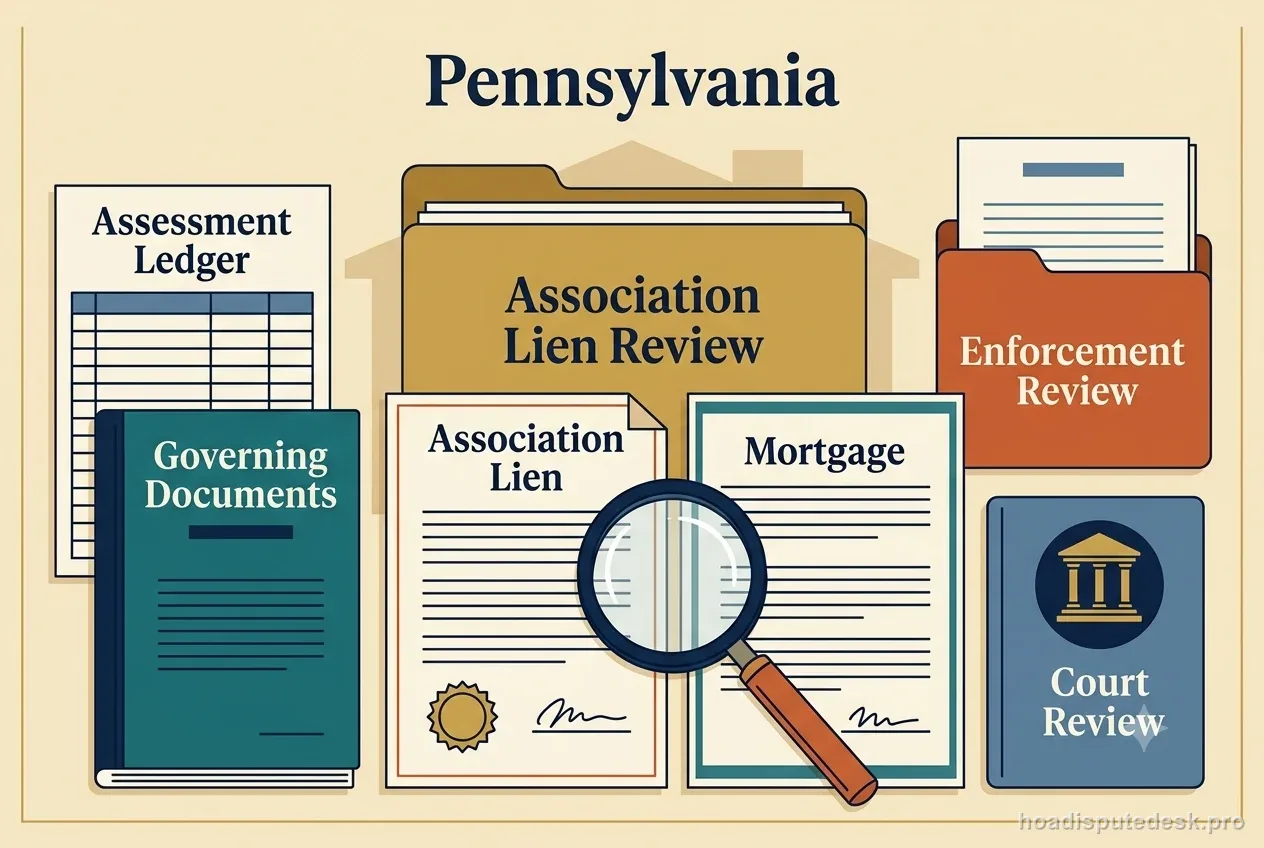
Pennsylvania's condominium and planned-community acts create assessment liens that may be foreclosed like real-estate mortgages. A prior first mortgage is generally protected, but §§ 3315 and 5315 preserve a six-month slice of qualifying common-expense assessments at a judicial sale through the statutes' limited-nondivestiture rule. Treat that as a narrow sale-proceeds protection, not as blanket first-mortgage priority for every fine, fee, legal charge, or older assessment.
Pennsylvania: planned-community law vs. condominium law
The first step in a Pennsylvania dispute is establishing whether the property is a planned community or a condominium, plus the declaration's recording date. For planned communities, start with Pennsylvania Uniform Planned Community Act, 68 Pa.C.S. Chs. 51–54. For condominiums, start with Pennsylvania Uniform Condominium Act, 68 Pa.C.S. Chs. 31–34. A label from the board or management company is not conclusive; legacy statutes and transition rules can govern an older community, so verify applicability before relying on any deadline, remedy, or voting rule.
Do not treat the statute as a substitute for the declaration in Pennsylvania. Pull the declaration and amendments, bylaws, rules, and any resolution tied to the disputed charge or enforcement action. The useful question is whether the association had authority under both mandatory law and its own governing documents, using the versions that were actually in effect when the dispute arose.
Disputing a regular or special assessment in Pennsylvania
Break an assessment challenge into authority and math. The association should be able to point to the budget or board action behind the charge, the declaration provision that spreads common expenses, the date notice went out, and any owner vote that Pennsylvania law or the governing documents made a precondition. Do not assume a special assessment cleared the same threshold as the regular budget; the two frequently carry separate voting requirements.
For a disputed Pennsylvania assessment, build the paper trail before choosing a payment strategy. Ask for the complete ledger, the budget or resolution supporting the charge, and any notice or vote the association relies on. State clearly which part you challenge. That makes it easier to test the association's authority without turning an accounting disagreement into an avoidable delinquency dispute.
Sources: [1]
What Pennsylvania requires before an association fine sticks
Both uniform acts integrate association powers and owner protections. A homeowner should identify whether the disputed amount is a fine or periodic assessment because lien priority and foreclosability can differ.
In Pennsylvania, a useful fine-defense file is a timeline rather than a stack of screenshots. Match the cited covenant to the notice, the notice to any cure period, and the hearing record to the final decision. If unequal treatment is part of the dispute, collect comparable examples that involve the same rule and similar facts; unsupported neighbor comparisons are usually weak evidence.
Pennsylvania record-inspection rules and refusal remedies
The uniform acts contain association-record rights. Make requests in writing and preserve the response, especially when the dispute concerns the calculation of an assessment or legal fees.
For records in Pennsylvania, narrow the request to documents that answer the dispute: owner ledger, budget or assessment approval, minutes, governing rule, property-specific enforcement history, supporting invoices, and recorded declaration or amendments. A focused request creates a cleaner record if access is denied. Ask for the basis of any refusal or redaction rather than debating it informally.
When an assessment lien attaches under Pennsylvania law
Sections 3315 (condominiums) and 5315 (planned communities) create a lien from the time an assessment or fine becomes due and allow foreclosure in the same manner as a mortgage on real estate. A first mortgage recorded before the relevant assessment is generally one of the statutory exceptions to the association's ordinary priority. The important Pennsylvania wrinkle appears in subsection (b)(2), labeled 'Limited nondivestiture.'
At a judicial sale in an action to enforce a lien against the unit, qualifying unpaid common-expense assessments that came due during the six months immediately preceding the sale are divested only to the extent that those six months are paid from sale proceeds. Older unpaid assessments receive a different, junior treatment after senior sale costs and liens. Calling this a 'six-month super-lien' can be convenient shorthand, but it is safer for homeowners to analyze the actual limited-nondivestiture language rather than assume every component of the association ledger outranks a first mortgage.
How association foreclosure works in Pennsylvania
Pennsylvania's Uniform Condominium Act and Uniform Planned Community Act both state that the association's assessment lien may be foreclosed in like manner as a mortgage on real estate. A homeowner should therefore treat a filed foreclosure complaint and judicial-sale schedule as court deadlines, not as an internal HOA collection step. The association can also pursue personal liability without necessarily giving up its lien remedies.
If lien priority matters, obtain the proposed distribution or payoff and separate the six-month common-expense component from fines, late charges, attorney fees, special items, and assessments outside that window. The limited-nondivestiture provisions in §§ 3315(b)(2) and 5315(b)(2) are tied to a judicial sale and should not be converted into a broad statement that the association automatically has six months of first-position lien from the moment a payment is missed.
What to complete before filing in Pennsylvania court
Pennsylvania does not impose one blanket mediation-or-ADR requirement across association disputes. A pre-suit obligation, where it exists, comes from the statute for the particular claim, the declaration and bylaws, or a court's procedural rules, so read those rather than assuming.
Sources: [1]
Where Pennsylvania HOA and condo disputes are decided
There is no single Pennsylvania agency or tribunal that decides the merits of association disputes in place of the courts. Where a claim lands depends on what it is: a trial court for most disputes, small-claims or a limited-jurisdiction court for a qualifying money amount, or an arbitration or mediation track created by statute or the governing documents.
Sources: [1]
Sources
- Pennsylvania General Assembly — 68 Pa.C.S. § 3315Condominium assessment lien, mortgage-style foreclosure, priority and limited nondivestiture.
- Pennsylvania General Assembly — 68 Pa.C.S. § 5315Planned-community assessment lien, mortgage-style foreclosure, priority and limited nondivestiture.
- Pennsylvania General Assembly — Title 68Current consolidated text for the Uniform Condominium and Planned Community Acts.