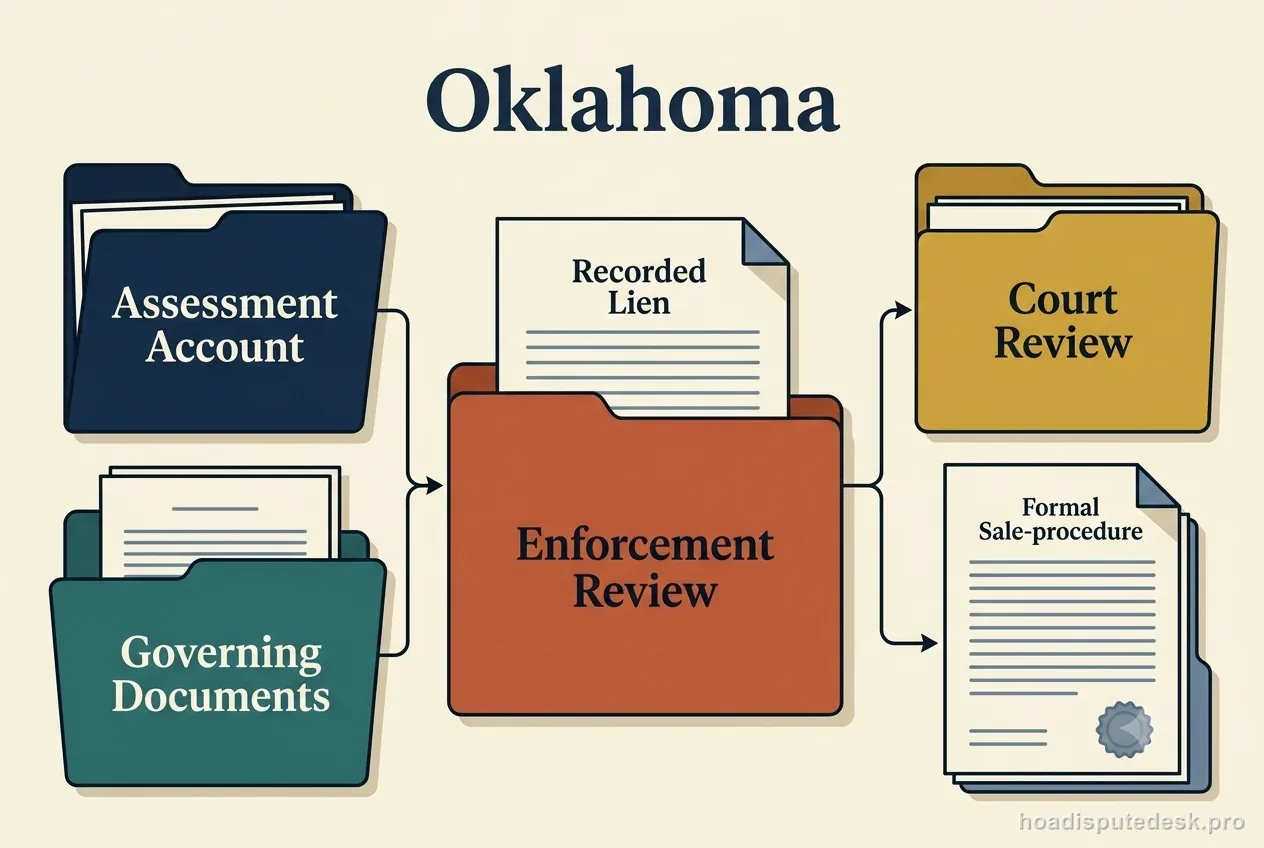
Oklahoma separates subdivision owners associations from unit-ownership condominiums. Section 60-852 lets a qualifying owners association enforce membership obligations through assessments that may become liens and be foreclosed by mortgage or deed-of-trust methods, with or without a power of sale. Condominium § 60-524 instead calls for a foreclosure suit like a mortgage. Neither statute gives the association a broad first-mortgage super-priority.
Identifying the governing law in Oklahoma
For a subdivision owners association, start with the Oklahoma Real Estate Development Act, 60 O.S. §§ 851–858, especially § 852. The statute applies to an owners association formed by the recorded instrument described there; § 855 limits the Act's application, so an older development should not be forced into this framework without checking when and how the association was created. For a condominium organized as a unit ownership estate, use the separate Unit Ownership Estate Act, 60 O.S. §§ 501–530.
The distinction matters because the two statutes do not use the same lien-enforcement language. The recorded declaration and bylaws still matter for the amount and procedure of assessments, but the statute supplies important enforcement rules that should not be replaced with generic covenant language. Preserve the recorded instrument, all amendments, the current rules, the owner ledger, and the notice the association says triggered the charge.
Assessment and special-assessment challenges under Oklahoma law
Read an assessment dispute as two questions: did the association have authority to levy the charge, and is the calculation correct. Ask which budget line or board vote created it, which declaration clause allocates common expenses among units, when owners were notified, and — where Oklahoma law or the governing documents required an owner vote — whether that vote actually took place. Ordinary annual dues and a special assessment often follow different approval paths, so confirm which one governs the charge in front of you.
To contest an Oklahoma assessment, put the objection in writing and ask for a current owner ledger instead of just withholding payment. Split what you concede from what you dispute, and keep every payment record and objection. Collection activity can continue on the unpaid balance while the dispute runs, so require the association to show the authority and the calculation for each line you challenge.
Sources: [1]
Fine notices and hearing rights in Oklahoma
Oklahoma's Real Estate Development Act gives an owners association power to enforce membership obligations, but § 852 does not create a detailed statewide fine-hearing procedure. That makes the recorded restrictions, bylaws, adopted rules, and ordinary due-process principles central to a fine dispute. Ask the board to identify the exact covenant or rule, the authority for the amount, the date and method of notice, any cure opportunity, and any hearing or appeal procedure promised by the documents.
For a condominium, the Unit Ownership Estate Act likewise does not supply the kind of comprehensive fine-hearing code found in some newer uniform-act states. Do not let the association re-label a disputed fine as a routine assessment without checking the declaration and bylaws. Build a dated enforcement file containing the alleged violation, photographs or complaints, every notice, the owner's response, hearing materials, board decision, and the ledger entry.
How to get board records from an Oklahoma association
Oklahoma condominium owners have a concrete statutory records provision in 60 O.S. § 521. The administrator or board must keep a chronological book of receipts and expenditures affecting the common elements, with the related vouchers, and both must be available to unit owners at convenient hours on announced working days. A condominium records request should cite § 521 and identify the accounting period and entries in dispute.
Section 852 does not give subdivision HOA members an equally detailed records code. For those communities, inspect the association's governing documents and, where applicable, Oklahoma entity law for additional inspection rights. In either setting, request the owner ledger, budget, assessment resolution, minutes tied to the charge, collection contract or policy, and the version of the restriction the association is enforcing rather than asking for an undefined universe of records.
Sources: [1]
How Oklahoma associations perfect an assessment lien
For a qualifying subdivision owners association, § 852(C) authorizes enforcement of a membership obligation by a levy or assessment that may become a lien on separately or commonly owned property of a defaulting owner. The same subsection allows foreclosure by any method Oklahoma law provides for mortgages or deeds of trust, with or without a power of sale. It also states that no lien may be placed or mortgage foreclosed unless the homeowner was informed in writing, on joining the association, of the restrictions and rules and the potential financial liability.
Condominium § 524 works differently. Unpaid common-expense assessments constitute a lien, but the statute expressly leaves prior taxes, prior judgments, prior recorded mortgages, and specified mechanics' or materialmen's liens ahead of it. That is why this guide does not describe Oklahoma as a condominium super-lien state. Before paying a demanded payoff, compare the assessment date, mortgage recording date, claimed fees, and the statutory or document authority for each ledger component.
Sources: [1]
The Oklahoma HOA foreclosure route, step by step
Oklahoma does not have one foreclosure sentence that fits every association. For a subdivision owners association within § 852, the assessment lien may be foreclosed in a manner Oklahoma law provides for mortgages or deeds of trust, expressly including methods with or without a power of sale. That does not mean every HOA can immediately schedule a sale: the association must first fit § 852, satisfy the recorded instrument, comply with the written-information prerequisite in subsection C, and follow the foreclosure law governing the method selected.
For a condominium, § 524(b) is more specific: the assessment lien may be foreclosed by a suit brought by the council of unit owners or its authorized agent in like manner as a mortgage foreclosure. The association may also pursue a money judgment without waiving the lien. A homeowner who receives a petition, notice of sale, or trustee-related notice should identify whether the collector is invoking § 852 or § 524 before evaluating deadlines and defenses.
Sources: [1]
Mandatory ADR and notice before suing in Oklahoma
There is no single Oklahoma rule that pushes every HOA or condominium dispute through mediation or arbitration before filing. Whether a pre-suit step is mandatory depends on the specific claim, what the governing documents say, and the court's own rules — check all three.
Sources: [1]
Oklahoma: courts, agencies, and ADR panels for these cases
Oklahoma routes association disputes through the regular court system rather than a dedicated HOA tribunal. The right forum turns on the claim — general trial court, small-claims or limited-jurisdiction court for a money claim under the threshold, or a statute- or document-created arbitration or mediation process.
Sources: [1]
Sources
- Oklahoma Legislature — Title 60, §§ 521, 524 and 851–858Official current Title 60 compilation covering condominium records/assessment liens and the owners-association provisions used in this guide.
- Oklahoma Legislature — statutes portalOfficial Oklahoma statutory index.