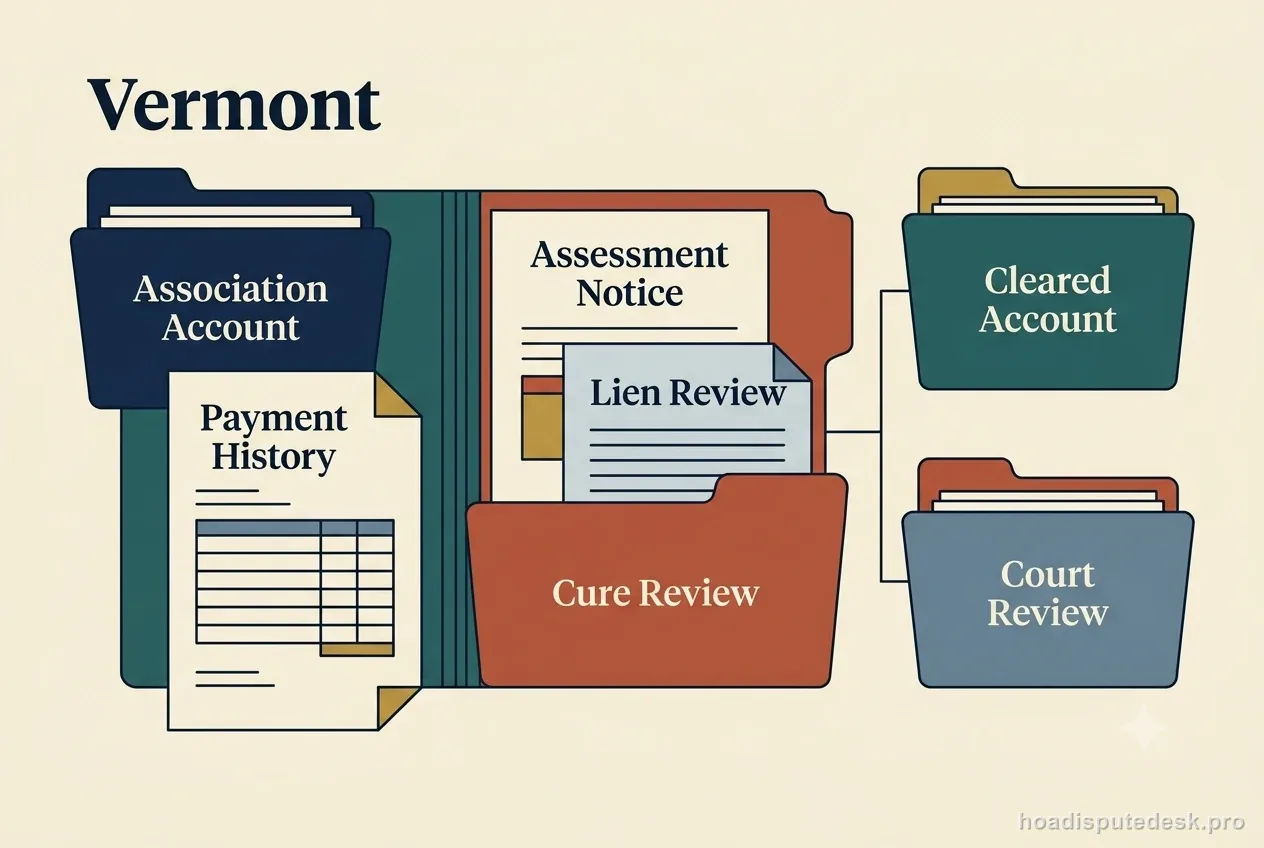
In Vermont, first identify whether the property is an HOA or condominium, then apply the correct statute and governing documents. Common-interest-community lien foreclosure is judicial and subject to statutory collection prerequisites. A limited six-month priority component can protect qualifying assessments. Do not assume mediation is mandatory for every claim; check the dispute-specific statute and governing documents. Get the ledger, lien, and notices before choosing payment, ADR, or court relief.
Vermont: planned-community law vs. condominium law
Before anything else in a Vermont dispute, pin down the property's legal form and when the declaration was recorded. For planned communities, start with Vermont Uniform Common Interest Ownership Act, Title 27A, for covered common-interest communities. For condominiums, start with Same Title 27A act governs covered condominiums and planned communities. Do not take the board's or manager's label at face value — an older community may sit under a legacy statute or a transition provision, so confirm what actually applies before you count on a deadline, remedy, or voting rule.
In Vermont, confirm the legal regime before arguing the merits. Obtain the recorded declaration, amendments, bylaws, rules, and any board resolution connected to the dispute, then compare them with the statute applicable to that community type. This prevents a common mistake: applying a condominium rule to a planned community, or a newer statute to a property governed by transition provisions.
Disputing a regular or special assessment in Vermont
Break an assessment challenge into authority and math. The association should be able to point to the budget or board action behind the charge, the declaration provision that spreads common expenses, the date notice went out, and any owner vote that Vermont law or the governing documents made a precondition. Do not assume a special assessment cleared the same threshold as the regular budget; the two frequently carry separate voting requirements.
When challenging an assessment in Vermont, ask the association to reconcile the account in writing and preserve your objection at the same time. Keep the ledger, notices, proof of payment, and the governing provision the board cites. If only part of the balance is disputed, distinguish that part clearly; a broad payment stoppage can obscure the original issue and create additional collection consequences.
Sources: [1]
What Vermont requires before an association fine sticks
Title 27A authorizes reasonable fines after notice and a hearing. A homeowner should distinguish a violation fine from a periodic assessment because foreclosure of non-assessment sums has additional limits.
The most useful record in a Vermont fine dispute is a dated enforcement file. Include the governing provision, initial notice, evidence, cure communications, hearing request, hearing notice, material considered, and final decision. If the issue is inconsistent enforcement, document comparable cases carefully; visual similarity alone does not establish that the properties were legally or factually alike.
Vermont record-inspection rules and refusal remedies
Title 27A contains a detailed association-records section. A written request should identify the requested statutory category and preserve the association’s response.
Treat a Vermont records request as an evidence request, not a fishing expedition. Ask for the ledger, approval records, relevant minutes, rules, invoices, contracts, and recorded governing documents that bear on the issue. Separate categories that may contain other owners' private information. A written refusal should identify what was withheld and why so the dispute is defined. Preserve both the request and the exact records produced so any missing ledger period or governing-document amendment can be identified later.
When an assessment lien attaches under Vermont law
Section 3-116 creates the lien, a six-month priority slice, and foreclosure safeguards. Current law requires at least three months of common-expense assessments, a failed payment-plan opportunity, and a board vote before the association commences foreclosure.
When reviewing an association lien in Vermont, separate the debt from the lien and the lien from foreclosure. Check the assessment ledger, any pre-lien notice, the recorded claim, legal description, amount, execution, and filing date. Then analyze priority and enforcement. This sequence avoids assuming that a recorded lien automatically outranks a mortgage or automatically permits a sale.
How association foreclosure works in Vermont
Vermont uses judicial foreclosure under 12 V.S.A. chapter 172 for common-interest association liens. The association must also satisfy the Common Interest Ownership Act's foreclosure prerequisites before proceeding. Owners should treat filed court papers and statutory notices as controlling and should not assume that recordation of the lien alone authorizes a private sale.
If a lien moves toward foreclosure in Vermont, work from the actual documents. Calendar the dates, reconcile the ledger, identify any statutory minimum or excluded charges, and check notice, board approval, cure, payment-plan, and redemption rules that apply. National summaries can miss a state-specific court, trustee, or filing step.
What to complete before filing in Vermont court
Vermont does not impose one blanket mediation-or-ADR requirement across association disputes. A pre-suit obligation, where it exists, comes from the statute for the particular claim, the declaration and bylaws, or a court's procedural rules, so read those rather than assuming.
Sources: [1]
Where Vermont HOA and condo disputes are decided
Vermont routes association disputes through the regular court system rather than a dedicated HOA tribunal. The right forum turns on the claim — general trial court, small-claims or limited-jurisdiction court for a money claim under the threshold, or a statute- or document-created arbitration or mediation process.
Sources: [1]
Sources
- 27A V.S.A. Article 3 — official Vermont LegislatureManagement, fines, records, lien, and foreclosure provisions.
- 27A V.S.A. § 3-116 — official Vermont LegislatureAssessment lien, six-month priority, payment-plan and foreclosure conditions.
- Vermont JudiciaryCourt information.